



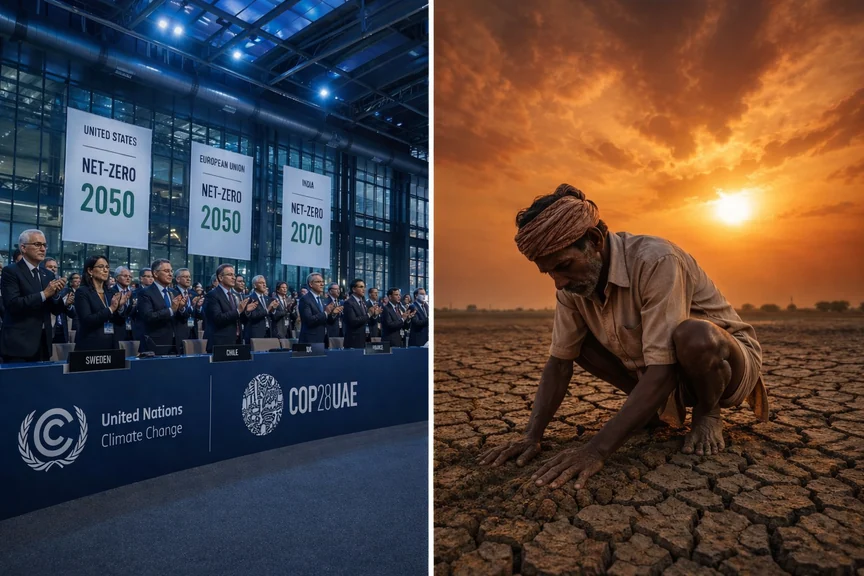
Rising heat in eastern India is no longer a matter of weather. It is an economic force — already straining power systems, eroding farm incomes, suppressing labour productivity, and tightening pressure on public finances. What was once seasonal discomfort has become a structural constraint, quietly rewriting the terms on which the region’s economy functions.
West Bengal's heatwaves are no longer seasonal disruptions to be endured and forgotten. With peak power demand breaching 10,000 MW in April for the first time, farm incomes squeezed by temperature stress, and a state utility carrying ₹15,439 crore in debt, the economic bill for climate inaction is now arriving — summer by summer, in compounding instalments.
The numbers that matter most this April are not temperature readings. They are the ones coming out of the West Bengal State Electricity Distribution Company's control rooms. On April 24, 2025, peak demand in the WBSEDCL service area crossed 10,000 MW for the first time in April — a threshold that, just a year earlier, had been breached only in June. The state's all-time record, set in June 2024, stands at 10,507 MW.
The direction of travel is unmistakable: the cooling season is lengthening, demand ceilings are rising, and a grid designed for a more temperate baseline, calibrated for the West Bengal of three decades ago, is being pushed toward limits its engineers did not anticipate and its regulators have been slow to acknowledge.
To frame this as a power sector story alone is to miss the larger argument. Electricity demand is the most legible symptom of a deeper economic condition: West Bengal's productive systems — labour markets, agriculture, and public finances — were calibrated for a climate that no longer exists with reliability. The result is a cascade of compounding damage that arrives not with the drama of a cyclone, but with the quiet persistence of structural drag.
"The economy does not halt under heat. It begins to drag - incrementally, across every sector, and at a cost that compounds with each passing summer."
The fiscal consequence of that surge falls on a utility that can ill afford it. WBSEDCL carried a total debt of ₹15,439 crore as of March 2024 — down from ₹16,587 crore the previous year, but still reflecting years of cost recovery falling short of expenditure. In FY2023–24, power and transmission charge recovery covered only 78% of total costs, a gap repeatedly bridged through state equity infusions: ₹949 crore in FY2024 alone. When heatwaves force short-notice purchases on the power exchange — often at two to three times contracted tariffs and largely from coal-heavy sources — the gap widens further, compressing the capital available for grid upgrades that would reduce future vulnerability.
India's Central Electricity Authority projects peak cooling demand in eastern states will rise by 35–40% by 2035 under moderate warming scenarios, with West Bengal among the most exposed. Demand curves are shifting faster than infrastructure can adapt — each summer of reactive management widens the gap between what the grid was designed to deliver and what a warming climate demands of it.
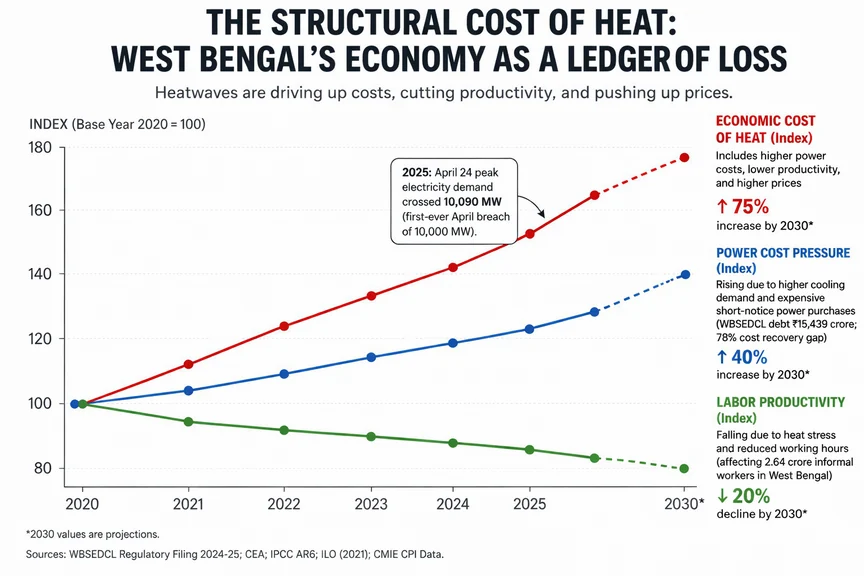
The numbers behind the argument speak for themselves:
10,090 MW — WBSEDCL peak demand, April 24, 2025: first-ever breach of 10,000 MW in April (PTI / WBSEDCL official statement).
10,507 MW — All-time WBSEDCL peak demand record, set June 16, 2024 (WBSEDCL).
₹15,439 crore — WBSEDCL total debt, March 2024; down from ₹16,587 crore the prior year (Infomerics credit rating report, June 2024).
78% — Power and transmission cost recovery as share of total costs, FY2024 (WBSEDCL / Infomerics).
80 million — Full-time jobs projected lost globally to heat stress annually by 2030, equivalent to $2.4 trillion (ILO, Working on a Warmer Planet, 2019).
Up to 10% — Rice yield loss per 1°C above optimal temperatures during flowering stage (Frontiers in Plant Science, 2023).
2.64 crore — West Bengal workers registered on e-Shram portal; third highest in India (Ministry of Labour & Employment).
The grid, however, is only the most visible part of the story. Consider what heat does before it reaches a balance sheet. A 62-year-old man in eastern India collapsed after a routine morning walk, despite having avoided the peak afternoon hours entirely. The reason was humidity. The air that morning was already too saturated for sweat to evaporate — and without evaporation, the body’s primary cooling mechanism fails. In effect, the wet-bulb temperature — the measure of heat stress that combines temperature and humidity had already approached levels at which the human body can no longer cool itself effectively, even in shade or at rest. His body had been accumulating thermal stress over several days, not a single extreme episode, and with humidity neutralising its only means of relief, the damage compounded silently. The clinical picture — dehydration, electrolyte imbalance, cardiovascular strain, early signs of kidney injury — had developed without warning, well within what most people, and most official advisories, would regard as safe conditions. He did not survive. His death will not appear in any official heatwave tally — it happened at a morning hour and under a humidity level that no standard heat alert would have flagged as dangerous. This is how heat imposes its heaviest economic toll: not through spectacle, but through the slow, unrecorded attrition of people who were simply going about their lives.
The lesson is structural, not anecdotal: heat risk is no longer confined to extreme moments or identifiable victims, and the economic costs it generates are less visible, more diffuse, and considerably harder to recover than any power demand curve captures.
The International Labour Organisation's Working on a Warmer Planet puts that structural reality into scale. Heat stress — defined as conditions that exceed the body's capacity for safe thermoregulation — measurably reduces productivity in physically demanding work, and the cumulative effect is vast. By 2030, the ILO projects losses equivalent to 80 million full-time jobs globally each year — an estimate that carries uncertainty, but not in its order of magnitude — representing an annual cost in the region of $2.4 trillion.
Agriculture accounts for 60% of those projected losses; construction for a further 19%. These are not abstract global figures. They describe, with precision, the two sectors that together employ the overwhelming majority of West Bengal's informal workforce.
West Bengal has over 2.64 crore workers registered on the national e-Shram portal — the third highest count in India — underscoring the scale of informal labour exposed to outdoor heat with little social protection. For these workers, a heatwave is a direct income shock: fewer billable hours, higher spending on hydration and medical care, and a statistical invisibility that keeps their losses out of headline economic data. Aggregate figures offer a deceptive counterpoint — sales of cooling appliances and cold beverages rise during extreme heat — but those gains accrue to the salaried and the well-served. The workers most exposed to heat remain the least able to adapt to it.
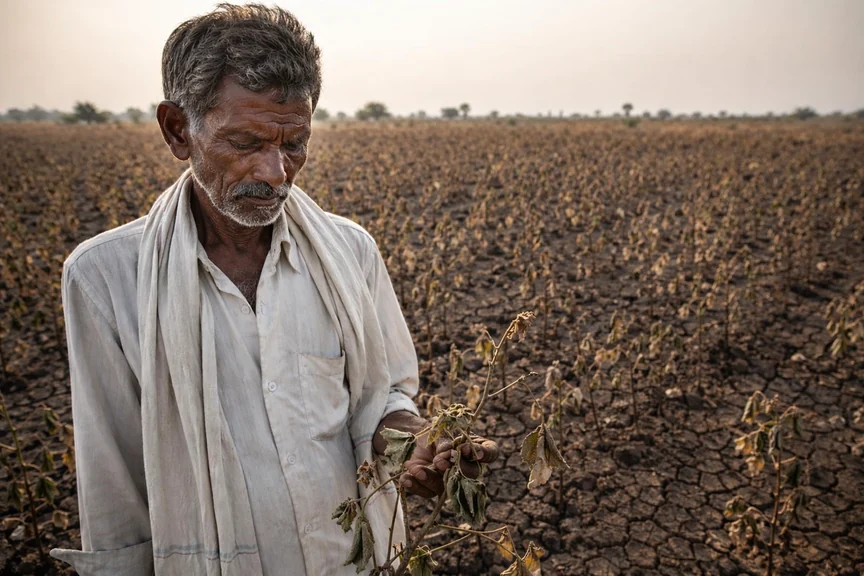 Move beyond the city, and the calculus becomes harsher. In rural West Bengal, rice — the backbone of the state's agricultural economy — is acutely sensitive to temperature spikes during its flowering stage. Research confirms yield losses of up to 10% for every 1°C increase above optimal thresholds, with the reproductive phase the most vulnerable window. Boro rice, cultivated during the dry season, is doubly exposed: it flowers precisely when temperatures in West Bengal are already nearing or exceeding safe limits.
The farmer's response is rational but costly. Facing yield risk, households increase irrigation — drawing more heavily on groundwater aquifers already under long-term stress. This raises input costs at precisely the moment that income expectations are weakest. The resulting compression of farm margins feeds directly into local food price inflation, a dynamic increasingly cited in monetary policy deliberations. In this way, a climatic event becomes a macroeconomic one: heat stress in the paddy fields of Bankura and Burdwan shows up in vegetable prices in Kolkata's markets.
"Heat stress in West Bengal's paddy fields shows up in vegetable prices in Kolkata's markets. The chain from climate to inflation is shorter than policymakers have been willing to admit."
All of this converges on the state's finances with a logic that is as predictable as it is unplanned for. Healthcare mobilisation, emergency water provisioning, and crisis power interventions represent unbudgeted expenditure — reactive spending that crowds out planned development investment. Maharashtra's 2024 heatwave, which triggered roughly ₹800 crore in unplanned emergency outlays over six weeks, is instructive — though "instructive" may be too generous a word for a lesson that no state government in India has yet visibly learned. For West Bengal, already operating at the limits of its fiscal headroom, the capacity to absorb such shocks without structural reform is narrow and shrinking.
The deeper trap is self-reinforcing: underinvestment in climate-resilient infrastructure raises reactive costs each summer, while those costs crowd out the capital expenditure — on grid modernisation, agricultural adaptation, and urban resilience — that would reduce future exposure. Each year of delay raises the eventual cost of action.
None of this lacks remedy, and none of it requires inventing new institutions or waiting for central government direction. The response required is not novel. It is merely serious — and in Indian state governance, seriousness is precisely what has been in short supply. Three priorities are clear, each with an identifiable owner, a known cost, and a precedent from elsewhere in India that removes the excuse of uncertainty.
First, grid investment must be treated as critical economic infrastructure, not a sectoral line item to be deferred when fiscal space tightens. WBSEDCL’s own modernisation programme already identifies the capital expenditure required for battery storage deployment and demand-management systems — what it lacks is a political commitment to front-load that spending rather than defer it to the next crisis. Gujarat’s pre-positioning of peak power contracts has demonstrably reduced emergency exchange purchases during comparable heat periods. West Bengal has the roadmap. The question is whether the state government will fund it before June, or explain the gap after it.
Second, agriculture policy must stop treating temperature risk as a bad-luck event and start treating it as a design parameter. The state’s extension network already has the reach to distribute heat-tolerant boro rice varieties at scale — what it lacks is a procurement mandate to do so. Crop insurance must be restructured to recognise flowering-stage heat stress as a trigger, not just flood or drought. And the groundwater dependence that heatwaves accelerate — as farmers irrigate more heavily to protect vulnerable crops — can only be addressed through investment in efficient micro-irrigation that the state has repeatedly announced and rarely delivered. The fiscal logic is straightforward: stabilising yields reduces the inflationary cascade from Bankura’s paddy fields to Kolkata’s vegetable markets, and from there to the Reserve Bank’s monetary policy calculations.
Third, and most critically — because without it the first two remain technical patches on a conceptual failure — heat must be embedded in economic planning as a permanent variable, not an emergency category that gets activated after the damage is done.
This requires climate-contingent fiscal provisioning, infrastructure standards aligned with projected 2050 temperature baselines, and a planning architecture that treats climate risk as a design condition rather than a disaster category. This could take institutional form through a dedicated climate-risk budgeting framework within the state's planning apparatus, linking expenditure decisions directly to heat-risk projections. The Planning Board exists. The data exists. What has been missing is a political leadership willing to treat next summer's heatwave as this budget cycle's problem.
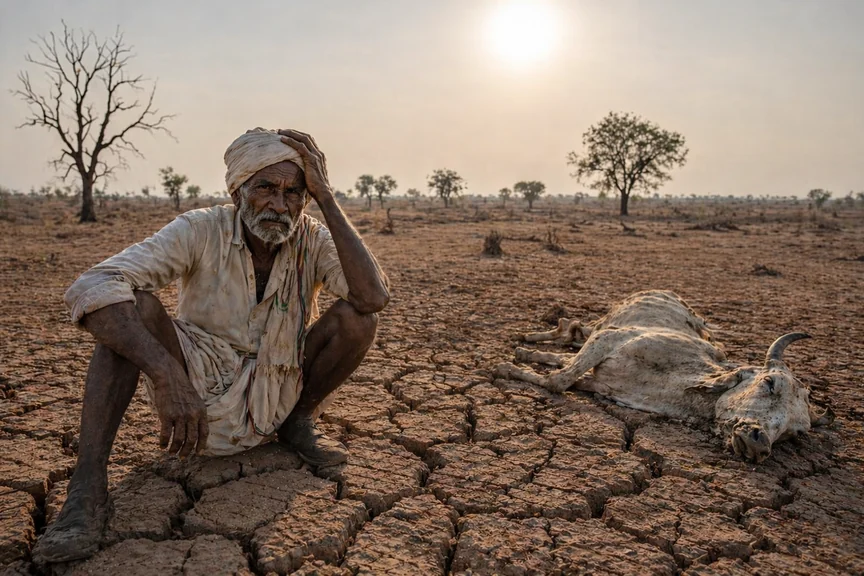
The case for action does not rest on projections alone. It is already visible in WBSEDCL's balance sheet, in the shrinking margins of Bengal's paddy farmers, and in the lost working hours of over 2.6 crore informal workers who have no insulation from a 42°C afternoon.
Heat stress has become, in effect, an undeclared tax — levied each summer on those least able to pay it, and compounded by inadequate infrastructure and reactive governance. It is a tax that does not appear in any budget line, is collected by no authority, and delivers its receipts directly to hospital wards, empty paddy fields, and a utility balance sheet that grows heavier with each passing June.
The 2025–26 state budget must be the last one drafted without a climate-risk line item. Before the next monsoon, the Planning Board should publish heat-adjusted demand projections for 2030 and 2035, WBSEDCL should table a binding capital plan for battery storage deployment, and the Agriculture Department should notify heat-tolerant boro rice varieties as a procurement category under the state’s extension programme. None of this requires new institutions. It requires existing ones to treat next summer’s heatwave as this budget cycle’s problem — because, by every measure already on record, it already is.
"The thermometer is no longer a measure of weather. It is a ledger of economic loss, updated in real time."





Discussion 4 comments