



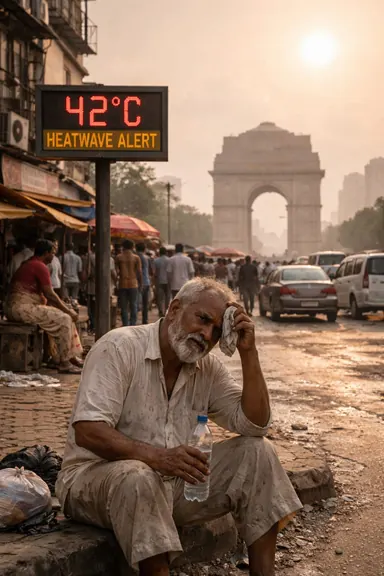
India’s major metropolitan centers are recording unprecedented temperature spikes this week, with the India Meteorological Department (IMD) reporting that temperatures in Delhi, Mumbai, and Ahmedabad have crossed the 40°C threshold nearly two months ahead of schedule. The early surge, recorded between March 11 and March 17, 2026, marks the virtual disappearance of the traditional spring season. Data shows that Delhi hit 36.8°C last week—the highest for the first half of March in over a decade—while cities in Gujarat and Maharashtra have seen the mercury touch 40°C, a deviation of nearly 8°C above the seasonal average. This "vanishing spring" has left urban infrastructure struggling to cope with energy demands usually reserved for the peak of May.
Meteorologists are particularly concerned because this heat is occurring during a "La Niña" year. Historically, the La Niña phenomenon is characterized by cooler-than-normal sea surface temperatures in the equatorial Pacific, which typically brings a cooling effect to the Indian subcontinent. However, the current "unending thirst" of urban expansion is now powerful enough to override these ancient natural cooling cycles. What we are witnessing is a convergent crisis where the demand for cooling in our cities is creating a dangerous feedback loop. As we use more energy to stay cool inside our offices and homes, our air conditioners and cars pump massive amounts of waste heat into the outside air. It is a cycle of progress that is now trapping us; we are generating more heat to fight the heat we’ve already created. The immediate trigger for this seasonal shift is a severe lack of moisture, following a February that recorded a staggering 81% rainfall deficit across the country. The winter rains, which usually provide a necessary buffer of moisture for the soil, were almost entirely absent. This has left the ground dry and baked hard, unable to absorb or dissipate the rising solar radiation. Without the cooling moisture of the winter recovery, the land has lost its natural ability to regulate its own temperature. This "biological debt" is now being collected in the form of early heatwaves. Furthermore, the lack of snowfall in the Himalayas has reduced the cooling winds that typically moderate Northern India’s transition into summer, leaving the plains exposed to early incineration.
The impact of this shift extends far beyond physical discomfort, threatening the very stability of our food systems. Agricultural experts warn that the early heat could devastate the winter wheat harvest, which requires a balanced path of moderate temperatures during the grain-filling stage in March. The crop is being forced to mature too quickly in this furnace-like heat, and when you lose the middle ground of spring, you lose the stability of the food supply. In the streets of Mumbai and Ahmedabad, the urban strain is visible as the traditional center point of comfortable weather has been replaced by a system under constant pressure. Residents report that the air no longer cools down at night, suggesting that the "thermal bankruptcy" of our cities is reaching a critical stage.
As the IMD forecasts a "roasting" period ahead for April and May, the focus is shifting toward how Indian cities can find a way to stay stable. Urban planners are now being urged to look at habitant health over pure construction speed. The current model of high-density, glass-heavy architecture is proving to be a metabolic liability, as these buildings trap heat and require massive energy to remain habitable. Experts suggest that the only way forward is to move away from the thirst for unmoderated growth and toward a more centered, resilient mode of existence. This involves protecting urban green spaces, restoring local water bodies to act as heat sinks, and rethinking the materials used in our infrastructure to reduce systemic friction.
The heatwave alerts that now dominate our digital feeds are not just weather updates; they are sirens telling us that the current system is reaching its limit. We have lived for too long under the illusion that nature is an infinite resource that can absorb any amount of industrial shock. The 40°C March in India is the final piece of evidence that this was a mistake. When the internal heat of our civilization matches the external heat of the sun, we have reached a metabolic limit. The question for 2026 is no longer how we will survive a single summer, but how we will redefine our relationship with the environment to ensure that the balance of the seasons can eventually return. We must stop treating the world as a map of targets and start seeing it as our only home, finding that center point where we live within our means before the spring is lost forever.



Discussion 6 comments