



For Peace, For Love...
Initiation of the Walk from Beliaghata Gandhi Bhavan to Santiniketan
2 October 2026, Mahatma Gandhi’s Birth Anniversary.
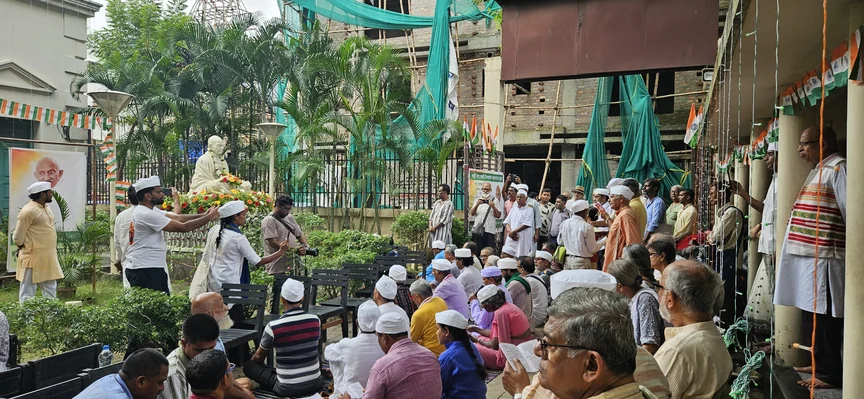
On this special day, a long journey "For Peace, For Love" began from the historic Gandhi Bhavan (formerly Hyderi Manzil) in Beliaghata. Organized by Sarva Seva Sangh, in collaboration with various democratic and peace-loving organizations and individuals across Bengal, this foot march (Padayatra) aims to reach Santiniketan on October 16, the historic Raksha Bandhan Day.
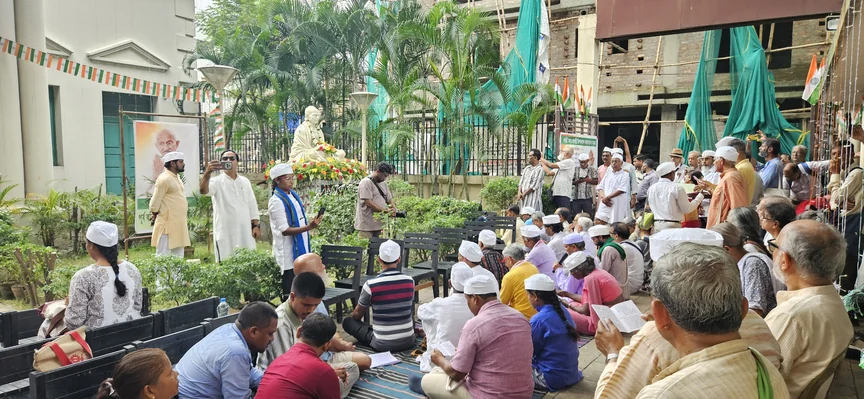
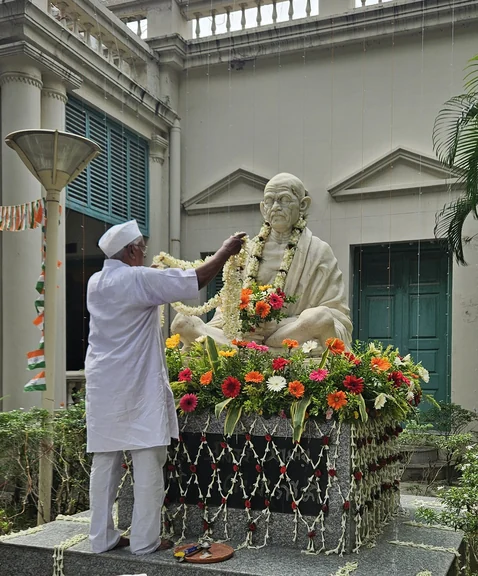
At around 9:30 AM, the day's program commenced with Shri Chandan Pal, President of Sarva Seva Sangh, offering a garland at the statue of Mahatma Gandhi at Gandhi Bhavan. Shri Ashok Bharat, Convener of the Publication Committee of Sarva Seva Sangh, led the gathering in reciting a message of peace. Following this, everyone joined in singing "Raghupati Raghav Raja Ram," a devotional song frequently used in Gandhiji's prayer meetings.
Shri Debasish Sengupta sang Rabindranath Tagore’s song “Barisha Dhara Majhe Shantir Bari” (Rain down the waters of peace upon the earth), and the attendees joined their voices with his. The atmosphere grew more profound with various messages of peace and harmony. Shri Arvind Anjum, Secretary of Sarva Seva Sangh, raised the slogan—“Jaha Pade Kadam Gandhi Ke — Ek Kadam Gandhi Ke Sath” (Where Gandhi stepped — walk a step with Gandhi). Smt. Papri Sarkar, Secretary of the Gandhi Smarak Samiti at Beliaghata Gandhi Bhavan, wished success for the padayatra. Shri Chandan Pal explained the objective of the walk, stating that raising awareness among the public about peace, love, non-violence, communal harmony, and standing against hatred and division is the primary goal of this long journey. During the event, the Sarvodaya Diary for 2027 was released, followed by soulful flute melodies.
The thought behind this journey is deeply rooted in India’s long social and cultural heritage. The event's leaflet highlighted India's "unity in diversity" through Tagore’s concept of "Jai Jagat" and Atul Prasad Sen's famous lines: "Nana Bhasha, Nana Mata, Nana Paridhan, Bibidher Majhe Dekho Milon Mahan" (Many languages, many opinions, many attires, yet see the great unity amidst diversity). The harmonious traditions of Buddha, Kabir, Nanak, Chaitanya, Ramakrishna, Vivekananda, Lalon, Sufi saints, Baul-Fakirs, and the Bhakti movement were also linked to the core theme of this walk.

Looking beyond the present, the leaflet referenced history, highlighting that Indian society has a long tradition of living side by side and intermingling despite differences in religion, language, and community. Examples cited include Jyotirao Phule and Savitribai Phule finding refuge and support in Fatima Sheikh for their educational initiatives, the presence of Muslim commanders in Shivaji’s army, and the joint participation of Hindus and Muslims in the freedom struggle.
This journey is also closely tied to the memory of the Anti-Partition Movement of Bengal in 1905. The leaflet noted that on October 16, 1905, when the partition took effect, Rabindranath Tagore called for the Raksha Bandhan festival to strengthen Hindu-Muslim harmony. Reaching Santiniketan on that very date—October 16—serves as a significant symbolic aspect of this present walk.
The association of this location in Beliaghata with Mahatma Gandhi gives special meaning to the program. When India gained independence on August 15, 1947, Gandhiji stayed at Hyderi Manzil in riot-torn Kolkata instead of attending celebrations in Delhi, fasting to restore peace. This historical event serves as a major inspiration for the current journey.
After leaving Gandhi Bhavan, the participants visited the nearby land adjacent to the historic house of Raja Rajendralal Mitra, a designated Kolkata Heritage site. Shri Kajal Mukherjee spoke about Raja Rajendralal Mitra’s historic role and his connection to the 19th-century Bengal Renaissance, mentioning that he was the first Indian Secretary of the Asiatic Society. He also noted that Gandhiji had addressed a public gathering at the Ras Mandir inside his house on August 15, 1947.
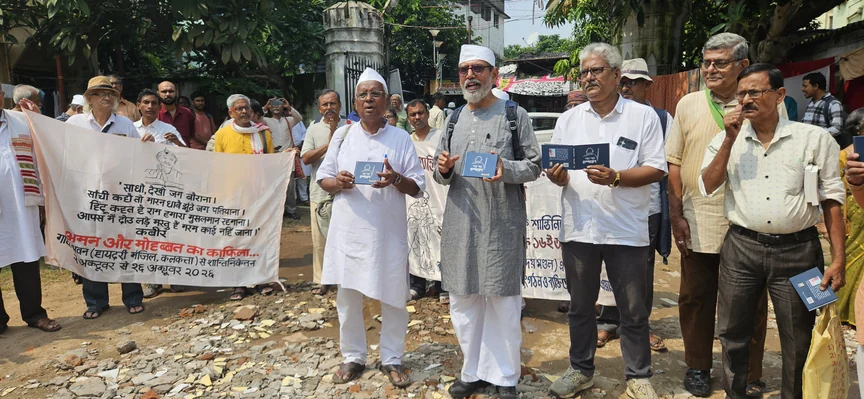
At this venue, the book "Paye Paye Champaran" (Step by Step Champaran) by Shri Jiten Nandi and a special edition of Chetana magazine titled "Dwesh-Hinsar Biruddhe Mahatma o Ahinsar Mantra" (The Mahatma and the Mantra of Non-Violence Against Hatred and Violence) were officially released. Thus, the first day of the march directly connected with Gandhiji's principles of Satyagraha, non-violence, and human love.
Next, the marchers moved from Beliaghata through Sealdah Flyover to the Bose Institute, where a roadside meeting was held. Passing through Shyambazar, the first day's march concluded around 5:00 PM at the Mahamilan Math of Akhil Bharat Jaiguru Sampradaya in Dunlop.
Nearly 100 participants of various age groups—from young men and women to middle-aged and elderly individuals—joined the first day's approximately 12 km walk. Participants came from states including Madhya Pradesh, Maharashtra, Delhi, Bihar, Jharkhand, Assam, Goa, and the host state, West Bengal. Along the route, they raised slogans, sang songs, engaged with people on both sides of the road, and distributed leaflets. The walk was not merely a procession; directly connecting with ordinary people and delivering messages of peace and love remained its defining feature.
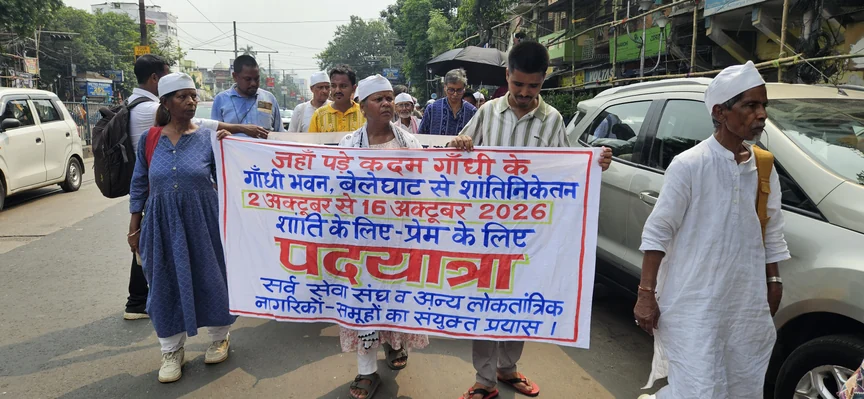
The messaging of the walk expressed deep concern over the growing environment of religious division, hatred, and malice in contemporary society. Simultaneously, it brought issues like education, culture, historical awareness, and the protection of natural resources to the forefront. According to the leaflet, hatred and malice narrow the human mind and weaken mutual empathy, cooperation, and love. Therefore, this journey emphasizes the necessity of building an open, rational, and harmonious society for future generations.
The second stanza of Tagore’s "Jana Gana Mana"—referencing "Hindu Buddhist Sikh Jain Parsee Muslim Christian" and "Prem-haara haya gaatha" (garlands woven with love)—was highlighted as a key theme of India’s identity. The central message is that differences in opinion and paths will exist, but amidst those differences, bonds of mutual respect, love, and harmony must be built.
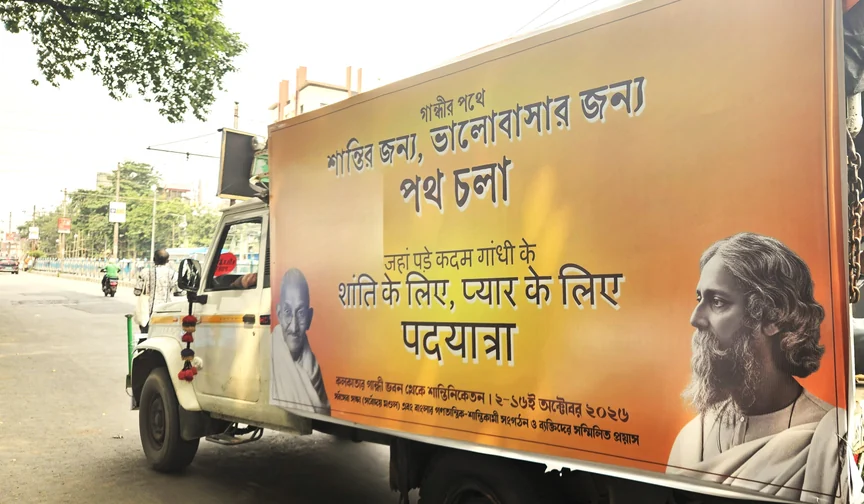
The journey that began from Beliaghata Gandhi Bhavan on October 2 is not just a single day's march. It carries Gandhiji's ideal of non-violence, Tagore's pluralistic vision of India, Bengal's tradition of harmony, and an appeal for mutual love and empathy. Throughout the march from Hyderi Manzil in Beliaghata to Santiniketan, every day will be dedicated to bringing this message to the people.
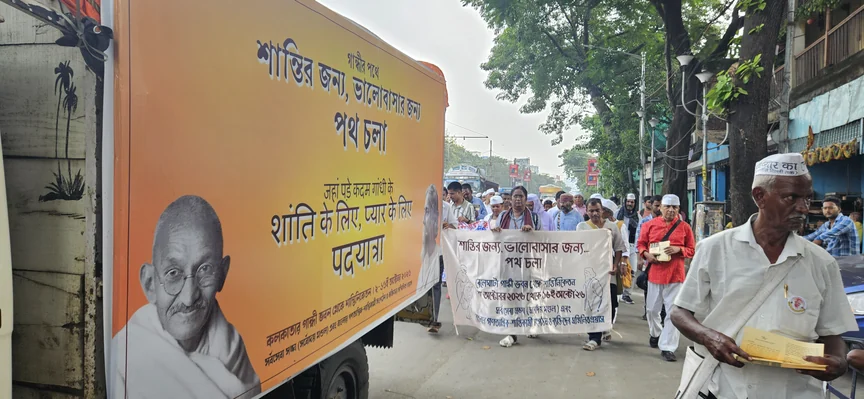
Tomorrow, October 3, the march will resume around 9:15 AM from Dunlop Crossing, heading towards Barrackpore. Traveling from city to city and town to town, the procession will reach Santiniketan on October 16.
For Peace, For Love—anchored in truth, love, and non-violence, this journey stands as an invitation to walk together, choosing empathy over hatred, love over malice, and harmony over division.


Discussion 1 comment