


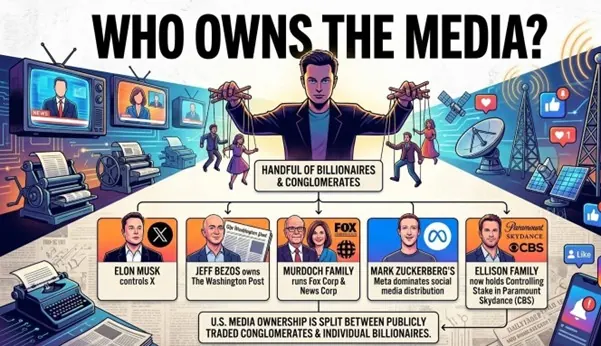
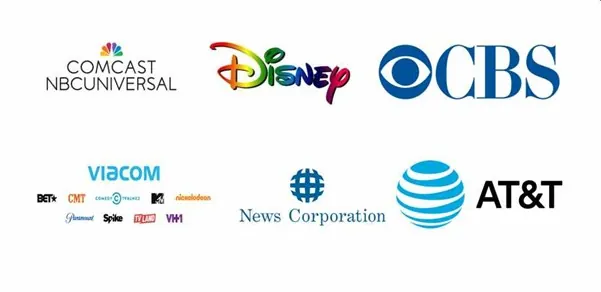
Six corporations now shape almost everything we read, watch, and quietly absorb as truth. That is not an accident; it is the core of their business model. Pick up your phone, open any app, glance at a headline: what reaches you has passed through a startlingly short chain of hands. Meta decides what your friends seem to care about, Google decides which newsrooms survive the digital economy, while Comcast, News Corp, Disney, and Warner Bros. Discovery own much of the television, film, publishing, and streaming that defines mainstream culture in the West. Bloomberg and Reuters set the frame for global financial reality and can, with a single story, lift or crush entire economies. This is not pluralism; it is a megaphone held by a few, pointed at billions.
The crisis this creates goes deeper than bias, misinformation, or polarisation. It is a crisis in how human beings come to understand the world at all. When the architecture of public knowledge is owned and monetised, truth itself becomes a product shaped to sell.

On platforms like Facebook, YouTube, and X, accuracy is not what the algorithm rewards; it rewards reaction. Outrage, fear, tribal belonging, and spectacle generate clicks, and clicks generate advertising revenue. The companies know this from their own internal research and have repeatedly chosen growth over correction. The result is an information environment in which the most emotionally charged version of any story reliably defeats the most accurate. Over time this does more than twist single news cycles; it alters what people think is real, possible, and even imaginable.
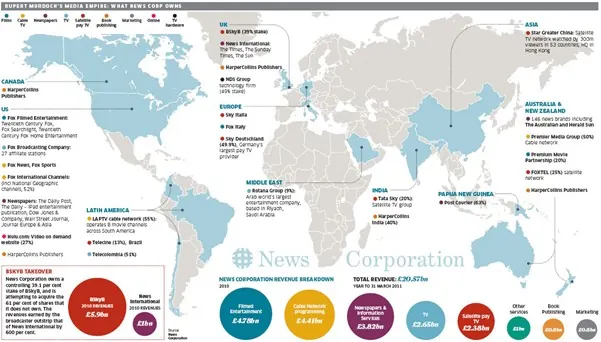
Rupert Murdoch’s media empire — Fox News, The Sun, The Times, The Wall Street Journal, and News Corp’s digital holdings — shows how concentrated ownership becomes concentrated political power. Governments on three continents have made policy while watching how his outlets would respond. This is not ordinary lobbying; it is a kind of editorial sovereignty over democracies themselves.
At the same time, the media that once carried local complexity has been hollowed out. Thousands of local newspapers in the United States have closed since 2005, many not because readers vanished, but because local advertising revenue was captured by Google and Meta. What disappears is not just employment or column inches, but intimate knowledge of particular places, people, and struggles — the kind of grounded understanding no national wire or trending hashtag can replace. Each generation raised on algorithmically curated feeds inherits a narrower sense of what exists, what matters, and who gets to be the subject of a story rather than its background scenery.
Financial media and credit rating agencies wield a similar, under-examined power. Bloomberg, Reuters, Moody’s, S&P, and Fitch do not simply describe economies; they help constitute them. A Bloomberg article hinting at governance problems can erase billions from a company’s value in hours. A sovereign downgrade from S&P can send capital fleeing a country. These decisions are made in New York, London, and a few other financial centres, while their consequences fall on communities that may never have heard the names of the institutions judging them.
Beneath all this lies a quieter wound. Many people have spent decades inside a media environment designed to sell them things: products, fears, candidates, enemies. Eventually, those manufactured priorities feel like their own. Questions the system does not want asked — about growth as a destructive ideology, about power, about whose suffering counts as news — simply stop arising. Not because people are foolish, but because their information ecosystem was never built to surface those questions. The most effective control today is not censorship but saturation; not silence, but noise.
Real resistance begins with insisting on a genuinely independent press: accountable to readers, rooted in real communities, and not enslaved to engagement metrics. The concentration of media power is not an inevitable by-product of technology; it is the result of political choices by regulators and of citizens kept in the dark about what was being decided. To demand a different kind of journalism — slower, more honest, willing to dwell in contradiction — is to insist that the world is larger than whatever the algorithm serves you. In a saturated, noisy age, that insistence is one of the most radical acts available.



Discussion 4 comments