



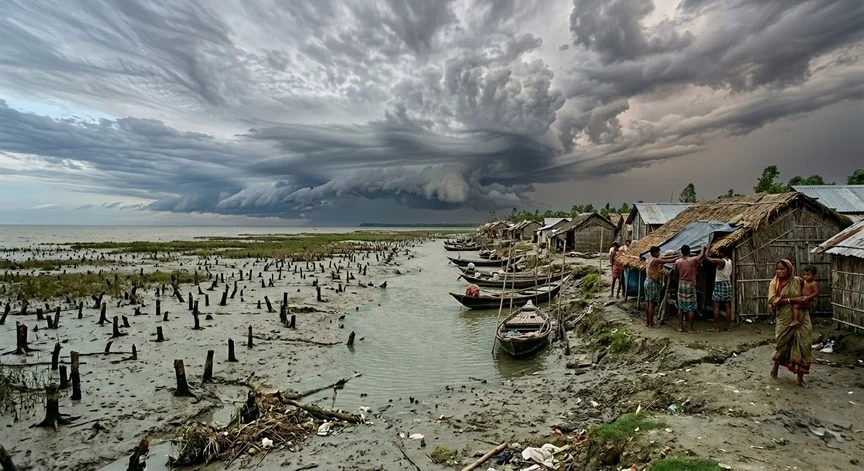

India is not being overwhelmed by nature. It is living with the accumulated consequences of choices made on its behalf — choices whose costs were never meant to appear on the balance sheets of those who made them.
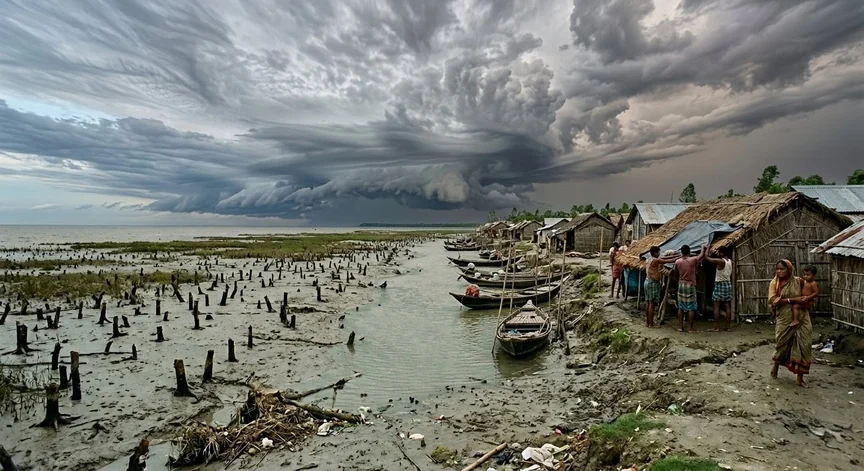
A 3,000-kilometre corridor of storm clouds stretching across the Indian subcontinent is not merely a meteorological curiosity. It is a reckoning — from a climate system absorbing the consequences of decisions made over generations, decisions that were recorded as growth while their true costs were quietly distributed among those who had no voice in making them.
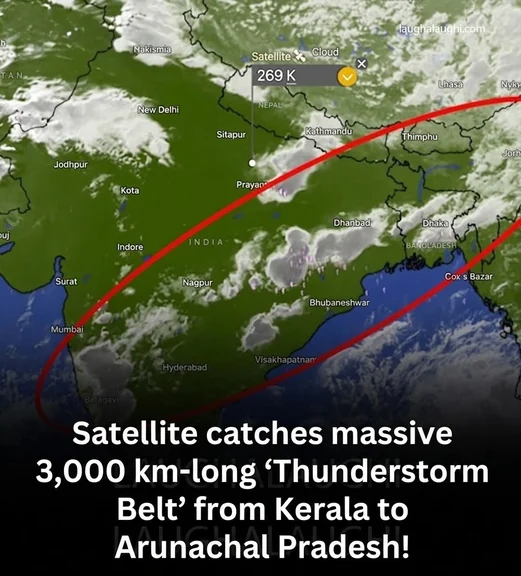
This May, a continuous cloud band extended from Kerala in the southwest to Arunachal Pradesh in the northeast. It was not a seasonal storm that expanded beyond its usual scale. It was a structurally different atmospheric event: multiple thunderstorm cells merging into a single organised system across a vast geographical span. Fed by record land temperatures and moisture surging inland from both the Arabian Sea and the Bay of Bengal, the cloud towers rose deep into the troposphere. Within hours, the system carried the potential for flash floods, relentless lightning, transport disruption and crop destruction across several states simultaneously.
The word used most often for events like this is ‘unprecedented.’ It is worth asking why unprecedented things keep happening on schedule.
“What was once statistically rare is steadily becoming part of the Indian climate calendar — which raises a harder question than meteorology can answer.”
What the Physics Records
The underlying science is not in dispute. A warmer atmosphere holds more moisture, stores more energy and lowers the threshold for extreme weather. Research led by Dr. Roxy Mathew Koll of the Indian Institute of Tropical Meteorology has documented a threefold rise in widespread extreme rain events over central India between 1950 and 2015, driven by increasing variability of the monsoon westerlies over the Arabian Sea.[1]
The Clausius-Clapeyron relation is precise: for every degree Celsius of warming, the atmosphere can hold roughly seven percent more water vapour — a relationship confirmed in the IPCC’s Sixth Assessment Report and observed consistently since the 1970s.[2]
What the physics cannot tell us is why the atmosphere is being asked to absorb this much energy in the first place. That question has an answer, but it lives outside the domain of meteorology.
The industrial model that drove a century and a half of emissions was not a natural phenomenon. It was a set of choices: about which costs to count, which assets to price, and which consequences to leave unbooked. Forests were cleared, wetlands drained, floodplains built upon, and coastlines hardened — each transaction recorded as productive output, each loss absorbed silently by the communities and ecosystems that had no seat at the table where the accounting was done.
The atmosphere kept its own accounts. It is presenting them now.
The Ecology That Was Called an Obstacle
To understand why the same rainfall event that once dispersed across wetlands now arrives as a catastrophe, it is necessary to look not only at what the sky is doing but at what was removed from the landscape before it arrived.
The Western Ghats — one of the world’s eight biodiversity hotspots and the hydrological backbone of peninsular India — have been systematically opened to quarrying, plantation agriculture and infrastructure projects, each individually cleared through processes designed to evaluate economic return while treating ecological function as an externality. Mangroves that once absorbed storm surges along India’s coastline have been reclassified as wastelands and converted to aquaculture and real estate. Floodplains that provided natural detention storage have been built upon under master plans that measured development in square footage rather than in flood retention capacity.
None of this happened without authorisation. Each clearance was issued. Each project was approved. Each conversion was logged as an addition to the national account — the loss of the ecology it replaced recorded nowhere, borne by no one with the power to refuse.
“The question is not why these floods are happening. The question is who decided that the systems which prevented them were expendable.”
When a flood now tears through a coastal town whose mangroves were cleared a decade ago for a resort, the disaster is reported as a natural event. The clearance that made it possible is not part of the weather bulletin. The resort remains. The mangrove does not.
Institutions Designed for a Different Purpose
India’s policy architecture is still organised around a climate regime that no longer exists. Heatwaves are managed by one ministry, floods by another, drought by another still. This fragmentation is not merely inefficient. It is structurally convenient. When no single authority is responsible for the interaction between ecological destruction and climate impact, it becomes very difficult to draw a line between a forest clearance approved in one corridor and a flood in another.
As Dr. Prodipto Ghosh — former Secretary of India’s Ministry of Environment, Forests and Climate Change, and Distinguished Fellow at TERI — has argued across multiple policy forums, India’s institutions were designed for average climatic conditions.[3] That observation is usually read as a call for modernisation. It can also be read as a description of a system that was never asked to account for the full cost of the conditions it was helping to create.
The language of development has been extraordinarily useful in this regard. It absorbs contradiction. A highway through a forest is infrastructure. A dam across a river system is progress. A port built on a tidal flat is connectivity. The communities downstream who lose their flood buffer, their fishery, their groundwater — they receive the vocabulary of benefit while bearing the arithmetic of loss.
“The language of development has been extraordinarily useful. It absorbs contradiction without resolving it — and assigns the residue to those least able to dispute the accounting.”
For millions of smallholder farmers, coastal fisherfolk and urban workers concentrated in low-lying, under-drained settlements, a single extreme weather event can erase years of precarious economic progress. They did not design the clearance regime that removed their ecological buffers. They did not sit on the committees that approved the encroachments. But they are the ones standing in the floodwater when the accounting finally comes due.
The Global Ledger
India currently accounts for approximately 7.6 percent of global greenhouse gas emissions — a share that has risen at roughly 2.8 percent annually over the past decade.[4] India’s historical contribution to cumulative global CO₂ emissions stands at approximately 3 percent. The atmospheric destabilisation now reshaping South Asian weather was accumulated primarily through industrialisation in Europe and North America over more than a century — an industrialisation that followed the same logic of externalised ecological cost, at a civilisational scale, over a longer time period.
The climate finance commitments made by wealthy nations to compensate for this asymmetry have been, repeatedly, announced and not delivered. This is not a diplomatic inconvenience. It is the same logic applied internationally: costs generated by the powerful, distributed among those who did not generate them, with the accounting arranged so that the connection is difficult to establish and easier still to defer.
India cannot be asked to finance climate adaptation alone while simultaneously absorbing the costs of emissions it did not produce. But India also cannot offer its own ecological systems as continued collateral for the growth of those who benefit from the current clearance regime. Both debts are real. Both remain unpaid.
What Would Actually Help
What is required is not another advisory report. It is a change in what gets counted.
A unified climate adaptation authority with executive coordination across ministries is a start — but only if it is empowered to measure ecological loss as an economic cost rather than an environmental sentiment. Treating the Western Ghats, surviving wetlands and mangrove systems as protective national infrastructure means pricing their function, not merely declaring their importance in policy documents that coexist with their clearance.
India must also close the gaps in its early warning network, which still leaves large rural geographies without adequate meteorological coverage — despite AI-assisted forecasting systems already operational in countries such as Bangladesh, where deep-learning flood prediction models have achieved accuracy rates above 98 percent, and the Netherlands, where the Deltares-KNMI operational system has integrated AI rainfall forecasting directly into emergency response protocols.[5] The technology exists. The question is whether those most exposed to extreme weather are considered a sufficient constituency for the investment.
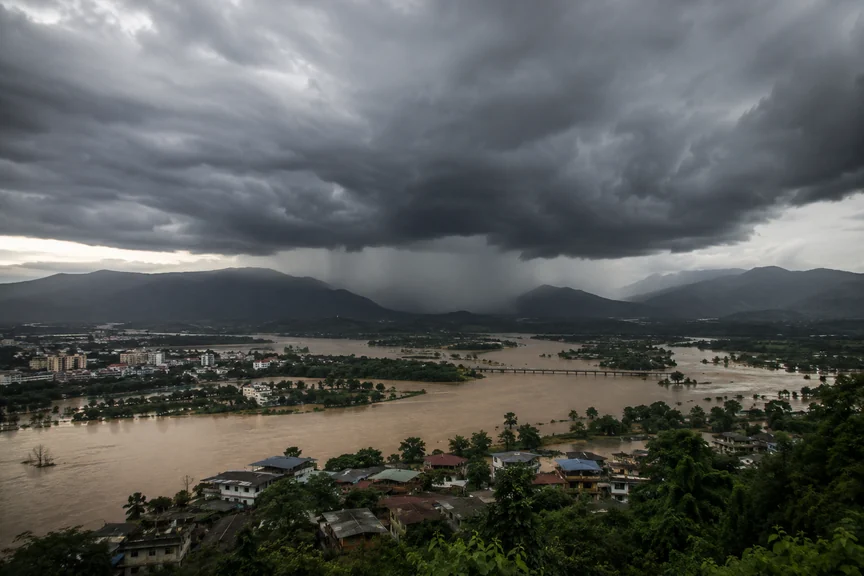
None of this is beyond India’s institutional capacity. What has been missing is not competence. It is an honest reckoning with who has been paying the costs of the decisions recorded as growth — and whether that arrangement is one that a democratic society, presented with the full ledger, would choose to continue.
The Full Ledger
The satellite image of that immense cloud corridor bending across the subcontinent may become one of the defining images of this decade. It will be described as a natural disaster. That description is not wrong. But it is incomplete. It is also the image of a landscape systematically stripped of the systems that would have moderated it. It is the image of an accounting convention that recorded the stripping as development and left the consequences as weather. It is the image of communities who were told they were the beneficiaries of decisions whose costs they are now, literally, living inside.
“The atmosphere does not distinguish between what was approved and what was warned against. It keeps the full ledger. It is presenting it now.”
India still possesses the ability to shape the terms of its climate future. That will require more than early warning systems and adaptation funds, essential as those are. It will require asking, with real political courage, whose interests have been served by the ecological choices recorded as growth — and whether a different accounting is possible before the ledger closes.
The sky has already answered. The question is whether the institutions that helped produce this outcome are prepared to read what it says.
SOURCES & NOTES:
[1] Roxy, M.K. et al. (2017). “A threefold rise in widespread extreme rain events over central India.” Nature Communications, 8, 708. doi:10.1038/s41467-017-00744-9 — Extreme rainfall events over central India tripled between 1950–2015, driven by increased variability of the Arabian Sea monsoon westerlies.
[2] IPCC Sixth Assessment Report (AR6), Working Group I (2021), p. 1065: “The Clausius–Clapeyron equation determines that low-altitude specific humidity increases by about 7% °C⁻¹ of warming.” Also p. 330: total column water vapour “very likely increased since the 1970s, at a rate consistent with the Clausius-Clapeyron relationship.” IPCC AR6 WG1
[3] Dr. Prodipto Ghosh: former Secretary, Ministry of Environment & Forests, Government of India (September 2003 – May 2007); Distinguished Fellow, TERI; principal author of India’s National Climate Change Action Plan; member, PM’s Council on Climate Change. TERI profile. The observation on institutional design is drawn from his wider body of published policy work and forum contributions.
[4] India’s share of global GHG emissions: 7.61% of global total (Global Carbon Project, 2023 data). Climate Change Tracker. Historical cumulative CO₂ share: approximately 3%. Global Carbon Budget 2024, Outlook Business.
[5] Bangladesh: GRU deep-learning flood prediction, accuracy above 98%. ResearchGate, 2025. Netherlands: Deltares-KNMI AI-integrated rainfall forecasting linked to operational emergency response. Deltares, 2025.




প্রতিবেদক মাঝে মাঝে যেসব প্রশ্ন গুলো রেখেছেন যেমন, শুধু আকাশের দিকে তাকালে হবে না, জমি থেকে কি কি নিশ্চিহ্ন করে দেওয়া হয়েছে।
বা, কোনটি অনুমোদিত বা কোনটির ব্যাপারে সতর্ক হওয়া উচিত ছিল বায়ুমণ্ডল তার মধ্যে তফাৎ করে না।
পাঠককে ভাবাবে। হয়তো প্রশ্ন করতে শেখাবে।
পড়ার পর সত্যিই ভাবতে বাধ্য হতে হয়।