



“The forest is not a resource. It is a republic — one that breathes, shelters, and remembers. When we cut it down for profit, we are not clearing land. We are erasing a civilisation.”
A Verdict Dressed in Procedure
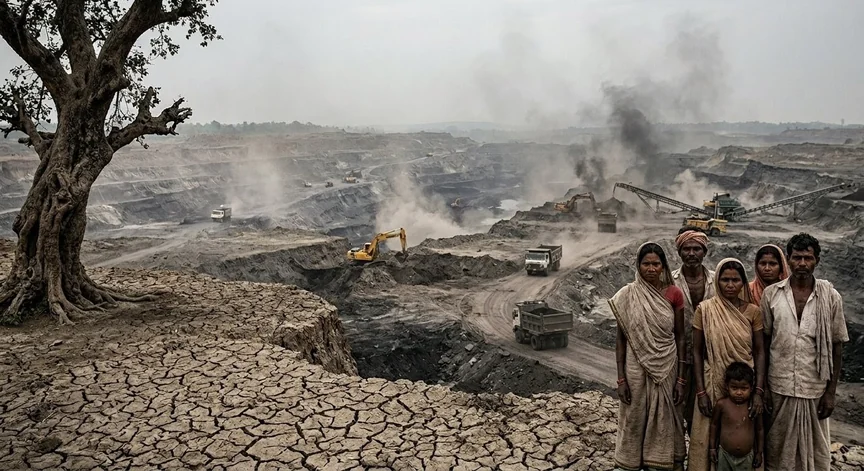
On May 21, 2026, the Supreme Court of India declined to examine the environmental clearances granted to Mahan Energen Limited — a subsidiary of the Adani Group — for its Dhirauli Coal Mining project in Singrauli, Madhya Pradesh. The Court’s reason was not that the forests were safe. It was not that the elephants were protected. It was not that the tribal communities would be heard. The reason was bureaucratic: the petition arrived too late.
That a legal technicality — a procedural time bar — should stand as the final word on the fate of 1,397 hectares of forest, over 600,000 trees, a transboundary elephant corridor, and the constitutionally protected rights of Scheduled Tribe communities is not, as some would have it, a regrettable malfunction. It is the system functioning precisely as it was designed to function: smoothing the conversion of living ecological wealth – once the property of commons – into corporate revenue, while ensuring that those who would interrupt that conversion arrive, always, too late.
Environmental activist Ajay Dubey had challenged the forest clearance before the National Green Tribunal. The NGT rejected his plea, citing Section 16 of the NGT Act, which permits challenges only within 30 days, or 90 days with sufficient cause. The Supreme Court, when approached, echoed the same refrain: “Why so much delay?” Two tribunals. Two refusals. Not a single substantive word about the forests. Not one question about the elephants. Not a syllable about the tribes.
The Geography of a Scandal
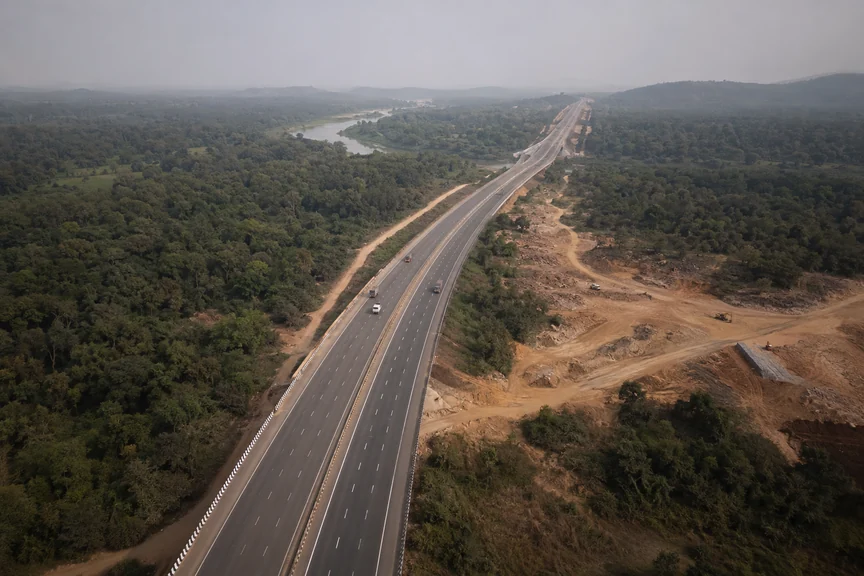
The Dhirauli Coal Block sits in a forest tract that the Union Ministry of Environment, Forests and Climate Change itself identified as a ‘no-go’ zone in 2011 owing to the exceptional density of its forest cover. Thirteen years later, the same ministry reversed course and handed the same land to a corporation whose net worth rivals the GDP of small nations. The forest that was once considered too precious to mine became, apparently, available for extraction.
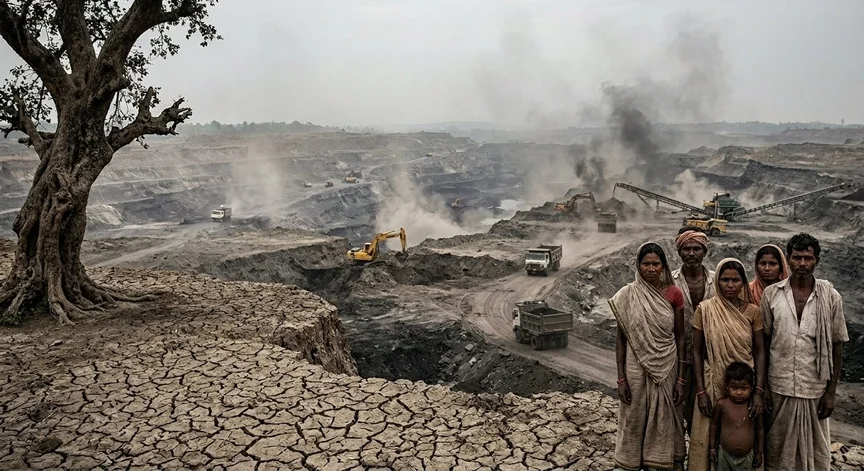
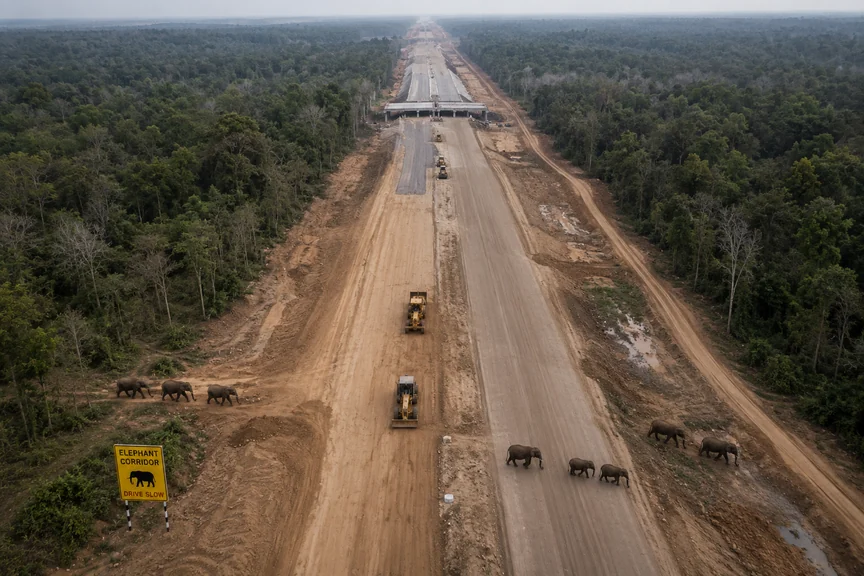
The project area falls within an Elephant Corridor spanning Madhya Pradesh, Chhattisgarh, and Jharkhand. Elephants do not recognise state boundaries. They follow ancient paths carved through millennia of ecological memory. The Dhirauli mine will sever one such path. The displacement of elephant herds does not merely threaten the animals; it triggers cascading conflicts with human settlements, destroying crops, livelihoods, and lives. The cost of this disruption will not appear in any quarterly earnings report. It will not reduce GDP. It will not register as a loss in any national account. That invisibility is not incidental. It is structural.
The project also falls within a Fifth Schedule Area under the Indian Constitution — a zone where tribal rights and self-governance are expressly protected by law. The Forest Rights Act, 2006 and the Panchayats (Extension to Scheduled Areas) Act, 1996 require that forest diversion receive the free, prior, and informed consent of Gram Sabhas. Former Environment Minister Jairam Ramesh has alleged that tree felling began without proper clearances and in violation of both statutes. Villagers, including members of a Particularly Vulnerable Tribal Group, continue to protest. Few institutions appear willing to hear them.
Growth Is Not the Answer. Growth Is the Problem.
The standard analysis of cases like Singrauli reaches for the concept of regulatory capture: corporations influence governments; institutions designed to restrain extraction are colonised by the interests they were meant to regulate. This diagnosis is accurate as far as it goes. But it does not go far enough. It frames destruction as a deviation — as though the system, if only properly defended against corporate intrusion, would otherwise protect forests, corridors, and communities.
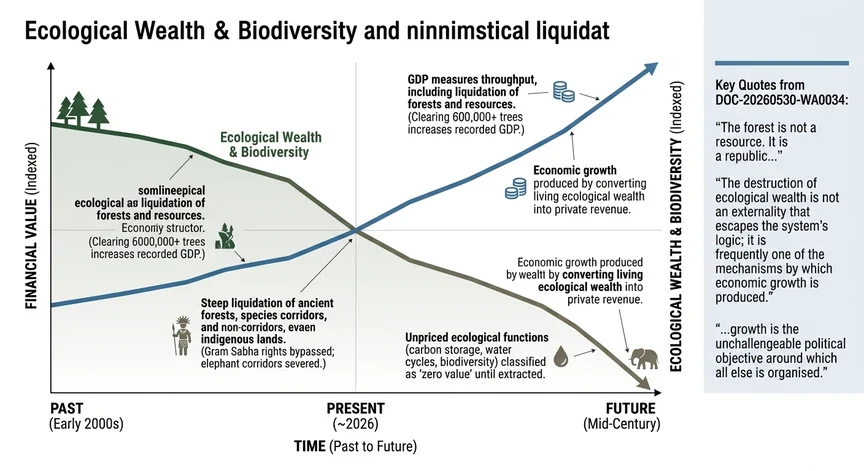
The evidence does not support that reading. What is happening in Singrauli is not a failure of the growth economy. It is the growth economy working. The destruction of ecological wealth (the property of commons) is not an externality that escapes the system’s logic; it is frequently one of the mechanisms by which economic growth is produced. GDP does not measure wellbeing. It measures throughput. When a standing forest is felled and the timber sold, GDP rises. When an ecosystem is mined, GDP rises. When communities lose ancestral land and are forced into wage labour, GDP rises. The destruction does not disappear from the ledger — it is simply recorded as a gain.
This is the central insight that distinguishes a degrowth critique from a liberal environmental one. Liberalism asks: how do we reform the system so that growth occurs without such costs? Degrowth asks: what if these costs are not incidental to growth but constitutive of it? What if the model that measures success by how effectively living ecosystems can be transformed into marketable commodities cannot, by its own internal logic, produce a different outcome than the one we are witnessing?
A standing forest stores carbon, regulates water cycles, sustains biodiversity, and supports human communities whose relationship to the land predates the Indian state itself. None of these functions appear in measures of economic output. Because they cannot easily be priced and sold, they are classified by the growth economy as having zero value — or, worse, as obstacles to value creation. The environmental clearance certificate is precisely the instrument by which this classification is formalised and made legally actionable. It authorises the liquidation of ecological wealth accumulated over centuries into financial capital that can be counted, reported, and distributed within a single investment cycle.
This is not corruption. This is policy. The Indian state does not clear forests for coal mining because regulatory institutions have been corrupted. It clears them because, within the framework of GDP-measured development, doing so constitutes growth — and growth is the unchallengeable political objective around which all else is organised.
The Architecture of Enclosure
What is unfolding in Singrauli belongs to a longer historical pattern. The enclosure of commons — the conversion of shared ecological wealth into privately owned productive assets — has been a recurring mechanism of capital accumulation across centuries and geographies. English peasants were expelled from forests and commons so that landlords could increase wool production. Today, tribal communities in Madhya Pradesh are displaced from ancestral forests so that corporations can mine coal for thermal power generation. The geography and the commodity differ. The logic is the same.
What makes the contemporary version more opaque is the machinery of legitimation that surrounds it. Environmental Impact Assessments. Clearance certificates. Gram Sabha consultations that are conducted as formalities rather than genuine exercises of consent. Judicial review windows calibrated to close before affected communities have fully understood what has been decided. Each of these mechanisms gives the appearance of procedural fairness while ensuring that the outcome — extraction — is never seriously in question.
The beneficiaries of the Dhirauli project are identifiable: Adani Power, its shareholders, and the financial institutions that hold its debt and equity. The costs — climatic instability, ecological fragmentation, watershed degradation, cultural destruction, loss of biodiversity — will not appear on those balance sheets. They will be distributed across forest communities, wildlife populations, and future generations whose consent was never sought and whose interests rarely enter the economic calculations that justify such projects. This is not an accident of bookkeeping. It is how the growth economy is structured to operate.
The Court’s Complicity Through Convenience
It must be said plainly: the Supreme Court was not merely a passive observer in this episode. By declining to exercise its extraordinary jurisdiction under Article 142 of the Constitution, the Court made a choice. It chose procedural tidiness over ecological scrutiny.
Article 142 exists precisely for moments where rigid adherence to procedure risks producing outcomes that offend justice itself. The Court has invoked it in commercial disputes, matrimonial disputes, and matters of far less consequence to future generations. That it declined to do so when an elephant corridor and hundreds of thousands of trees hung in the balance raises difficult questions about whose interests the judiciary instinctively moves to protect.
The timing compounds the difficulty. Barely a week before dismissing the petition, the Chief Justice publicly complained that environmentalists were “dragging everything to court.” Judicial independence requires more than freedom from direct interference. It requires an institutional culture capable of resisting the gravitational pull of a political economy that treats extraction as development and dissent as delay.
In environmental conflicts, time is not neutral. Justice delayed is not merely justice denied. In ecological terms, it is destruction ratified. Every week that legal proceedings are deferred is another week in which felling schedules advance, topsoil is disturbed, and the corridor is narrowed. The procedural clock runs in one direction only, and it runs fastest for those who have already received the permits.
What Democratic Accountability Actually Demands
Conventional environmental advocacy responds to cases like Singrauli with demands for procedural reform: extend the NGT’s time windows, insulate clearances from political pressure, enforce FRA and PESA rigorously, recommit the judiciary to its tradition of environmental jurisprudence. These demands are not wrong. They are, however, insufficient. They address symptoms without naming the disease.
The disease is a model of development that measures prosperity by the volume of ecological wealth i.e. the property of commons converted into economic output in a given period. Within that model, forests are not valuable in themselves. They are valuable only to the extent that they can be made to contribute to GDP. A standing forest that regulates a watershed, sequesters carbon, sustains biodiversity, and supports a community of tribal rights-holders registers in national accounts as economically inert. A mined forest that generates coal revenues, shareholder returns, and employment statistics register as growth.
The question that democratic accountability actually demands is not how to make the clearance process fairer, but whether clearance should be granted at all — and, more fundamentally, whether a society’s measure of its own success should be one in which granting such clearance counts as progress. Singrauli is not a place where development is happening despite the destruction of nature. It is a place where the destruction of nature is what development means.
The NGT’s time limitations require reconsideration, not as a concession to activists, but as an acknowledgment that ecological harm does not announce itself according to legal calendars. Communities often need months to understand the implications of a clearance that reshaped landscapes for centuries. FRA and PESA must be enforced as rights, not consulted as formalities. And the judiciary must recommit itself to the understanding that ecological justice is not a subspecialty of administrative law. It is the condition of all other justices.
But these reforms remain trapped within the logic of the existing system unless they are accompanied by a deeper reckoning: that GDP growth cannot remain the unchallengeable objective around which all ecological and social considerations are organised as secondary constraints. The communities of Singrauli do not need better procedure. They need a state that treats their forests, their corridors, and their rights as ends in themselves — not as inputs to be optimised within a growth calculus.
The Price the Future Will Pay
Every tree that falls in Singrauli releases stored carbon into an already destabilised atmosphere. Every hectare of forest erased weakens a watershed. Every elephant displaced disrupts an ecosystem refined over millennia. The coal extracted from Dhirauli — 6.5 million tonnes per annum — will burn. Its emissions will join an atmosphere already burdened beyond its absorptive capacity. The resulting climatic instability will fall disproportionately on communities least responsible for producing it and least equipped to absorb it.
Defenders of the project will argue that India needs energy, employment, and industrial growth. The argument deserves a direct response rather than a concession. The question is not whether India requires electricity. The question is who decides how it is generated, at whose cost, and for whose benefit. Coal extraction in Singrauli generates electricity whose primary beneficiaries are industrial consumers and urban populations. The ecological costs are borne by tribal communities, forest-dependent peoples, and wildlife populations who consume almost none of that electricity and participated in none of the decisions that produced it.
This is not development. This is a transfer of ecological wealth from the commons to private ownership, of costs from corporate balance sheets to communities and future generations, of decision-making power from those most affected to those most insulated from the consequences. A model that records such transfers as growth is not measuring prosperity. It is measuring dispossession.
Future generations may inherit the electricity generated by projects like Dhirauli. They will also inherit the climatic instability, ecological fragmentation, and irreversible losses that made that electricity possible. History may record Dhirauli as a coal mine, an infrastructure project, a contribution to economic growth. Ecology will remember it differently: as another act of enclosure, another moment when a living republic of forests, wildlife, watersheds, and human communities was dissolved and entered into the national accounts as development, while the resulting losses were deferred into the future as somebody else’s burden to bear.
The Question of Whom the State Serves
The Dhirauli case is ultimately a question about whom the Indian state serves — and about the civilisational choices embedded in the answer. A democratic state derives legitimacy not merely from elections but from its willingness to protect the rights, resources, and futures of all its citizens: including those without corporate influence, political access, or institutional power. The forest communities of Singrauli are such citizens. The elephants of the Dhirauli corridor occupy a different legal category, but they belong to the same ecological republic whose destruction this piece is concerned with.
The forests of India do not belong to any government, corporation, or generation. They are part of a living inheritance, held in trust across time. The tragedy of Singrauli is not simply that a forest may disappear. It is that an economic order has become so thoroughly organised around the conversion of ecological wealth into financial wealth that the conversion itself is celebrated as development, its opponents are dismissed as obstructionists, and the courts are recruited, consciously or otherwise, into managing the procedural tempo of dispossession.
The real question that Singrauli poses is not whether India can reform its environmental governance within its existing development model. It is whether a different model is possible: one that measures prosperity not by how rapidly ecological commons can be converted into private revenues, but by the health of the communities, ecosystems, and living systems that make prosperity possible in the first place. That is not a question for environmentalists alone. It is a question for everyone who inherits the consequences of decisions made in the name of growth by those who will not live long enough to pay for them.
Sources and References:
https://tribal.nic.in/FRA.aspx
(Ministry of Tribal Affairs — Forest Rights Act, 2006)
https://www.indiacode.nic.in/handle/123456789/2025?col=123456789%2F1362
(The National Green Tribunal Act, 2010)
https://panchayat.gov.in/en/pesa-act/
(Panchayats (Extension to Scheduled Areas) Act, 1996)
https://repository.tribal.gov.in/handle/123456789/73962
(Compendium of Circulars, Guidelines and Proceedings on the Forest Rights Act)
https://repository.tribal.gov.in/handle/123456789/73773
(Compendium of Guidelines and Executive Instructions on Forest Rights)
https://www.un.org/en/climatechange/science/climate-issues/biodiversity
(United Nations — Biodiversity and Climate Change)
https://unfccc.int/news/what-is-the-triple-planetary-crisis
(United Nations Framework Convention on Climate Change — Triple Planetary Crisis)
(UN Environment Programme Global Foresight Report)
(OECD Environmental Outlook on the Triple Planetary Crisis)
https://www.umweltbundesamt.de/en/publikationen/triple-crisis-interconnected-challenges
(German Environment Agency — Climate Change, Biodiversity Loss and Environmental Pollution)




By cutting it down for the economical growth of a few, we are erasing a civilisation, which applies for Hasdeo, Shimlipal, the Nicober and on and on.
And when its comes to Republic its for the public.
Neither for the States eventually chosen by the people of a country nor for the few entrepreneurs.
So we must decide for growth or degrowth.
His suggestions for judicial reforms also points out towards the accountability of the personnel on the chair of the judicial system of the country.