



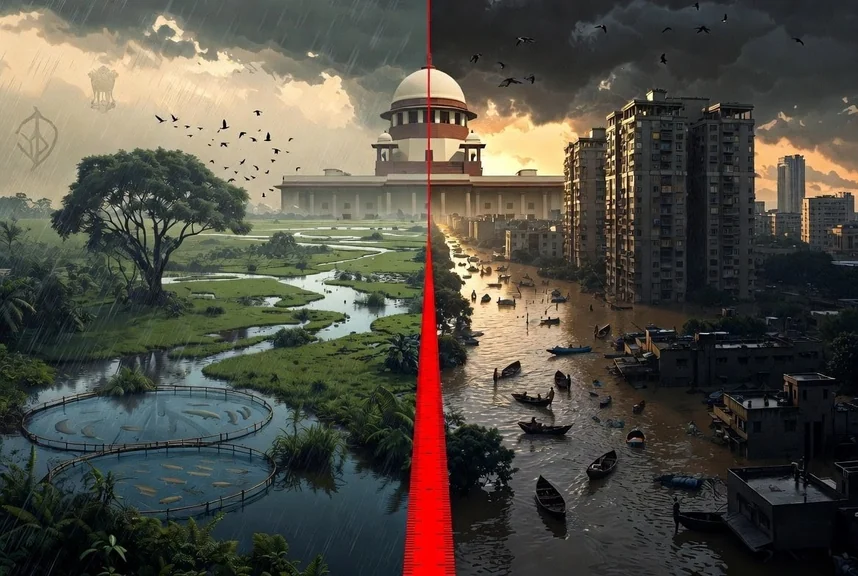

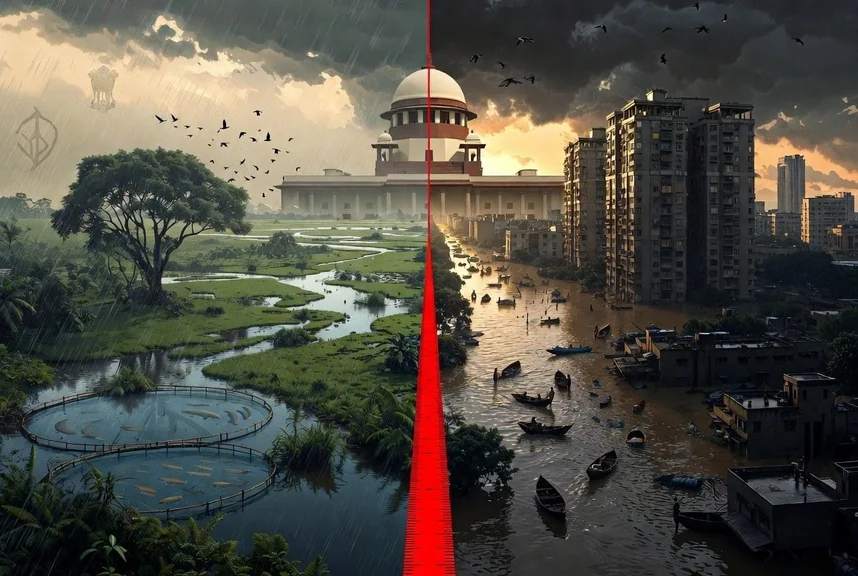
The Supreme Court’s scrutiny of India’s Wetlands Rules is not merely a dispute over drafting precision. It is a constitutional test of whether environmental law can still recognise ecological systems as living continuities—or whether governance will continue slicing them into administratively convenient fragments until their destruction becomes legally invisible.
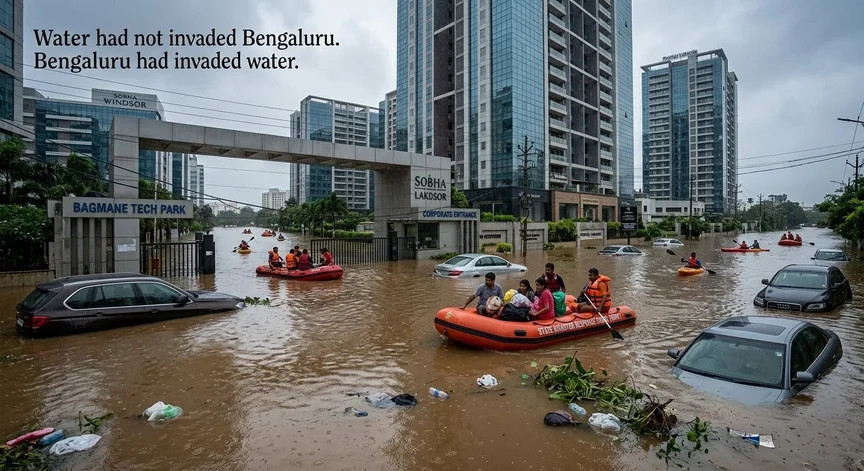
During the 2022 floods in Bengaluru, images emerged of apartment complexes submerged waist-deep in brown water while residents paddled through gated tech corridors in inflatable boats. Luxury towers stood marooned beside drowned roads built over what were once interconnected lakes and stormwater channels. The scene appeared surreal only because the city had forgotten what the landscape originally was.
“Water had not invaded Bengaluru. Bengaluru had invaded water.”
That memory sits at the centre of the Supreme Court’s decision to examine Rule 2(g) of the Wetlands Rules, 2017. Petitioners argue that the definition of wetlands is so narrowly framed that it excludes ecologically connected systems such as river channels, paddy fields, aquaculture zones, salt pans, and traditional water infrastructure. Formally, the Court is examining a narrower constitutional question: whether the definition is so vague or restrictive that it permits arbitrary enforcement. In reality, the case raises something larger and more uncomfortable—how law chooses to “see” nature itself.
The 2017 framework did not merely refine an administrative category. It reorganised ecological reality into legal fragments.
By excluding river channels, paddy fields, aquaculture ponds, salt pans, and irrigation systems from the definition of wetlands, the rules effectively drew legal boundaries around systems that do not behave in bounded ways. Rivers spill into floodplains, floodplains recharge aquifers, seasonal wetlands absorb monsoon surges, and paddy fields routinely function as temporary water-retention landscapes.
"Ecology operates through continuity; law prefers borders."
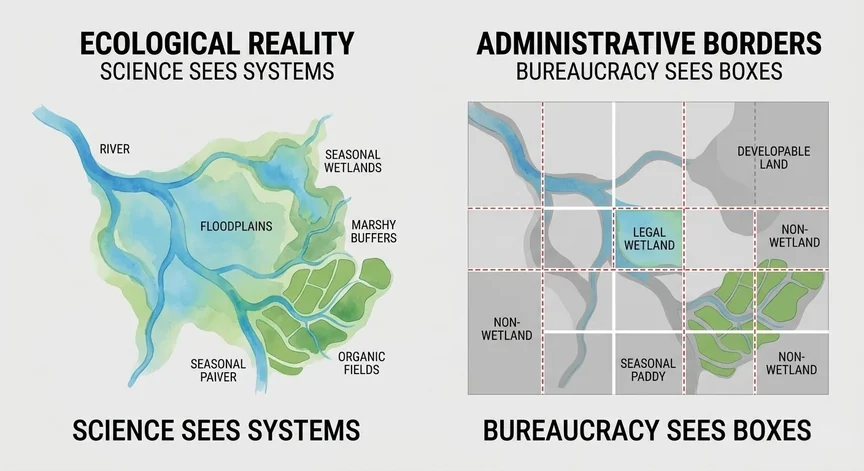
Hydrologist Luna Leopold’s watershed research demonstrated decades ago that rivers cannot be understood separately from their floodplains and surrounding catchments. Water systems function through circulation, overflow, absorption, and release. Yet environmental governance increasingly depends on rigid distinctions between “wetland” and “non-wetland,” “natural” and “man-made,” “permanent” and “seasonal.” Science sees systems. Bureaucracy sees boxes.
And what falls outside those boxes becomes vulnerable to disappearance—not because it has ceased to function ecologically, but because the law has ceased to recognise it.
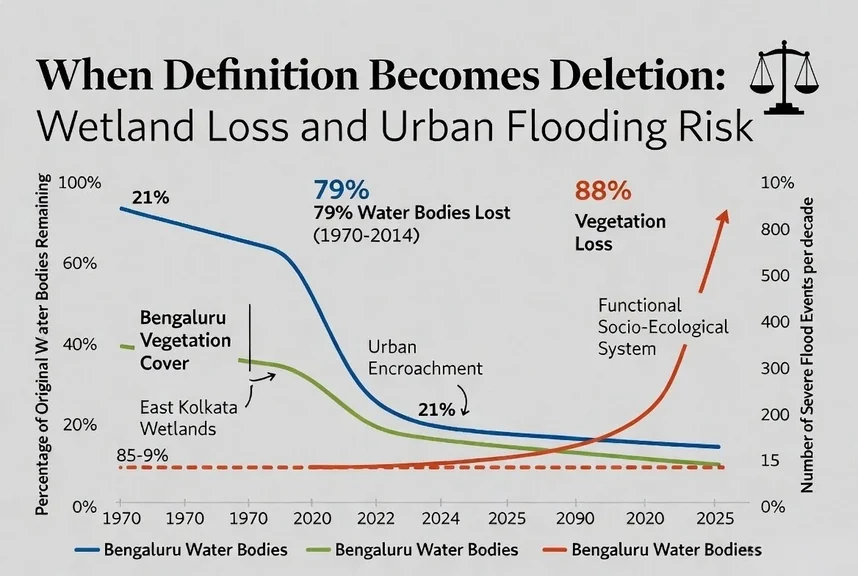
That disappearance is no longer theoretical. Between 1970 and 2014, Bengaluru lost nearly 79% of its water bodies and roughly 88% of its vegetation cover due to urban expansion and wetland encroachment, according to studies conducted by the Indian Institute of Science. The consequences are now visible every monsoon season. Floodwater moves through the city faster than its fragmented drainage logic can contain it.
The same pattern echoes across India’s expanding urban centres. Chennai’s catastrophic floods, recurring urban inundation in Gurugram, and collapsing groundwater systems across multiple metros are not isolated planning failures occurring independently of ecological policy. They reflect a deeper governance philosophy in which wetlands are treated as idle land reserves waiting for conversion rather than as active hydrological infrastructure. Water obeys terrain, not paperwork.
Nowhere is the cost of this blindness clearer than in the East Kolkata Wetlands. This is not a pristine wilderness untouched by human presence. It is a functioning socio-ecological system where sewage-fed fisheries, agriculture, and natural wastewater treatment operate as one integrated metabolic network. The wetlands process an estimated 750 million litres of Kolkata’s wastewater every day while sustaining thousands of livelihoods through fisheries and farming—an ecological service system that would cost enormous public capital to artificially reproduce through engineered infrastructure.
Yet regulatory frameworks remain deeply suspicious of landscapes that blur categories. Systems that are neither fully “natural” nor fully “industrial” often slip into classificatory grey zones where legal protection becomes conditional.
This reveals a deeper bias within environmental governance itself: the belief that nature is only worthy of protection when emptied of labour, habitation, or productive use. But as environmental historian Ramachandra Guha argued in his critique of fortress conservation, South Asian ecological resilience has historically emerged through coexistence between communities and landscapes, not through their separation.
Law, in this sense, frequently lags behind ecological history.
The Supreme Court’s focus on vagueness sharpens the constitutional stakes further.
“The law may legitimise disappearance by erasing from definition the systems that hold Indian cities above water.”
Vagueness in environmental law does not merely create interpretive uncertainty; it redistributes power. When definitions become narrow or indeterminate, discretion shifts downward to local administrative authorities who decide—often informally—which water body deserves protection and which can be absorbed into urban expansion.
In systems where ecological damage is frequently irreversible, that discretion is not procedural flexibility. It is structural risk.
At the same time, the Court is not being asked to redesign environmental policy. It is being asked a narrower constitutional question: whether the current framework permits arbitrary exclusion of ecologically significant systems under the guise of classification.
That question sits directly within Article 14 jurisprudence. As the Supreme Court repeatedly held from E.P. Royappa onward, arbitrariness is antithetical to equality. If ecologically identical systems are treated differently simply because one fits bureaucratic definition while another exceeds it, the constitutional problem is no longer administrative convenience alone. It becomes irrational classification.
The state’s defence, however, cannot be dismissed as cynical or irrational. Governance requires legibility.
Environmental regulation at national scale cannot function if every seasonal depression, temporary waterlogged field, or monsoon pool is automatically treated as protected wetland. Without definitional limits, enforcement capacity risks collapse. The 2017 framework, in this reading, attempts to restore operational clarity by focusing protection on identifiable and relatively permanent water bodies.
This argument has institutional logic. But it also rests on a dangerous assumption: that what is difficult to classify is less essential to protect.
That assumption collapses under ecological scrutiny.

Limnologist Ruth Patrick’s work on freshwater ecosystems demonstrated decades ago that ecological stability often depends precisely on transitional zones—edges, buffers, and seasonal interfaces that resist rigid categorisation. These are the first landscapes to disappear when governance mistakes ambiguity for dispensability.
The conflict, then, is not between clarity and confusion. It is between two competing forms of rationality.
Administrative rationality demands fixed categories, measurable borders, and enforceable simplicity. Ecological rationality operates through overlap, transition, and seasonal transformation.
The present framework resolves the first problem by deepening the second.
By prioritising bureaucratic clarity, the law transfers complexity out of administrative systems and into ecological collapse. Flooding, groundwater depletion, wetland fragmentation, and intensifying urban heat are not external accidents occurring beyond governance. They are feedback from landscapes simplified beyond ecological tolerance.
There is also a constitutional limit to the state’s position. Article 14 does not require perfect ecological taxonomy. But it does require that legal classifications maintain rational nexus with the object they claim to regulate. If the stated objective is wetland protection, then systematically excluding hydrologically functional systems that perform identical buffering roles begins to strain that nexus beyond credibility.
Ultimately, this case is not about whether wetlands should be defined broadly or narrowly. It is about whether environmental law can continue operating through classifications that distort the systems they claim to protect. A definition that is too vague weakens enforcement. A definition that is too narrow weakens survival itself.
The Supreme Court is not being asked to choose between development and conservation. It is being asked something more foundational: whether the state can legally simplify a living hydrological system until its complexity disappears from legal vision—and then disclaim responsibility when that disappearance returns as disaster.
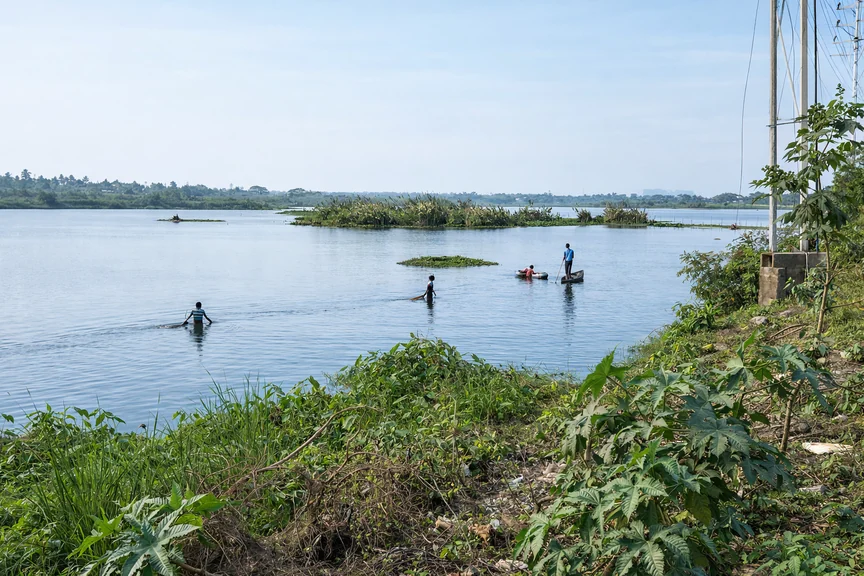
A constructive path forward exists: the Court could direct the adoption of a functional-hydrological test for wetland status. Instead of rigid categories, protection would turn on whether a landscape performs key ecological functions—monsoon water retention, groundwater recharge, flood attenuation, or wastewater processing—regardless of whether it is seasonal, human-modified, or "natural." Several jurisdictions use functional assessments to protect ecologically critical areas without collapsing enforcement. This approach preserves administrative clarity while aligning legal visibility with ecological reality.
As ecologist Aldo Leopold warned in a different context, intelligent conservation begins by seeing the system as a whole. The danger before the Court is not simply that wetlands may disappear from maps. It is that the law may legitimise disappearance itself—by defining away the very systems that continue, even now, to hold Indian cities above water.
It is that the law may legitimise disappearance itself—by defining away the very systems that continue, even now, to hold Indian cities above water.
Sources:
Wetlands Rules, 2017 (Government of India Gazette Notification) moef.gov.in
Ramsar Convention — East Kolkata Wetlands wastewater treatment system
(Referenced for sewage treatment capacity and ecological significance) ramsar.org
East Kolkata Wetlands Management Authority (Official Portal) (Referenced for wetland geography, fisheries, ecological structure, and wastewater-fed aquaculture system) ekwma.wb.gov.in
Indian Institute of Science-linked findings on Bengaluru’s wetland and vegetation loss
(Referenced for 79% water body loss and 88% vegetation loss figures) indiaspend.com
Centre for Science and Environment / Bengaluru lake loss reporting timesofindia. indiatimes.com
Scientific study on East Kolkata Wetlands ecological and wastewater functions (Referenced for wastewater treatment scale, fisheries, agriculture, and hydrological significance) sciencedirect.com
India Water Portal — East Kolkata Wetlands ecological role (Referenced for sewage-processing and livelihood functions) indiawaterportal.org
Scientific assessment of East Kolkata Wetlands transformation and encroachment risks sciencedirect.com
Reuters — Bengaluru water crisis and ecological stress reuters.com
Associated Press — Bengaluru lake degradation and urban flooding pressures apnews.com
The New Indian Express — IISc expert commentary on encroachment and flooding newindianexpress.com
Supreme Court jurisprudence referenced E.P. Royappa v. State of Tamil Nadu (1974) indiankanoon.org
Environmental historian Ramachandra Guha — conservation critique Savaging the Civilized: Verrier Elwin, His Tribals, and India penguin.co.in
Aldo Leopold — ecological systems philosophy A Sand County Almanac global. oup.com
Luna Leopold — watershed and hydrological systems thinking U.S. Geological Survey archival references usgs.gov
Ruth Patrick — freshwater ecosystem science britannica.com
Supreme Court order examining vagueness challenge to Rule 2(g) (2026) (Referenced for the Court limiting notice to the issue of “vagueness”) livelaw.in
Supreme Court Order — Wetlands Rules, 2017 objections (Official PDF) (Referenced for judicial observations on abdication of responsibility and the 2017 Rules framework)
Wetlands (Conservation and Management) Rules, 2017 — Official Notification (Primary legal text for Rule 2(g) and exclusion clauses) supremetoday.ai
M.K. Balakrishnan v. Union of India (2017) (Referenced for Supreme Court directions regarding protection and identification of wetlands) supremecourtcases.com
M.K. Balakrishnan v. Union of India — Ramsar Wetlands Monitoring Order (Referenced regarding Ramsar-site protection and judicial monitoring concerns) supremecourtcases.com
Swacch Association, Nagpur v. State of Maharashtra (Referenced for judicial discussion of Rule 2(g)’s definition and exclusions) supremecourtcases.com
E.P. Royappa v. State of Tamil Nadu (1974) (Referenced for the constitutional doctrine that arbitrariness is antithetical to equality under Article 14) indiankanoon.org




As a technologist and a person of scientific orientation, extrapolating to visualise this with imposed political borders on geographical systems that had natural borders! We are pacing towards scientific progress without looking back to control appropriately and continue to devastate not only the environment but also the geography-dictated practical social systems!
In essence ruining stability all-out ant an impractical pace.