


In the past week, the escalating conflict between the United States and Iran has revealed a truth that is both immediate and deeply unsettling:
War does not only kill the present, it erases the past.
While global attention remains focused on military strategy and human casualties, a quieter destruction is unfolding across Iran’s cultural landscape.
Archaeological sites—repositories of memory, identity, and knowledge—are being damaged, destabilised, or lost.
To understand the gravity of this destruction, one must move beyond a narrow view of war and recognise what can be described, borrowing a precise conceptual term, as a polycrisis: a multidimensional crisis that is simultaneously political, cultural, ecological, and epistemological.
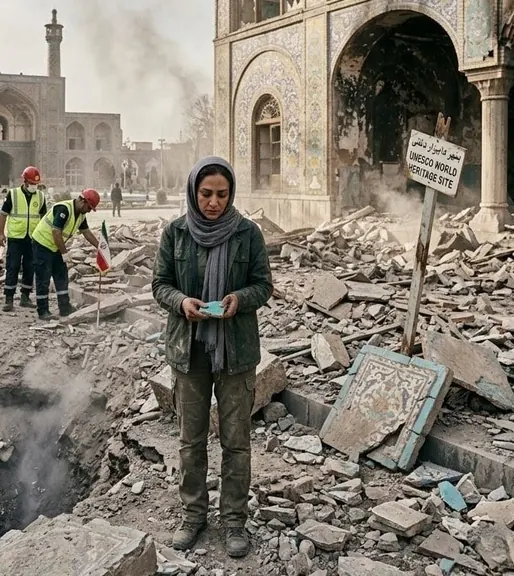
Recent reports confirm that several major heritage sites have already been affected. The Golestan Palace in Tehran, a UNESCO World Heritage Site, has suffered structural and decorative damage due to nearby explosions. Its fragile mirror halls—symbols of Persian artistic refinement—have been partially shattered. In Isfahan, the Masjed-e Jāme, a mosque whose architecture reflects over a millennium of Islamic history, and the Chehel Sotoun Palace, a Safavid-era masterpiece, have both been impacted. Even more troubling is the reported damage to areas near the Khorramabad Valley, where prehistoric caves dating back tens of thousands of years offer rare insight into early human life.
These are not isolated incidents. Iranian authorities indicate that dozens of museums and historical sites have been damaged within days. The scale suggests not merely collateral damage but a systemic vulnerability of cultural heritage in modern warfare. Despite international protections and the sharing of site coordinates with military actors, the reality remains stark: cultural preservation is often subordinated to strategic imperatives.
To fully grasp the significance of this destruction, it is necessary to widen our lens. This war is not a single, contained event but part of an unfolding polycrisis, in which multiple forms of breakdown overlap and intensify one another. It is a military confrontation, certainly, but it is also an ecological disaster, as explosions, fires, and contamination scar landscapes and poison air and water.
It is a cultural crisis, as irreplaceable sites of memory and meaning are damaged or erased.
It is a psychological crisis, leaving individuals and communities with wounds that stretch far beyond the battlefield. And it is an epistemological crisis, because the loss of ancient sites and fragile artefacts severs vital links to the past and narrows what humanity can know about its own history. Archaeological and historic places sit precisely where these dimensions meet; when they are damaged or destroyed, the shock travels outward in every direction, from the soil and stone of a specific site to the global story we tell about who we are and how we came to be.
There is also a deeper layer of suffering involved, which can be understood through the notion of multiform suffering. The destruction of a site like Golestan Palace is not only a material loss; it produces a complex web of suffering. There is the immediate loss (the destruction itself), the suffering caused by change (the irreversible alteration of cultural landscapes), and the suffering embedded in conditioned existence (the realisation that such losses are structurally inevitable in modern conflict). These layers do not exist separately; they reinforce one another, creating a profound sense of cultural dislocation.
Moreover, the war highlights a fundamental tension in how truth and value are perceived where the truth is multifaceted and cannot be reduced to a single perspective. Applied to the current situation, this suggests that the destruction of heritage cannot be understood solely through military logic or political justification. What may appear as a strategic necessity from one viewpoint may simultaneously constitute an irreparable loss for humanity. The failure to hold these perspectives together leads to a dangerous simplification of reality.
The implications for archaeology are particularly severe. Excavations are halted, research is interrupted, and sites become inaccessible or vulnerable to looting. Archaeology depends on continuity—on the careful, layered accumulation of knowledge. War disrupts this process entirely. When a site is damaged, it is not only the visible structure that is lost, but also the invisible context: the stratigraphy, the relationships between artefacts, the stories embedded in the soil. These cannot be reconstructed once destroyed.
What is at stake, therefore, is not only heritage but the very possibility of historical understanding.
The loss of archaeological sites constitutes an epistemological rupture—a break in our ability to know and interpret the past. In this sense, the war does not merely destroy objects; it destroys knowledge.
Faced with this reality, the question is not simply how to protect individual sites, but how to rethink the framework within which such destruction becomes possible. In the context of war, this would mean recognising that military objectives cannot be pursued in isolation from their cultural and historical consequences.
Ultimately, the destruction of archaeological heritage in the US–Iran conflict reveals a deeper crisis of modern civilisation.
It exposes a world in which technological power has outpaced ethical restraint, and where the preservation of history is treated as secondary to the imperatives of conflict. If this trajectory continues, the loss will not be confined to one region or one culture. It will be a loss for all humanity.
The bombs falling today do more than destroy buildings. They erase memory, fragment identity, and sever the fragile continuity between past and present.
In a world already marked by polycrisis, this is not merely collateral damage. It is the quiet disappearance of history itself.

Be the first to join the discussion.