



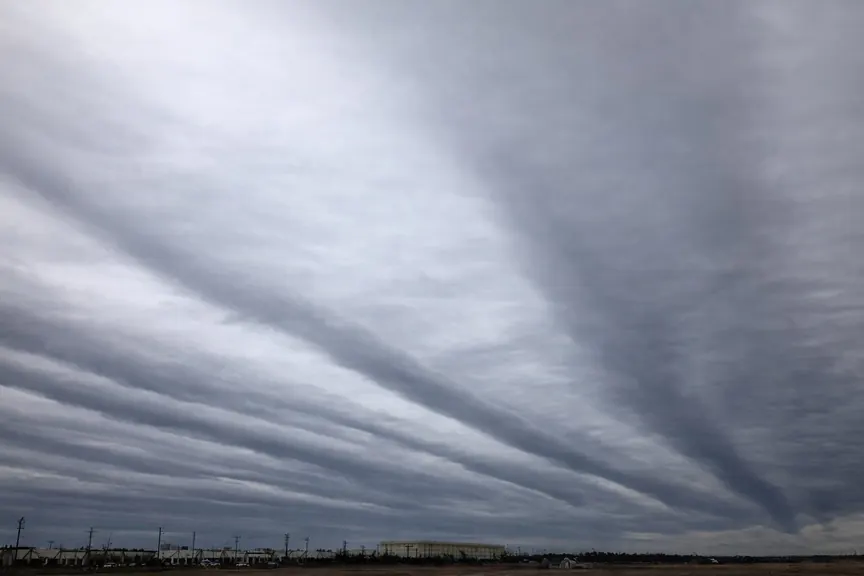
The image is unsettling in its precision: a 1,000‑kilometre‑long band of cloud and rain stretching from Afghanistan across Pakistan into northern India, slicing the sky in an almost ruler‑straight line where weather is usually messy and curved. Meteorologists describe it as a rare alignment of a western disturbance with surface conditions. Television anchors call it an “unusual rain band.” Yet to treat it as a quirky weather oddity is to miss what it exposes about the age we inhabit.
We are no longer facing isolated disasters — a flood here, a heatwave there — but a dense tangle of crises that act on and through one another. The rain band arrived after an early, almost summer‑like March in North India, with Delhi touching temperatures more typical of late April. The same atmosphere that scorched cities suddenly cooled them by several degrees with violent thunderstorms, hail, and squalls. Far away in Australia, “fast and furious” downpours along the Great Ocean Road turned roads into rivers within hours, sweeping vehicles into the sea. Scientists there describe extreme rainfall events intensified by a warmer atmosphere that holds more moisture and then releases it in short, devastating bursts.
Globally, these scenes unfold against the backdrop of one of the hottest years ever recorded, with temperatures now well above the pre‑industrial average and ocean heat surging to new highs. Sea ice shrinks at both poles; coastlines erode; familiar seasons wobble. Each extra fraction of a degree of warming makes the atmosphere more volatile, increasing the likelihood of intense rainfall, severe storms, and other extremes. But the story is not only about physics. It is also about how economies are organised, how power is distributed, and how societies decide whose suffering can be ignored.
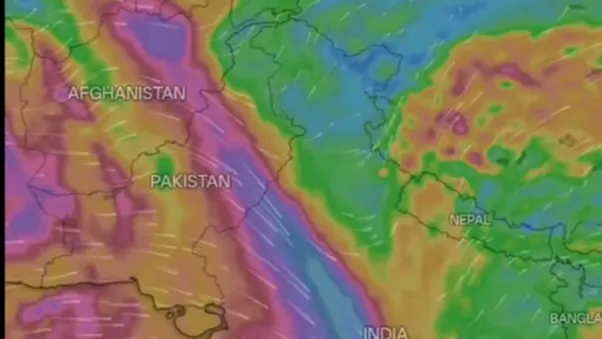
The damage from a straight band of rain is not measured only in flooded fields and traffic disruptions. It leaves behind multiform suffering: farmers watching unseasonal storms flatten their crops; informal workers losing wages to washed‑out days; families quietly absorbing the stress of a world that no longer behaves in recognisable ways. Layer this onto existing economic precarity, political instability, and cultural erosion, and the result is less a series of separate emergencies than a single, interwoven disturbance to how life is lived and imagined.
Yet the way such events are narrated often strips them of this depth. A rare rain band makes for dramatic satellite imagery and viral clips; record global temperatures generate a burst of headlines before vanishing into the next cycle. Media systems built around clicks and engagement favour spectacle over structure, panic over patient explanation. The consequence is a public conversation that oscillates between alarm and numbness, while the underlying drivers of ecological breakdown — an extractive growth model, deep inequality, the sidelining of local knowledge — remain largely unexamined.
A more honest approach to climate journalism would start from the assumption that crises are many‑sided. An extreme rainfall event is at once ecological, economic, social, psychological, and ethical. No single viewpoint can exhaust its meaning. The farmer in Punjab, the migrant worker in Delhi, the meteorologist in Melbourne, the coastal resident in Bangladesh each inhabit a different facet of the same reality. Holding these perspectives together is difficult, but necessary, if we are to understand what is truly at stake.
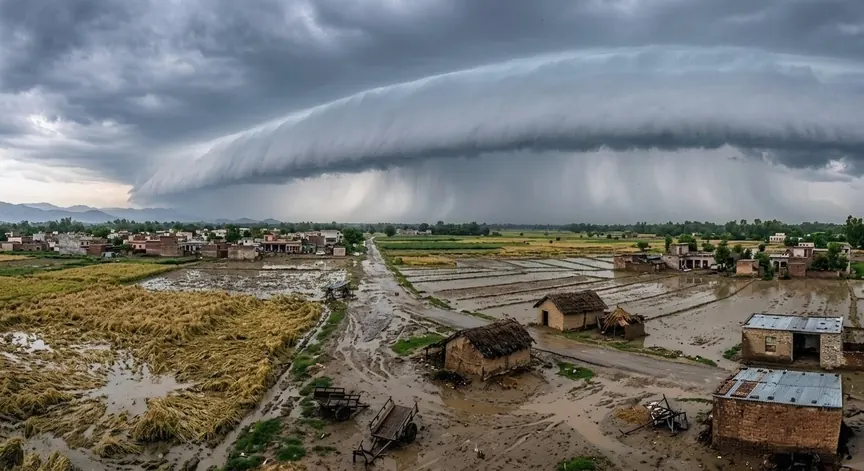
Such an approach also calls for a kind of “middle path” in how we tell these stories: refusing both the comforting illusion that incremental tweaks will suffice and the paralysing fatalism that nothing can be done. It means tracing links between atmospheric dynamics and policy choices, between local storms and distant boardrooms, without pretending that there is a neat, single solution. It also means recognising that responses must emerge from communities themselves, grounded in their specific histories and forms of knowledge, rather than being imposed from above in the language of abstract targets and markets.
The straight line of rain across South Asia is not just a meteorological curiosity. It is a sign etched into the sky of a civilisation out of balance — a world in which technological power has raced ahead of ethical restraint, and where the quest for endless growth continues to destabilise the very systems that make life possible. To look at that line and see only “bad weather” is to collude, however unintentionally, in a dangerous simplification of reality. To insist on seeing it as part of a larger, entangled crisis — and to keep telling that more demanding story — is one quiet but vital act of resistance in a rapidly warming world.


Discussion 3 comments