




WORLD EARTH DAY — 22 APRIL 2026
We Called It Earth Day. Earth Called It a Final Notice.
We gave it a name, a date, a billion participants, and a founding promise that every person on Earth has a right to a healthy environment. Then we raised atmospheric CO₂ to its highest level in three million years, doubled the rate of sea-level rise, pushed five climate tipping points to the edge of irreversible crossing, and began mining the planet’s most fragile ecosystems to power our green transition. Earth Day 2026 is not a celebration. It is a reckoning.
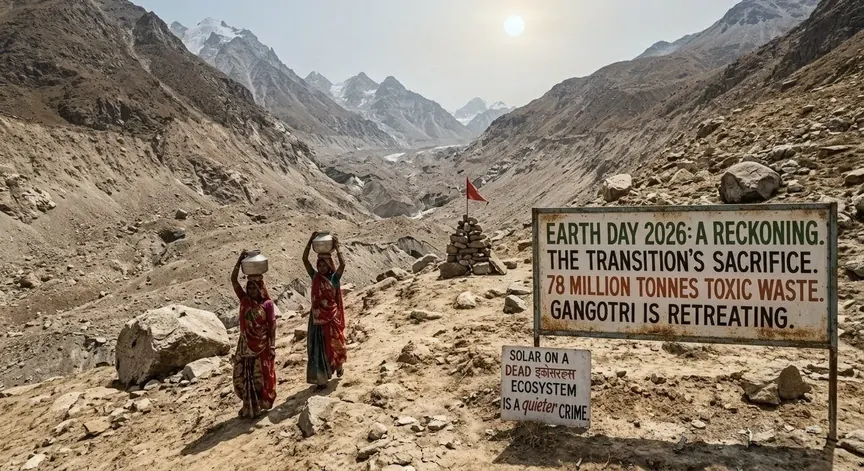
On 18 March 2026, the European Space Agency confirmed that global average temperature had sustained a breach of 1.5°C above pre-industrial levels for an unbroken twenty-four months — the threshold 196 nations pledged in Paris never to cross. The Copernicus Climate Change Service had already confirmed 2024 as the first calendar year to exceed 1.5°C as an annual mean, with every month between June 2023 and December 2024 breaking all prior monthly temperature records. The Intergovernmental Panel on Climate Change: the United Nations’ foremost scientific body on climate, whose Sixth Assessment Report (AR6) drew on the peer-reviewed work of over 700 scientists across eight years and nearly 8,000 pages — is unambiguous: global surface temperature is at its highest in 125,000 years, atmospheric CO₂ at 422 ppm is 72 parts per million above the safe boundary and at its highest in three million years, sea levels are rising at 4.7 millimetres per year — double the rate of a decade ago — ocean heat has set a new record for eight consecutive years, glacier mass balance is the most negative in recorded history, and the IPCC states with virtual certainty that heatwaves, once a once-per-decade event, will occur 9.4 times more frequently at 4°C of warming. For India, these are not statistics. The Gangotri glacier, which is the sacred source of the Ganga, sustaining 500 million Indians, has retreated 22 kilometres since 1780. Delhi recorded 52.9°C. Chennai drowned in 45 centimetres of rain in 48 hours. Over 10,000 Vidarbha farmers have died since 2015 as the monsoon fails. The Western Ghats, feeding seven river systems and 245 million people, recorded their fourth year of catastrophic landslides. The data does not plead. It indicts.
The first Earth Day on 22 April 1970 was built by two men: Senator Gaylord Nelson, galvanised by a California oil spill, and Denis Hayes, then a Harvard graduate student, whose organisational genius turned one senator’s outrage into 20 million Americans in the street — and who in 1990 expanded it into a global movement of 200 million across 140 countries. Today the Earth Day Network unites one billion participants annually across 190 countries on a single founding moral premise: that all people, regardless of race, gender, income, or geography, have a moral right to a healthy, sustainable environment. India had already encoded that premise in its civilisation — in the Bishnoi community that gave 363 lives to protect trees in 1730, in the Chipko women who embraced forests in the 1970s, in Articles 48-A and 51-A(g) of the Constitution. At Stockholm in 1972, Indira Gandhi warned that poverty and ecological destruction were inseparable. The world applauded and then, over the next fifty years, proved her right in every detail while ignoring her in every policy. The result: five climate tipping points now at risk of being crossed at current warming levels. Coral reefs — which the 2025 Global Tipping Points Report says may already have crossed their threshold, with a 99 percent probability of collapse above 1.5°C — are bleaching across Lakshadweep and the Gulf of Mannar. Greenland and West Antarctic ice sheets, containing 12 metres of potential sea level rise, have tipping point estimates that fall within the Paris Agreement’s own target range. Permafrost holds twice the carbon in Earth’s atmosphere; its thaw could add 0.3°C independently and trigger the Amazon dieback that would, through a cascade of failing ocean currents, reach the Indian monsoon and the food security of a billion people. This is not a chain of future risks. It is the present architecture of collapse, measured and confirmed.


Before this board delivers its verdict, intellectual honesty demands we hear the strongest case for optimism — because it deserves to be heard before it is dismantled.
India has built 90 gigawatts of solar capacity in a decade which is the third-largest solar fleet on Earth — and solar electricity is now the cheapest power source in human history. Renewables crossed 40 percent of global electricity generation in 2025. The IPCC’s own AR6 acknowledges scenarios where rapid renewable deployment constrains warming to 1.7°C to 1.9°C — painful but survivable, and dramatically better than the 2.6°C projected under current policies. To call solar an ecological threat, the optimists insist, is to hand a propaganda victory to the coal industry at the moment it is most vulnerable.

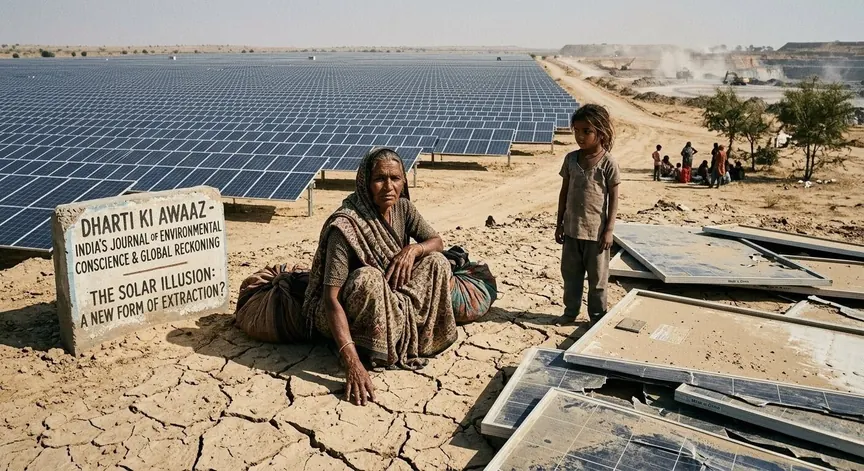
India’s 500 gigawatt target requires between 50,000 and 1,00,000 square kilometres of land — much of it Rajasthan’s living Thar Desert ecosystem and the commons of Rabari, Bhil, and Bishnoi communities. The World Bank’s Minerals for Climate Action report warns the transition demands a 500 percent increase in lithium and 460 percent in cobalt by 2050 — extracted from the Congo Basin, Chile’s Atacama, and India’s own Jharkhand tribal belts where adivasi communities are already being displaced. Solar panels contain cadmium, lead, and selenium; India has no recycling policy for the 78 million metric tonnes of toxic panel waste the International Renewable Energy Agency projects by 2050. We are building a second ecological time bomb inside the casing of the first. The Earth Day Network was founded on the moral premise that all people — regardless of race, gender, income, or geography — have a right to a healthy environment. That premise is violated daily by a green transition whose benefits flow to the wealthy and whose costs are borne by the poor. The adivasi woman of Jharkhand displaced for a lithium mine has not been liberated by the green transition. She has been sacrificed by it.


We do not trade in despair. We trade in demands. Three are non-negotiable.
First: India must enact a National Solar Waste and Land Impact Policy before approving a single additional gigawatt. Mandatory panel recycling, hazardous waste standards, and a land-use protocol excluding forest land, adivasi commons, and ecologically sensitive zones. A green energy policy that poisons the soil and displaces the poor is not a climate solution. It is environmental injustice with a renewable label.
Second: The Gangotri-Goumukh corridor must be declared a National Ecological Heritage Zone. No dam, no mine, no infrastructure project in Himalayan eco-sensitive zones without full glaciological impact assessment. The Namami Gange programme’s ₹30,000 crore has not addressed the retreat of the glacier that feeds the river. Cleaning the Ganga while its source retreats 22 kilometres is polishing the deck of a sinking ship.
Third: Loss and damage is not foreign aid. It is reparation. The IPCC confirmed that the top 10 percent of global income earners produce 45 percent of emissions while the bottom 50 percent produce 15 percent and bear the greatest cost. The COP29 target of $300 billion annually is less than a quarter of what the UN calculates is needed. India must lead the Global South in demanding legally binding, independently audited climate finance — without apology, without deferral, and without trading the demand away for bilateral investment deals.
Denis Hayes turned one senator’s outrage into a movement of one billion people bound by a founding promise that every person has a right to a healthy environment. The IPCC has now measured that promise against the planet’s actual condition across six physical parameters and found it broken on every single one. Temperatures at their highest in 125,000 years. Emissions at their highest in three million. Sea levels rising at double the rate of a decade ago. Five tipping points at risk of crossing right now. One — coral reef collapse — may already have crossed. India’s Ganga is thinning, its farmers are dying, its children are breathing poison, and its glaciers are retreating into memory. The path forward is not the rejection of solar energy but the insistence that every technology must answer to the ecology it inhabits — that decentralised solar, responsible mineral sourcing, mandatory recycling, and enforceable climate finance are not utopian demands but the minimum conditions under which the green transition deserves its name.
The Earth does not issue reminders. This was the final notice.





Mother Earth is very smart
The elements disturbing other entitites shall erase theme slowly but surely
There will not be any reminder as its the final notice
We celebrate Earth Day, but don’t really change anything.
Makes me realise how serious things have become.