



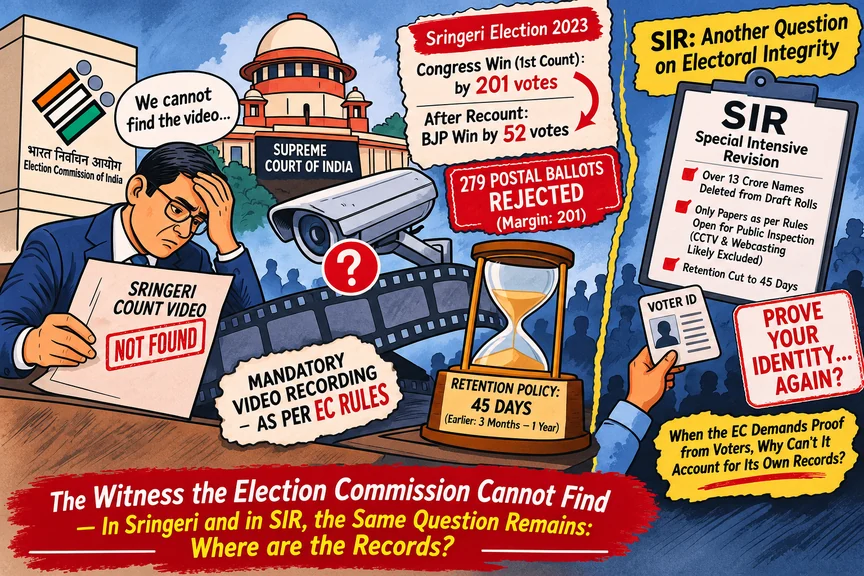
The Election Commission demands that every voter prove who they are, yet it has told the Supreme Court it cannot find the video of a disputed count in Sringeri. A seat won by 201 votes was reassigned by a recount and restored by the Supreme Court within days. The one record that could settle the dispute is missing, and the body responsible for keeping it has not said whether it was never made, destroyed or misplaced.
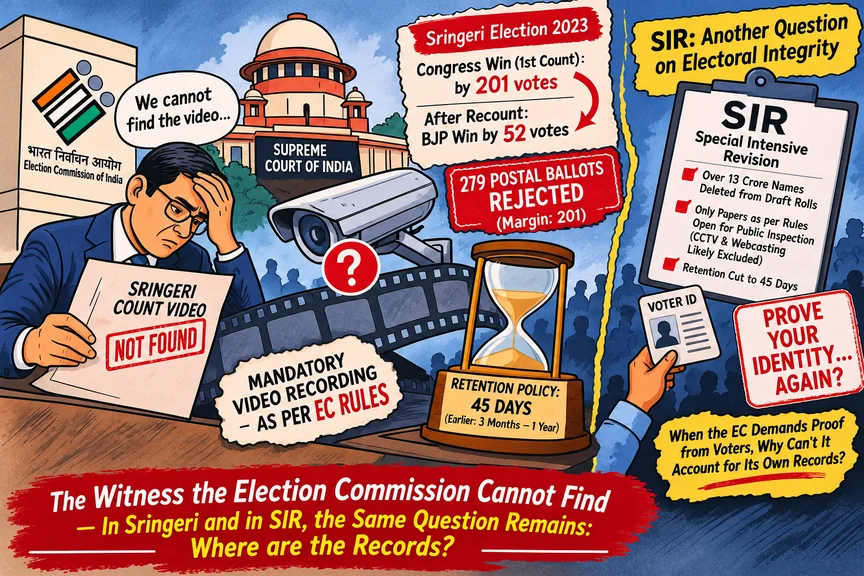
A Congress candidate won the Sringeri seat in Karnataka by 201 votes in 2023. Three years later, a recount of postal ballots flipped it: the BJP candidate was declared the winner by 52. Now the Election Commission of India tells the Supreme Court it cannot find the video of the original count. This is not a clerical hiccup. That footage is the baseline against which the recount must be judged, and the institution charged with keeping it is the one that cannot find it.
The video was mandatory. Under the Commission's own rules, if the winning margin is smaller than the number of rejected postal ballots, those ballots must be re-verified before the result is declared, and the process must be recorded on video. In Sringeri, 279 postal ballots were rejected against a margin of 201, so the rule applied. The Karnataka High Court found that the 2023 count carried no proper record of that rule being followed. The reason for rejecting each of those 279 ballots was not even written on the ballot, and the counting officer admitted the lapses in court. The failure begins before the footage went missing. Either the re-verification was never properly recorded, or it was recorded and the recording cannot now be found. Both are failures of the Commission's core duty.
Nor can the Commission shelter behind its own retention policy, and here the distinctions matter. Footage that was lawfully destroyed, footage that should have been preserved, and footage that cannot be located are three different things. In a notice dated 30 May 2025, the Commission cut the retention period for polling videos to 45 days, citing misuse by people outside the contest. Earlier instructions had kept such footage for three months to a year. The notice's stated condition for destruction is that no election petition has been filed for the constituency. The Sringeri petition was filed in June 2023, within weeks of the count and long before the notice. If the footage went after May 2025, that condition was not met; if earlier, the Commission's older instructions will show whether the same protection existed. Either way, the 45-day rule is no defence, and the Commission has not said whether the video was never made, destroyed or misplaced. Each means a different failure: of recording, of preservation, or of custody. The bench of Justices Sanjay Kumar and Sanjeev Sachdeva told the Commission it would not accept "lame excuses" and that its conduct "doesn't inspire confidence." The court was right.
The numbers show why the missing footage matters. The High Court ordered the 279 rejected postal ballots re-examined. On the Supreme Court's first-glance reading, the Returning Officer went further and re-examined ballots already counted as valid for Congress's T D Rajegowda, deducting about 250 of them and cutting his postal total to 314. The margin moved by 253 votes, from a 201-vote Congress win to a 52-vote win for the BJP's D N Jeevaraj. Justice K Vinod Chandran put the objection plainly: "There is no question of reverification of already validated postal ballots." The BJP says invalid votes were wrongly credited to Congress in the first count. Congress alleges that fresh marks appeared on its candidate's ballots. Both are testable claims, and neither is proven. According to LiveLaw, the Commission produced the recount footage in a sealed cover but not the footage of the original count. The one record that would let a court test both claims is the one that is missing.
On 11 May, the Supreme Court acted on that view. It put every step taken under the recount exercise in abeyance, ordered the status quo restored and returned Rajegowda to office, even though Jeevaraj had by then been sworn in as an MLA on the strength of the recount. Those observations were prima facie, and the appeal is undecided. Jeevaraj has asked the High Court to quash the FIR over alleged tampering, and the court has reserved its verdict. The seat is held, for now, by the man the first count elected, but the recount that unseated him cannot be fully tested without the footage of the count it overturned.
Sringeri is not an isolated lapse. It is one face of a wider asymmetry over who must prove what. In December 2024, on the Commission's recommendation, Rule 93 was amended so that only papers specified in the rules remain open to public inspection, which officials say takes CCTV and webcasting footage out of it. A challenge is pending in the Supreme Court. In May 2025, retention was cut to 45 days. Meanwhile, the Special Intensive Revision has deleted over 13 crore names from draft electoral rolls across 30 states and union territories. The Commission says those removed were dead, relocated, duplicated or ineligible, and that voters wrongly left out can claim re-inclusion. The logic is the same in both places. A voter wrongly deleted must gather documents, file claims and sometimes go to court to prove the Commission wrong, while a citizen who doubts a count finds the footage restricted by rule or, in Sringeri, missing altogether. In each case the burden of proof falls on the citizen and the evidence sits with the Commission.
Three questions follow, and the record answers none of them well. Who controls the evidence? The Commission, alone. It records the count, stores the footage, writes the retention rule and, through Rule 93, decides who may see what it keeps. It says candidates still have access to the papers they need, yet the candidates in this dispute cannot get this footage. A court testing the Commission's count must ask the Commission for the proof, and here its counsel reportedly said the footage could not be traced because the officers responsible at the time had been transferred. That treats a public record as the private memory of individual officers. Who bears the cost when the evidence cannot be produced? Not the custodian. The cost falls on a challenger who has litigated for three years, on voters whose postal ballots are now in dispute, and on a constituency whose seat was reassigned by a recount and restored within days.
And what accountability follows? Nothing reported so far shows a named officer, an inquiry into the loss, or any consequence for the failure to document the 2023 re-verification beyond the High Court's findings. The only sanction the Supreme Court has warned of is an adverse inference, which would count against the Commission in this case but against no individual. An institution whose officials can lose the central record of a disputed election at no personal cost has no reason to guard the next record any better.
The remedy should be proportionate to what is known. The court first called for the original record in May, so the Commission has had months, not days. It has so far directed only that the Commission produce whatever records it holds before the next hearing on 15 February 2027, failing which an adverse inference may be drawn. It should go further. It should require a named senior officer to swear an affidavit stating whether the 2023 re-verification was recorded, who held the footage, and when and on whose instruction it was lost or discarded. If the physical postal ballots from both counts remain in custody, it should have them sealed and examined by an independent forensic expert, so the claim of fresh marks is settled by evidence and not by assertion. And if the footage does not surface, the adverse inference should be accompanied by a finding on who answers for the failure. The challenge to Rule 93 has waited long enough.
A count nobody can check is not a result. It is a claim. When the witness to an election goes missing, every winner and every loser is left with a verdict that rests on trust, and that is the one thing an election commission exists to make unnecessary.
Photo: AI
Sources:
-
The News Minute, "Karnataka HC orders re-verification of postal ballots in Sringeri," 7 April 2026
-
LiveLaw, "Supreme Court Stays Sringeri Recount Results Favouring BJP's DN Jeevaraja, Restores Congress' TD Rajegowada As MLA," 11 May 2026
-
LiveLaw, "Karnataka High Court Reserves Verdict On BJP Leader DN Jeevaraja's Plea Against FIR In Postal Ballot Tampering Case," 31 July 2026
-
LiveLaw, "Supreme Court Asks ECI To Produce Video Records Of Vote-Counting In 2023 Sringeri Assembly Election," 16 October 2026
-
Bar & Bench, "Won't accept lame excuses, produce it: Supreme Court slams ECI for claiming it lost 2023 Karnataka vote-counting video," 14 October 2026
-
Lawchakra, "Supreme Court Rejects ECI Claim Of Lost 2023 Sringeri Counting Video, Warns Of Adverse Inference," October 2026
-
Scroll.in, "Citing 'misuse', EC cuts storage time of polling videos, photos to 45 days," 20 June 2025 (reporting the Commission's notice of 30 May 2025)
-
Deccan Herald, "Centre amends election conduct rules restricting public access to certain poll documents," 21 December 2024
-
CivilsDaily, "SIR draft rolls see over 13 cr deletions so far, Delhi leads with 33% left out," 1 September 2026

সবার আগে আলোচনায় যোগ দিন।