


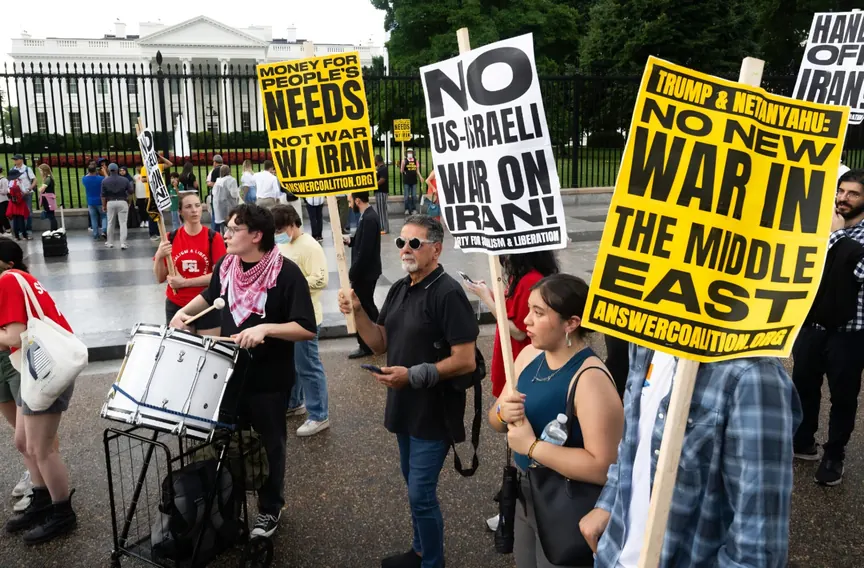

In recent months, the destructive war between Iran, Israel, and the United States has hardened into a volatile cycle of strikes, reprisals, and strategic signalling. Military actions are described as calibrated, responses as proportionate, and escalation as manageable. War, in this framing, appears as a system—complex but ultimately controllable. We speak of “deterrence” as if it were a mathematical constant and “red lines” as if they were physical barriers. What is missing from this clinical vocabulary is a deeper recognition: that no system of conflict operates independently of the mindset that sustains it. We are witnessing a tragedy of perceived rationality, where each actor believes they are making the only logical choice, unaware that the logic itself is flawed.
Long before modern geopolitics, Gautama Buddha articulated an observation that now reads less like spiritual teaching and more like systemic insight. Human crises, he suggested, do not emerge from single causes but from converging conditions—layers of impulse, perception, and reaction that reinforce one another until they appear inevitable. The ongoing war between Iran, Israel, and the United States reflects precisely such a convergence: a chain reaction of strategic interests, historical grievances, security anxieties, and ideological certainties, each feeding into the next, creating a crisis that no single actor fully controls yet all continue to intensify. In this web of “dependent origination”, the principle of Ahimsa, the commitment to dynamic non-injury and the refusal to cause suffering, takes on a radical new relevance. It is not a call for passivity; it is a deliberate intervention into the chain of causality, a refusal to provide the spark for the next explosion.
Within this convergence lies a more intimate dynamic, one that operates beneath policy and doctrine. It is the restless drive to secure more—more influence, more deterrence, more certainty in an uncertain world. This drive rarely presents itself as excess; it appears instead as necessity. Yet in practice, it functions without a natural limit. Each gain demands reinforcement, each advantage requires protection, and each perceived vulnerability invites pre-emption. What begins as a pursuit of stability gradually becomes a cycle of accumulation, one that expands until it destabilizes the very system it was meant to secure. Here, the warning against the “poison” of grasping becomes a geopolitical reality. When a state’s identity becomes inseparable from its dominance, it enters a state of perpetual hunger that no amount of military hardware can satiate. The practice of Ahimsa, or active harmlessness, begins with the recognition that security cannot be hoarded; it must be cultivated.
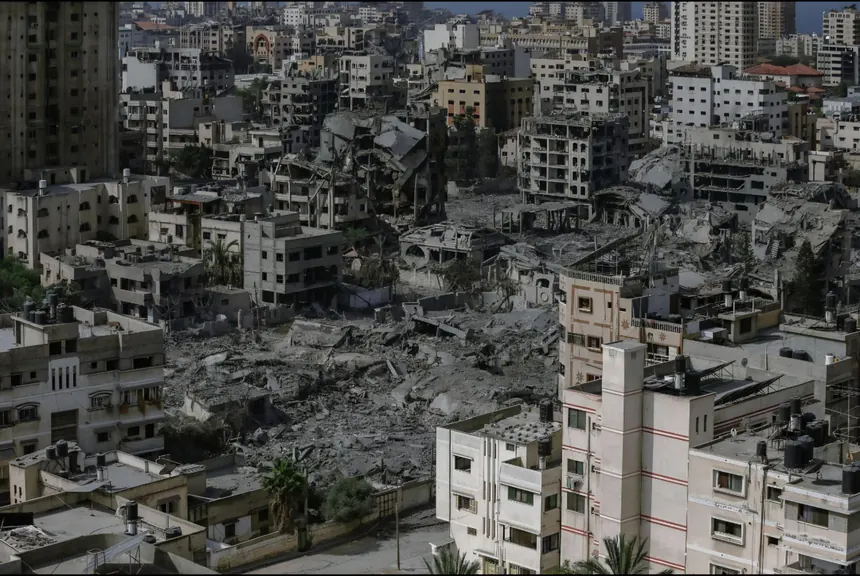
To speak of this refusal to inflict pain in a geopolitical context is often dismissed as idealism, yet a cold-eyed, practical pragmatism reveals that the current path is mathematically unsustainable. Practical pragmatism acknowledges that a state’s primary duty is the protection of its people, but when deterrence requires ever-increasing levels of violence to remain “credible”, it ceases to provide security and begins to manufacture its own demise. A truly pragmatic strategy would recognize that absolute security for one party is absolute insecurity for the other. When Israel and the U.S. seek to eliminate every possible risk through offensive force, they inadvertently drive Iran into a posture of defensive retaliation. This is not a failure of diplomacy; it is a failure of geometry. A stable system requires “off-ramps” that are as strategically fortified as the “on-ramps” to war. Pragmatism, therefore, demands the creation of predictable boundaries—not out of trust, but out of a shared interest in avoiding a mutually assured exhaustion. This strategic restraint is the ultimate form of dynamic non-injury: the understanding that to strike the other is, eventually, to strike oneself.
Alongside this drive runs a narrowing of perception. Over time, the actors in this triad increasingly view one another not as societies shaped by history and internal complexity, but as singular threats. Nuance collapses into designation: ally or enemy, stability or chaos. This simplification enables action, but it does so at a cost. Once the “other” is reduced to a category, the threshold for harm lowers. Policies that would otherwise demand moral scrutiny become easier to justify. This is the antithesis of “Right Perception”. When we fail to see the humanity in the adversary, we lose the ability to predict their reactions. We stop playing a game of chess and start fighting a mirror, reacting to our own shadows projected onto the enemy. The commitment to avoid causing suffering requires us to break this mirror and acknowledge the internal complexities of those we oppose.
The language of modern conflict both reflects and reinforces this process. Terms such as “surgical strike” and “collateral damage” do not merely describe events; they shape how those events are understood. They convert lived realities into abstractions, compressing human experience into technical outcomes. A strike is successful if it meets its objective; its human consequences are secondary, often deferred into statistical summaries. In this way, the distance between decision and suffering widens, allowing escalation to proceed with a sense of administrative control. Yet the events themselves resist such containment. The pattern of exchanges—missile strikes, cyber-attacks, and maritime interventions—reveals a system operating under mounting strain. Each action introduces new variables, new uncertainties, and new risks of miscalculation. The architecture of control begins to resemble a structure stretched beyond its tolerance, stable in appearance but increasingly fragile in reality.
At this point, the assumption that conflict can be indefinitely managed through precision begins to falter. What appears as rational strategy reveals its dependency on less stable foundations: fear of loss, pressure to respond, and the need to maintain credibility. These forces are rarely acknowledged explicitly, yet they shape decisions at every level. Strategy, in this sense, is not purely rational; it is conditioned. There is an older way of examining such conditions—not as doctrine, but as practical insight. It begins with the recognition that crises are sustained by feedback loops. Desire generates action, action provokes reaction, reaction reinforces perception, and perception intensifies desire. The loop closes, then accelerates. In modern terms, this is how escalation operates: each move validates the assumptions that justified the previous one, creating a self-confirming cycle of violence.
History offers a moment that captures this dynamic with unusual clarity. A dispute once arose between two neighbouring communities over access to the Rohini river—water that both sides considered essential for survival. As tensions escalated and armed confrontation loomed, the Buddha intervened not with a new strategy, but with a question: what is of greater value—the water of the Rohini, or the blood of the men that will be spilled to secure it? The power of that question lies in its disarming precision. It does not deny the importance of the objective; it recalibrates it. It exposes the imbalance between abstract goals and irreversible consequences. Applied to the present war, the question becomes unavoidable. What, precisely, is being secured through continued escalation? Strategic advantage, deterrence credibility, regional influence—these are tangible objectives. But they exist alongside other realities: densely populated cities under threat, critical infrastructures vulnerable to disruption, and populations whose lives are reduced to variables within strategic calculations.
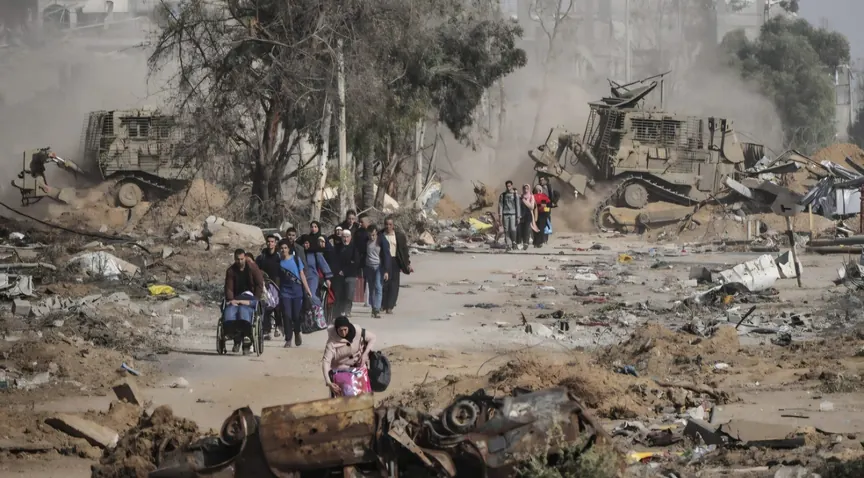
Active harmlessness is the recognition that the “enemy” is also a living system. War does not occur in isolation; it intersects with environmental, economic, and social systems. Military activity is a significant source of emissions; the destruction of infrastructure releases pollutants; the diversion of resources delays responses to the global ecological crisis. In a world already facing accelerating strain, a large-scale war between Iran, Israel, and the United States functions as a multiplier of risk. Its consequences do not remain confined; they disperse, accumulate, and return. The Vietnamese thinker Thich Nhat Hanh described this as “inter-being”—the fact that we are all part of a single, fragile fabric. To tear a hole in one part of the fabric is to weaken the whole.
Recognizing this does not eliminate the need for action. States will continue to protect their populations. The question is whether those responses reinforce existing cycles or begin to alter them. There is a narrow path between passivity and escalation—a mode of engagement that neither ignores risk nor amplifies it unnecessarily. It requires restraint, but not weakness; clarity, but not simplification. Such a path is difficult precisely because it resists extremes. It asks decision-makers to hold multiple realities at once: immediate security concerns alongside long-term systemic risks. This is the essence of refusing to inflict unnecessary injury in statecraft: the courageous choice to break the cycle of retaliation, not because one is afraid, but because one is wise enough to see where the cycle ends.
The difficulty is that such moderation runs counter to the prevailing momentum. Political systems reward decisiveness; public discourse often equates restraint with weakness. Yet history suggests that systems driven to their extremes often produce their own instability. The absence of limits is not strength; it is exposure. To reconsider this war through the lens of dynamic harmlessness and practical pragmatism is to expand the field of analysis. It is to include not only the visible elements—capabilities and alliances—but also the less visible conditions that guide their use. Without this broader view, strategy risks becoming increasingly precise in execution while remaining limited in understanding.
As the current tensions continue to evolve, the true measure of power now lies not in how far conflict can be extended, but in whether it can be consciously brought to an end. The wisdom of non-injury teaches us that victory gained through the suffering of others is a hollow seed that will only grow into future conflict. The only true security is that which is shared. In that distinction lies the difference between a system that perpetuates its own crises and one that begins, however gradually, to move beyond them. We must decide whether we will remain prisoners of our own “rational” escalations or whether we will have the strategic intelligence to choose a path that preserves the very future we claim to defend.





An eye-opener toward the metaphyisical explanation of conflicts between the humanities, however without touching upon the fact of transhistorical economic reason of disproportionate accumulation of wealth by a section of power mongers that contentiously try to open furthur space for primitive buildup leading to a conflict. A war between the countries eventually the outcome of controlling the means of production system and expantion the scope of relevant value exchange . In short, to a layman's eye, identify the real "cause" of wars bears absolutely necessity leaving behind the philosophical aspect of its "effect" in a consequent manner.
The real peril is not only in the destruction we see today, but in the lost opportunities for peace, trust, and coexistence tomorrow.
👌.