



Why humanity’s clearest insight remains structurally ignored
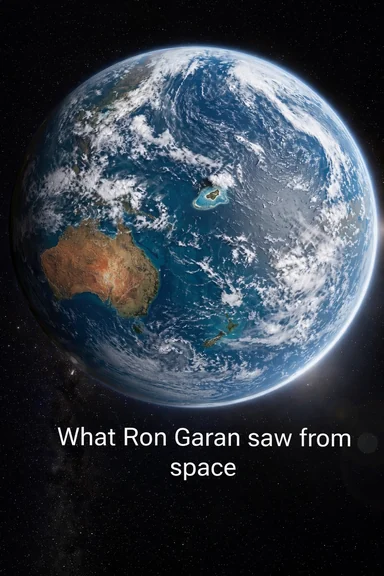
After 178 days aboard the International Space Station, astronaut Ron Garan returned with more than technical knowledge. He returned with what may be the most empirically grounded moral insight available to our species: from a sufficient distance, the divisions that organise human life disappear.
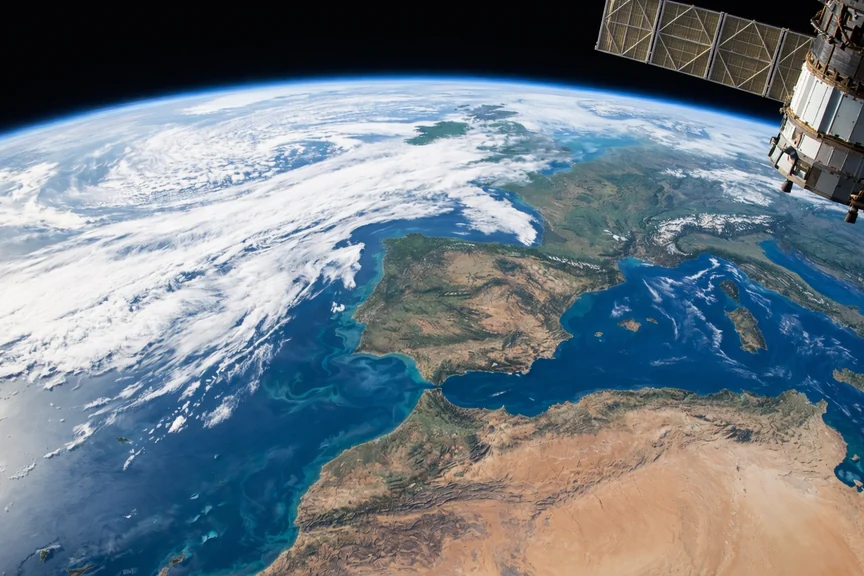
From orbit, Earth is not a geopolitical map but a single, interdependent system. Borders are invisible. Conflict dissolves into indistinction. What emerges instead is continuity of atmosphere, of oceans, of life. This is not metaphor; it is observation. And it produces what astronauts call the “Overview Effect”: a cognitive shift that reframes humanity not as competing units, but as a shared condition.
The analytical question then is not what this perspective reveals. It is why it fails to translate into behaviour on Earth.
Because the problem is no longer one of seeing. It is one of refusing to reorganise around what is already visible.
The answer lies in the architecture of our systems. In other words, the problem is not human blindness. It is institutional design.
Modern political and economic institutions are organised around fragmentation. Nation-states derive legitimacy from boundary-making. Markets reward growth within jurisdictions. Power accumulates through distinction between countries, classes and identities. In such a design, planetary cooperation is not simply absent; it is actively disincentivised.
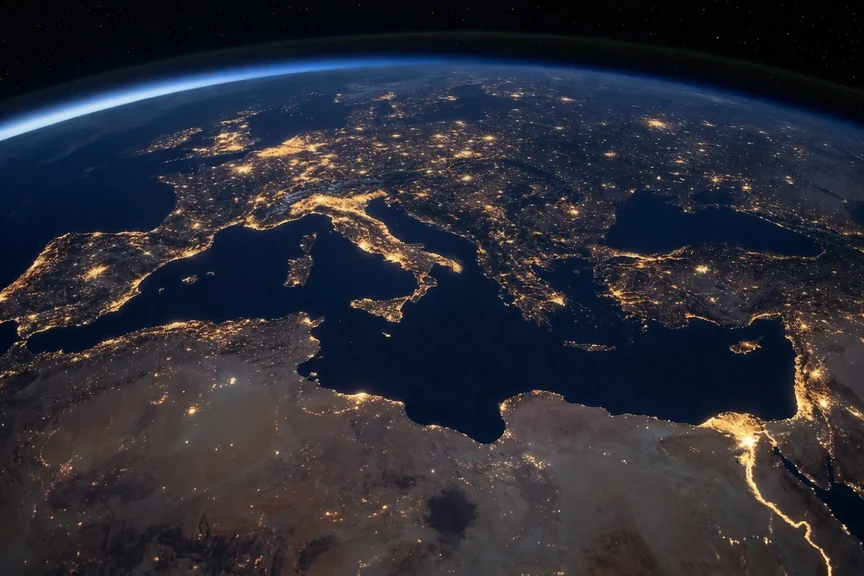
The problem, in other words, is not that we see the world incorrectly. It is that we have built systems that make acting on what we see nearly impossible. We have clarity without consequence.
This creates a structural contradiction. The biosphere operates as a single system, while governance proceeds as if it were divisible. Climate change makes this contradiction measurable: emissions are produced locally, their effects distributed globally, and accountability diluted across borders.
The costs are shared; the incentives are not. What appears from space as a unified crisis becomes on Earth a coordination failure.
A civilisation that depends on a shared system but governs through division is not merely inefficient. It is unstable.
Consider the Arctic. Its sea ice loss is accelerating due to emissions produced overwhelmingly by distant industrialised nations, yet its consequences are distributed across coastal communities, global weather systems and indigenous populations who contributed least to its cause.
Garan’s proposed hierarchy - planet, then society, then economy, is therefore not aspirational. It is corrective. It restores a dependency that current systems obscure: that economic activity is nested within social stability, which itself is bounded by ecological limits.
Remove the foundation, and the rest does not adapt. It collapses.
His metaphor of Earth as a spacecraft sharpens the point. A spacecraft is a closed-loop system. Resources are finite, margins are thin, and survival depends on collective maintenance. If even a fraction of its occupants behave as passive passengers, assuming others will manage the system, failure becomes a matter of time, not probability.
We are behaving not as crew, but as competing claimants to the same failing vessel.
Why then does the orbital perspective remain politically weak?
Because immediacy outcompetes abstraction. Human cognition privileges visible, short-term gains over diffuse, long-term risks. Electoral cycles compress decision-making horizons. Identity offers faster political returns than interdependence. In effect, the scale at which we decide remains misaligned with the scale at which we now live.
The consequences are no longer theoretical. Environmental stress compounds across regions even as responses remain fragmented. Conflicts persist, increasingly entangled with resource pressure, climate strain and inequality. The language of “us versus them” endures, even when “us” and “them” occupy the same vulnerable system.
Here the paradox sharpens into risk.
In nature, competition is bounded by ecological constraint; it rarely drives a species toward systemic self-erasure. Humanity may be the exception, not by fate, but by design. Our institutions reward behaviours that are locally rational yet globally destabilising, producing outcomes no individual actor intends but the system reliably generates.
Evolution offers no exemption. Species persist only so long as they remain compatible with their environment. If human systems continue to operate in contradiction to planetary limits, the outcome is not philosophical. It is biological.
The Overview Effect does not lack evidence. It lacks integration. We possess the perspective required to act; what we lack is the willingness to reorganise power, incentives and identity around it.
From orbit, unity is undeniable. On Earth, it remains inconvenient. But inconvenience, at planetary scale, is another name for denial.
This is no longer a philosophical failure. It is a structural risk with material consequences. A system that refuses to align with the conditions of its own survival does not persist. It corrects, often abruptly.
The choice, then, is narrower than we admit: to translate perspective into structure, or to let structure render that perspective irrelevant. Because the distance between seeing clearly and acting accordingly is not just a moral gap.
It is the space in which a species decides whether it intends to survive its own intelligence. We are not failing to understand the planet. We are organised to ignore it.


আলোচনা 1 comment