


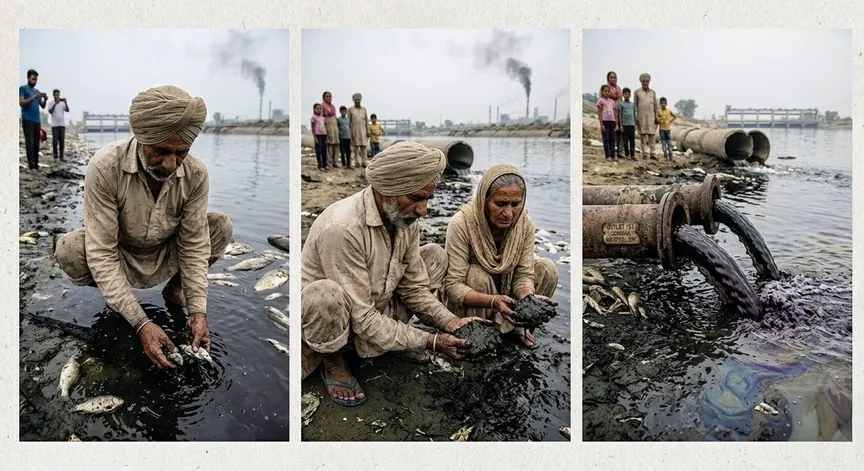
The mass fish deaths reported in the Sutlej on 4 April 2026 are not an isolated environmental mishap. They stand as a grim testimony to a terminal ecological crisis fueled by industrial negligence, the erosion of wetlands, and a growth-at-all-costs mandate. As life floats lifelessly downstream, the river offers a direct warning: the biological systems sustaining human survival are fracturing under systemic pressure.
The scene near Dina village, downstream of the Harike Headworks, was haunting. Local communities and activists gathered to document a graveyard of scales and toxic silt. Silt, the fine mud that settles on the riverbed, acts like a toxic blanket when soaked with industrial chemicals. It suffocates the microorganisms at the bottom of the food chain and coats the gills of fish so they cannot process oxygen.
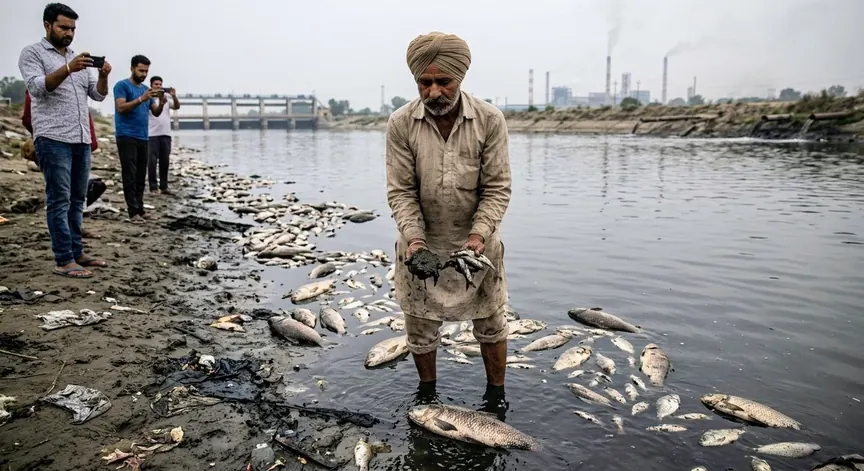
For Gurmeet Singh, a local farmer whose family has lived on these banks for generations, the sight was more than a technical failure. “We don't just see dead fish,” he noted while standing near the blackened water. “We see the death of our soil. If the water cannot sustain a fish today, how will it sustain our children tomorrow?” His words reflect a growing fear among those who see a primary source of water turning into a conduit for chemicals.
While local communities point to industrial negligence, official responses remain cautious. Wildlife Range Officer Kanwaljit Singh stated that responsibility is limited to a 500-meter zone downstream of the Harike Headworks, where no fish mortality was observed. On the regulatory front, Punjab Pollution Control Board (PPCB) Member Secretary Lavneet Dubey noted that directions had been issued to investigate the matter. Additionally, some observers noted that authorities released extra water upstream shortly after the incident—a move critics argue was an attempt to dilute the evidence and wash away the dead fish.
The history of this disaster reveals a tragic, decades-long transformation of the landscape. What was once the Buddha Dariya, a clean and natural stream, has been turned into the Buddha Nullah, an open sewer for toxic dyes and metal waste from the industrial hubs of Ludhiana. This occurred because progress was measured solely by industrial output, disregarding the river's natural regenerative capacity. Official reports from the National Green Tribunal (NGT) and the Central Pollution Control Board (CPCB) have repeatedly flagged that industrial waste containing heavy metals and city sewage are not being kept separate.
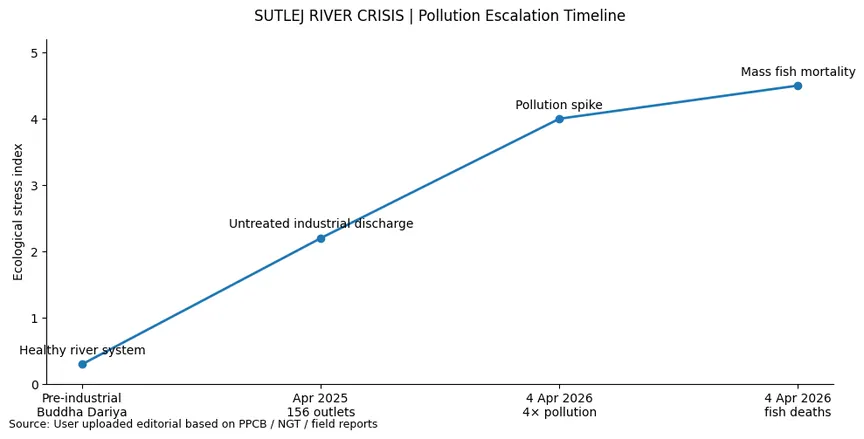
A major survey in April 2025 confirmed that 156 industrial outlets were still pouring untreated waste directly into the water. These outlets are primarily linked to the textile dyeing, electroplating, and tannery sectors clustered in the Ludhiana industrial belt. Testing by the PPCB has shown that oxygen levels in the water have dropped so low that the river is effectively dying. In scientific terms, when organic waste and chemicals flood a river, they trigger a process that uses up all the dissolved oxygen. The pollution levels recorded on April 4 were four times higher than what is considered highly polluted. At these levels, the water becomes a trap where fish simply cannot breathe.
The consequences reach far beyond the riverbanks. As the Sutlej becomes a drain, poisons soak into the deep underground aquifers that millions depend on for drinking. Furthermore, as this water irrigates the fertile heartland, heavy metals like chromium, lead, cadmium, and nickel are absorbed by the roots of plants. These toxins eventually reach the wheat and vegetables in city markets through biomagnification. To simplify, the poison becomes more concentrated as it moves through the food chain. It begins in the soil, intensifies in crops, and finally reaches dangerous levels in the people who consume them. This is a direct threat to the safety of every plate in the country.
Beyond the immediate ecological damage lies a deeper crisis in the economic model driving such disasters.
The way out of this crisis lies in the principle of Dynamic Equilibrium. It means rejecting both extremes-unchecked exploitation and complete stagnation. Instead, a balanced economic model is required where production levels are determined by the Earth’s ability to regenerate. It represents a shift away from the desire for excess toward a state of environmental stability.
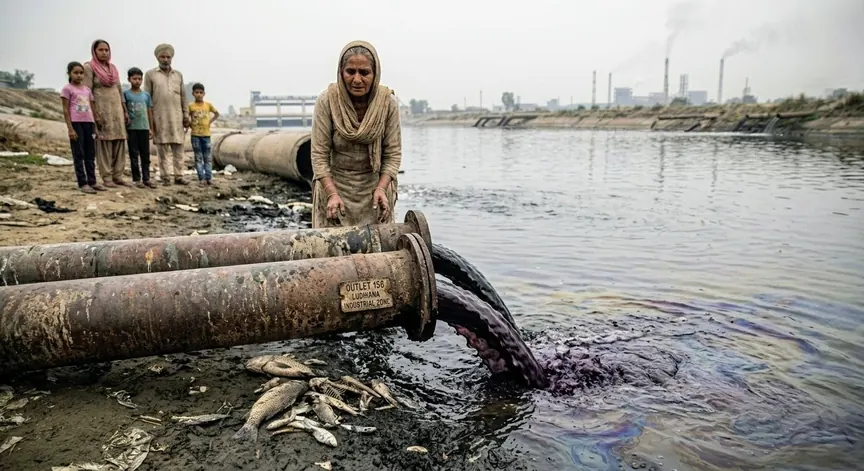
This crisis exposes an economic model that values output over life itself. In this distorted economic logic, a river is no longer treated as shared heritage. It is reduced to a free utility, drained until it is biologically bankrupt. It is a stark reminder that when the drive for excess overrides the necessity of balance, the resulting growth becomes a form of systemic poison.
A meaningful correction of this course begins with a shift in the role of society. A meaningful response requires society to move from passive consumption to active ecological responsibility. This involves demanding radical transparency regarding waste and supporting local, restorative economies. The solution rests on simplifying the demands placed on the Earth, prioritizing quality and longevity over the “cheap and fast” production cycles that fuel those 156 illegal pipes.
When requirements are simplified and the boundaries of the Earth are honored, progress is not lost. Instead, a stable foundation is gained where the water, the soil, and the human body can finally exist in a state of health. The Sutlej offers a final warning: the most profound form of abundance is found not in the accumulation of the most, but in requiring exactly what the Earth can afford to give. The true strength of a nation lies not in how much it produces, but in the quality of water, soil, and life it leaves for the next generation.


which will be unknown measures recommended will not be followed obviously because there will be nobody to monitor. The same thing happens in Delhi for Yamuna pollution every year as pollution level becomes unbearable water flow is increased from upstream to wash away the chemical foaming in top of water. We only rise to the occasion when human death starts taking place but death of fishes or verious aquatic species is a single for human beings to be aware and change the course of action. Hopefully people read these symptoms and rectify the root causes accordingly.
which will be unknown measures recommended will not be followed obviously because there will be nobody to monitor. The same thing happens in Delhi for Yamuna pollution every year as pollution level becomes unbearable water flow is increased from upstream to wash away the chemical foaming in top of water. We only rise to the occasion when human death starts taking place but death of fishes or verious aquatic species is a single for human beings to be aware and change the course of action. Hopefully people read these symptoms and rectify the root causes accordingly.