


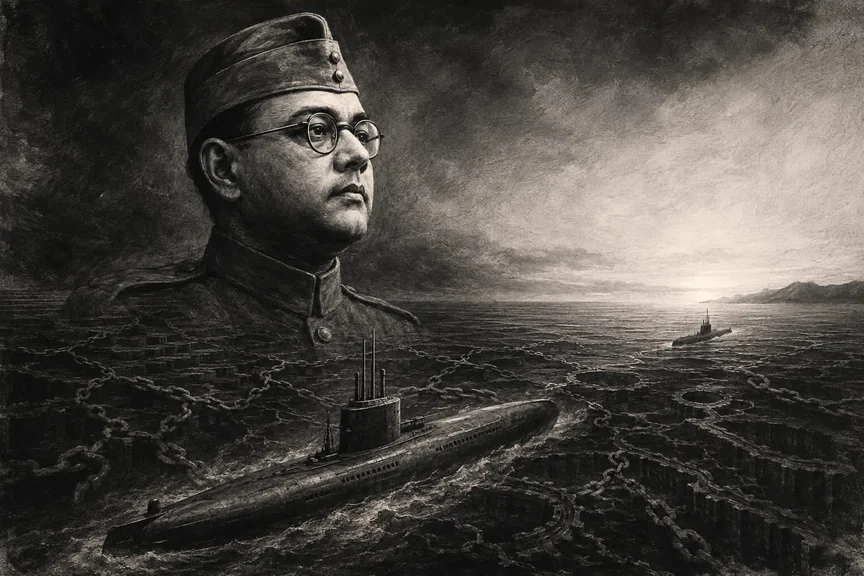
In 1943, Subhas Chandra Bose crossed enemy waters in a German submarine and transferred at sea to a Japanese one, gambling his life on an international strategy to break British rule. The voyage was an act of astonishing courage—and a warning that a just cause does not purify every alliance made in its name.
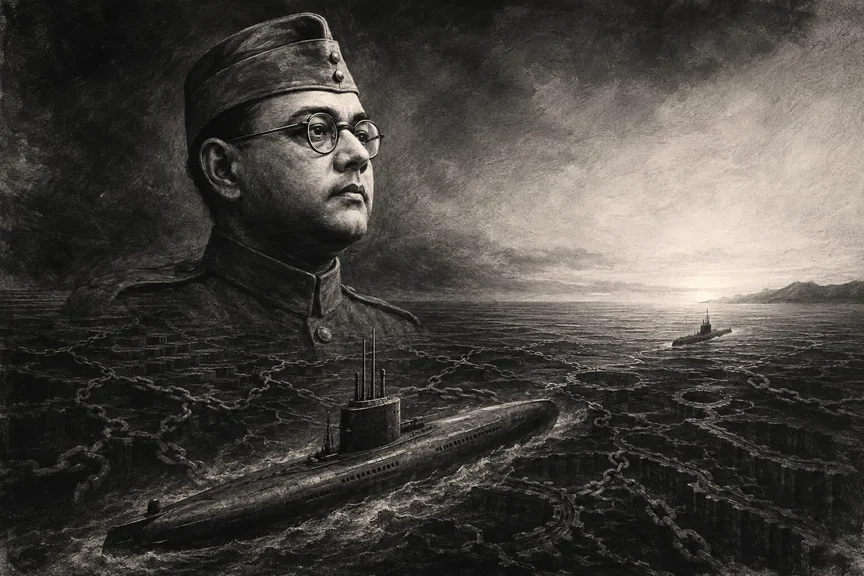
The morning after Independence Day, the flags still fly, the speeches still circulate, and the familiar names—Gandhi, Bhagat Singh, Nehru, Patel, and Subhas Chandra Bose—remain close to the national imagination. The rituals are reassuring because they turn a disputed, many-sided struggle into a memory we can share. But when the ceremonies begin to recede, some episodes refuse to become comfortable symbols. Bose’s submarine journey from Nazi Germany to Japanese-occupied Asia is one of them. It was an act of astonishing courage. It was also a political gamble conducted inside the machinery of two authoritarian empires.
On 8 February 1943, Bose and his aide Abid Hasan left Kiel aboard the German submarine U-180. Conventional routes were closed, and British intelligence was hunting him. The vessel travelled into the Atlantic, around the Cape of Good Hope, and towards the Indian Ocean. Near Madagascar, in rough seas, Bose and Hasan crossed by raft to the Japanese submarine I-29. There was no harbour, no diplomatic ceremony, and almost no margin for error. On 6 May, I-29 brought them safely to Sabang, off Sumatra.¹
The physical danger is easy to grasp. The political calculation is harder.
Bose was not merely escaping surveillance. He was trying to reach East Asia, assume leadership of the Indian National Army, build an armed challenge to British rule, and internationalise India’s struggle. In October 1943, he proclaimed the Provisional Government of Free India in Singapore.² His strategy rested on a stark proposition: Britain’s enemies could be used as temporary instruments against the British Empire.
That proposition made strategic sense to Bose. It also created the central contradiction of his legacy.
Hitler’s Germany and militarist Japan were not neutral vehicles waiting to transport Indian freedom. They were racial, authoritarian, and expansionist powers pursuing their own projects of domination. Bose entered that world because he judged the crisis of the Second World War to be a rare opening against British imperial power. That explains his choice. It does not absolve it.⁴
This is precisely where historical memory becomes dangerous when it becomes devotional.
To admire Bose’s courage does not require suspending judgment about his alliances. To condemn fascism and Japanese militarism does not require denying his uncompromising commitment to Indian independence. A serious republic must hold both truths at once. Otherwise, history becomes either worship or prosecution: the hero is made flawless, or the flawed actor is made worthless.
Bose’s journey deserves neither a patriotic fairy tale nor a moralistic dismissal. It deserves scrutiny.
Nor was the British Empire the only power against which Bose had to struggle. His re-election as Congress president in 1939 came despite Gandhi’s declared preference for Pattabhi Sitaramayya. Vallabhbhai Patel and much of the Congress establishment resisted Bose’s leadership; Govind Ballabh Pant’s Tripuri resolution effectively required his Working Committee to command Gandhi’s confidence; and Rajendra Prasad succeeded him after his resignation. Nehru’s position was more conflicted. He shared more of Bose’s socialist and internationalist vocabulary than the Congress conservatives did, and retained a personal bond with him, yet he would not follow Bose towards an alliance with the Axis. Bose’s isolation, therefore, was not merely colonial. It was produced within the national movement by competing answers to the question of how freedom should be won.⁵
He understood something that ceremonial nationalism often conceals: power is international. The British Empire did not survive by speeches alone. It rested on armies, capital, extraction, shipping routes, corporations, law and administrative institutions connecting India to distant centres of command. Bose answered an international architecture of domination with an international counter-strategy.
There was audacity in that thinking. There was also danger.
Liberation movements rarely act in morally pristine conditions. They face empires, rival states, unequal resources and brutal calculations of survival. The temptation is to believe that because the objective is just, every instrument used to reach it becomes legitimate. History proves otherwise.
A just cause does not make every alliance just.
That distinction reaches far beyond Bose. Governments invoke national security; corporations invoke investment and jobs; technocrats invoke efficiency; political movements invoke historical necessity. Each asks the public to judge a desirable end while looking away from the means, the beneficiaries and the casualties. The vocabulary changes. The political manoeuvre remains: convert power into virtue by naming its objective.
Bose’s story also unsettles the mythology of freedom itself.
Bose’s central question was: How can British imperial rule be overthrown?
Ambedkar’s deeper challenge was: What value does political independence possess if caste domination survives inside the independent nation?⁶
Independence did not arrive as a complete condition on 15 August 1947. Political sovereignty ended British rule, but freedom could never be only a transfer of authority from foreign rulers to Indian rulers. The deeper questions remained: freedom from what, freedom for whom—and freedom at whose expense?
For a Dalit, independence without freedom from caste hierarchy is an unfinished promise. For a worker, the national flag cannot substitute for a living wage, security or control over the conditions of labour. For a woman, sovereignty does not dismantle patriarchy. For an Adivasi or forest-dwelling community, development is not freedom when land, forest and consent can be reorganised around interests more powerful than their own. For a citizen, democracy is incomplete when criticism of a government is treated as hostility to the country.
The flag can represent freedom. It cannot, by itself, distribute it.
This is where Bose’s voyage becomes contemporary without ceasing to be his story. In the same Indian Ocean through which he travelled, the Great Nicobar ‘holistic development’ project is justified through security, trade, connectivity and growth. The government’s own account says the project covers 166.10 square kilometres, including 130.75 square kilometres of forest land; that up to 7.11 lakh trees may be felled; and that part of an existing Tribal Reserve is to be de-notified. It also promises green zones, compensatory afforestation, monitoring and no displacement of Shompen or Nicobarese communities.³ The particulars belong to our time, but the moral problem is the one Bose’s journey leaves us: does the declared nobility of an end settle the legitimacy of the instruments and sacrifices chosen to reach it?
It does not. Security, connectivity and employment are real concerns, just as liberation from British rule was a just cause. But a rainforest is not an inventory of trunks replaceable by plantations elsewhere, and ‘no displacement’ is too narrow a test if a community’s territory, food systems and capacity to refuse are transformed around it. The state–capital nexus needs no secret conspiracy: it operates through policy, clearance, finance, contracting and the authority to decide whose land becomes infrastructure and whose loss becomes an acceptable externality. Ecological freedom therefore belongs inside the meaning of independence. A citizen who cannot breathe clean air, drink safe water or defend the land sustaining a community possesses formal rights inside a materially shrinking world.
These are not questions against India. They are questions demanded by India.
An untethered reading of Bose refuses every ready-made camp. He cannot be imprisoned inside the heroic silhouette of the nationalist shouting slogans from history. Nor can he be reduced to the regimes whose help he sought. He must be read as a political actor under extraordinary pressure, making choices that were brave, consequential and morally dangerous. Mature memory does not choose between worship and rejection. It thinks without asking permission from either side.
The submarine offers more than a dramatic image. Inside it there was little space, limited visibility and almost no room for error. Much of modern power is organised in the same way: beneath public sight. Decisions in ministries, corporate boards, military establishments, regulatory agencies and financial institutions can reorder millions of lives before citizens encounter them as an accomplished fact.
Democracy therefore requires more than elections. It requires the political equipment to see beneath the surface.
Who designed a policy? Who financed it? Who received the concession, contract, mineral block, data, forest clearance or public guarantee? Who earns the return? Who bears the pollution, debt, surveillance, eviction or depleted aquifer? Which institutions were consulted, and which were made compliant? Whose dissent becomes disorder? Whose suffering becomes an ‘externality’?
An independent citizen asks these questions not only of an opposing party, a disliked corporation or a foreign empire, but of every institution claiming to act in the public name. Freedom is not the privilege of believing one’s own side is always right. It is the capacity to interrogate every side—including one’s own.
Bose risked his life because he believed the political structure imprisoning India could be broken. Today that structure is different. India has a Constitution, universal adult franchise, courts, institutions and formal rights. Yet freedom can still be hollowed out by caste, concentrated wealth, precarious work, captured regulation, majoritarian fear, ecological destruction and the conversion of public institutions into instruments of private or partisan power.
Colonialism was defeated. Power itself was not.
The day after Independence Day must therefore ask what the ceremonies could not settle: not only who fought for freedom, but who can actually use it. The answer will not be found in louder nationalism, grander commemorations or histories edited until they no longer disturb us. It lies in the everyday condition of people: whether they can speak, organise, dissent, work with dignity, breathe, drink clean water, protect a forest, refuse dispossession and obtain justice without first becoming powerful.
Bose crossed the Indian Ocean to change who ruled India. The political question carried through those dark waters remains alive: what must change after the rulers have changed?
Freedom is never finally won. It must be defended, distributed, deepened and ecologically secured by every generation.
Perhaps that is the most honest way to remember Netaji after the ceremonies have ended—not as a flawless monument, but as an invitation to political courage without intellectual obedience. He dared to imagine that an empire could be broken. Our responsibility is to refuse every arrangement that preserves domination beneath the language of freedom, development or national interest.
Source notes:
-
Sugata Bose, His Majesty’s Opponent: Subhas Chandra Bose and India’s Struggle against Empire (Harvard University Press, 2011); Netaji Subhas Bose historical portal, ‘Far East—Realizing the Vision.’
-
National Archives of Singapore, photographic record, ‘Proclamation of Provisional Government of Azad Hind (Free India) by Netaji Subhas Chandra Bose,’ 21 October 1943; Leonard A. Gordon, Brothers Against the Raj (Columbia University Press, 1990).
-
Press Information Bureau, Government of India, ‘Great Nicobar Project,’ 1 May 2026. The figures and the government’s stated safeguards in this paragraph are drawn from the official account.
-
For the wider moral and political controversy surrounding Bose’s wartime strategy, see Romain Hayes, Subhas Chandra Bose in Nazi Germany: Politics, Intelligence and Propaganda 1941–43 (Oxford University Press, 2011).
-
On the Congress crisis of 1939 and the political relationships among Bose, Gandhi, Patel, Pant, Prasad and Nehru, see Leonard A. Gordon, Brothers Against the Raj (Columbia University Press, 1990), and Sugata Bose, His Majesty’s Opponent (Harvard University Press, 2011).
-
B. R. Ambedkar, Annihilation of Caste, in Dr. Babasaheb Ambedkar: Writings and Speeches, vol. 1; and ‘I Yield to None in My Desire for the Freedom of This Country,’ July 1942, in Dr. Babasaheb Ambedkar: Writings and Speeches, vol. 17, part 3.




Discussion 4 comments