


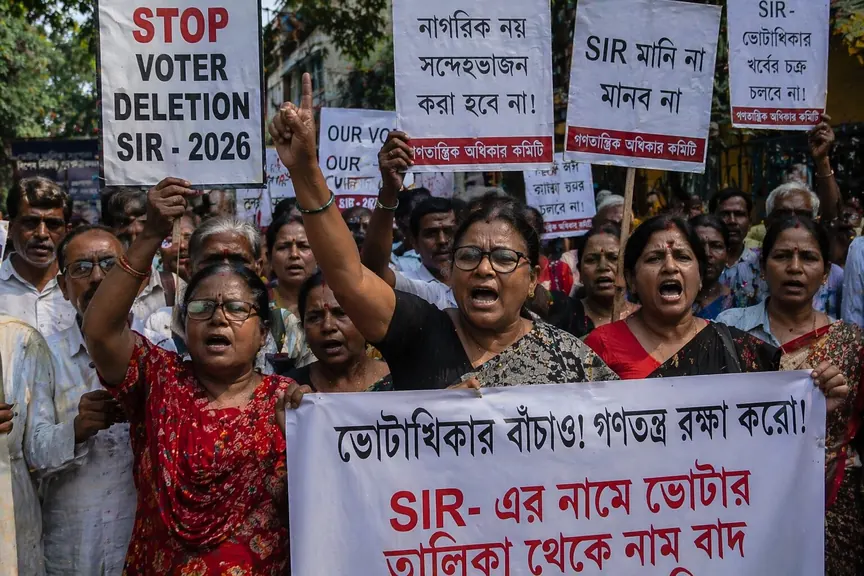
The Special Intensive Revision (SIR) 2026 has unleashed a calculated administrative crisis in West Bengal, where the fundamental right to vote is being systematically transformed into a precarious privilege. This intentional mess, marked by the removal of over 91 lakh names and the flagging of 1.25 crore records, serves as the bureaucratic machinery for a wider ideological purge. By inverting the burden of proof, the state has forced its most vulnerable citizens—from the elderly to the marginalized—into a desperate struggle to prove an identity that was once their birthright. Beneath the guise of "electoral purity" lies a dangerous design to achieve mass disenfranchisement and reshape the very soul of the Indian Republic.
The history of our democracy is currently witnessing a profound reversal. On January 26, 1950, India began a radical experiment in universal inclusion. This vision was championed by the then-ruling Indian National Congress, which, as early as the Karachi Session of 1931, called for political equality and universal adult franchise regardless of caste, creed, or gender. Leaders like Jawaharlal Nehru gave this secular vision institutional shape, while the legal and moral framework was forged by Dr. B. R. Ambedkar. Together, they ensured the state remained neutral toward all religions and focused on associating all sections of society in national development. This was a bold departure from colonial practices, granting immediate voting rights to all adults in a society marked by deep inequality.
In 2026, however, that experiment has collided with a systematic administrative machinery designed for exclusion. The autocracy of the BJP has been violently and planfully aggressive in ruining every parameter of democracy through a sequence of calculative steps and acts. This is not a matter of clerical accidents. It is a cold political project orchestrated by the Bharatiya Janata Party (BJP) to fulfill the long-standing goal of its parent body, the Rashtriya Swayamsevak Sangh (RSS). Every autocratic bill passed in recent years serves as a deliberate step to modify India into a non-secular Hindu Rashtra. Under this ideological blueprint, the BJP is working to dismantle the secular fabric of the nation to create a majoritarian polity that prioritizes Hindu hegemony.
This project is exceptionally dangerous because it replaces the "Rule of Law" with the "Rule of Identity." By treating the Constitution as a mere hurdle rather than a sacred boundary, the state is effectively deconstructing the "Idea of India" as a home for all. When citizenship is linked to faith and caste, the foundation of the Sovereign Republic cracks. It creates a permanent underclass of millions who are made to feel like "undeserved guests" in their own land. This legal and social alienation does not just hurt minorities; it destabilizes the entire nation, inviting civil unrest and shifting the state’s energy from development to policing its own people.
Central to this transformation is an illegal shift in the burden of responsibility. Historically, the Election Commission of India (ECI) was held strictly accountable for ensuring that each and every eligible citizen was included in the voter list. Today, that logic has been maliciously inverted. Under the current regime, the state has shed its accountability. Instead, the citizen is held accountable to prove their own eligibility. The common man is now forced to produce decades of legacy data to justify their right to be a valid voter.
This administrative aggression has culminated in the Special Intensive Revision (SIR) of 2026, which activists have labelled the "highest disenfranchisement in the history of the nation." Figures suggest that more than 1.25 crore voter records were initially flagged for discrepancies, and nearly 91 lakh names were eventually deleted in West Bengal alone. While the SIR in Bihar was extended to the entire country as a test case, activists suggest Bihar was merely the "dry run" and West Bengal is the "real game" for this mass disenfranchisement. Political analysts argue that the SIR is being used as a tool to “reduce the electoral weight of the States where the BJP is not sure of its support” and claim it acts as a “backdoor entry” for the controversial NRC and CAA.
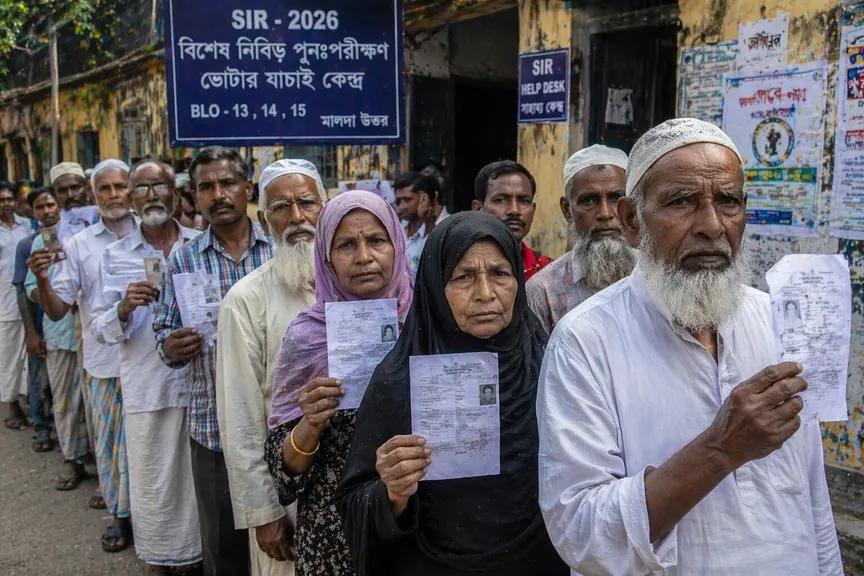
The human wreckage of this "real game" is most visible in the faces of those now treated as suspects in their own land. While Muslim-majority districts like Murshidabad, Malda, and North 24 Parganas have been hit with a disproportionate surge of "under adjudication" notices, the net of exclusion is cast far wider. This is not merely a communal exercise; it is a systematic assault on the marginal class as a whole. The Matua community, for instance- a group that has historically struggled for social and political recognition, now finds itself in the crosshairs of the very machinery they were told would protect them. By weaponizing the lack of ancestral land records and "paternal trails" common among refugee and Dalit communities, the state is effectively silencing the voices of the downtrodden.
This broad-spectrum targeting reveals the deeper ideological rot driving the SIR: a regressive belief in Manubad (Manuvadi hierarchy). Critics argue that the RSS-backed vision of a Hindu Rashtra seeks to replace Ambedkar’s egalitarian Constitution with a tiered social order where the marginalized- the Shudra and the landless- are stripped of their primary political tool: the universal franchise. By casting these citizens as "suspected," the regime is attempting to re-establish a hierarchical hegemony that prioritizes privilege over democratic equality.
The intentionality of this mess is further laid bare when contrasted with states where the ruling party is already secure. In Assam, a similar SIR resulted in 10.56 lakh deletions largely attributed to natural causes like death or relocation. Yet in West Bengal, the ECI has bypassed the natural to manufacture the artificial, weaponizing software-generated “logical discrepancies” to achieve mass disenfranchisement of loyal opposition voters- a premeditated strike designed to flip the election’s outcome. This double standard proves that the SIR is a surgical strike against democracy.
This flawed design is particularly devastating for women, who struggle to provide a "paternal trail" through decades of history, and our aged citizens. Deletion rates for women have reportedly been 7.1% higher than for men, as married women who moved villages decades ago find it impossible to produce the legacy documents the state now demands. Even the war veterans from the Kargil conflict and other highly decorated soldiers are being treated as "suspects" who must stand in long lines to defend their citizenship, and decorated soldiers like Rejanul Karim Tarafdar, who once conducted elections himself, have been forced to stand in exhausting queues to defend their right to be a voter. To tell an 80-year-old they are no longer a "valid" part of the country they built is a cruelty that no software error can justify.
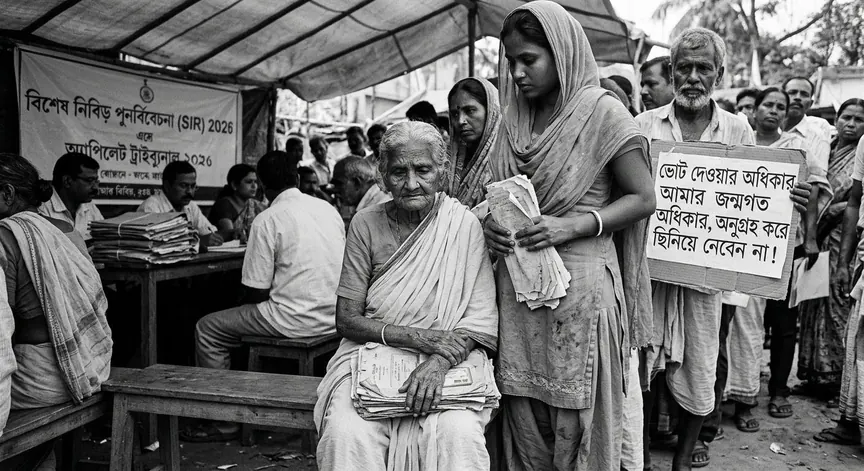
The gravity is compounded by the linkage between the CAA and the NRC, creating a tiered citizenship where the NRC acts as a sieve and the CAA as a safety net exclusively for non-Muslims. This leaves Indian Muslims uniquely vulnerable; in areas like Nandigram, as many as 95 per cent of the names deleted were Muslims, showcasing a surgical pattern of mass disenfranchisement.
Amidst this chaos, the resistance from West Bengal’s political front has reached a fever pitch. The All India Trinamool Congress (AITC), as the state's largest political force, has spearheaded a massive public and legal outcry against the SIR process. Chief Minister Mamata Banerjee’s decision to move the Supreme Court to seek judicial intervention created a colossal media hype, amplifying the fears of millions and bringing the issue to the national center stage.
While sceptics may view this as a desperate move to protect her electoral stronghold, the scale and volume of the Trinamool’s protest have undoubtedly served as a primary catalyst in exposing the SIR’s potential for electoral manipulation. Simultaneously, the Left Front has emerged as a sharp analytical voice. M. A. Baby, the General Secretary of the CPI(M), issued a formal letter to the Chief Election Commissioner (CEC) on April 9, 2026, expressing "anguish, grave concern and strong protest" regarding the Special Intensive Revision (SIR) in West Bengal. In his correspondence, he characterized the SIR as a "systematic exercise in mass disenfranchisement."
Meanwhile, the silence of our highest institutions remains deeply worrying. The Supreme Court, while directing the publication of lists, in effect told 27 lakh persons whose names were deleted that they "may not be able to vote this time." The Court focused on the administrative infrastructure of Appellate Tribunals rather than naming the act that was actually being appealed against—disenfranchisement.
The wreckage of the SIR 2026 leads to an unavoidable conclusion: this exercise is a grand "show-off"—a mask of "electoral purity" for a face of autocracy. The motive is clear: the permanent acquisition of power by paving the way for a non-secular Hindu Rashtra through mass disenfranchisement. To reclaim the Republic, the citizen must refuse to be a pawn. The Election Commission must be held accountable to the law, not the ruling party. Every Indian must be recognized as a citizen by birthright. If we do not recognize this hijacking, the Sovereign Republic will soon be a memory, replaced by a communal mold. This is the ultimate betrayal of 1950, and the darkest chapter of 2026.




Discussion 4 comments