


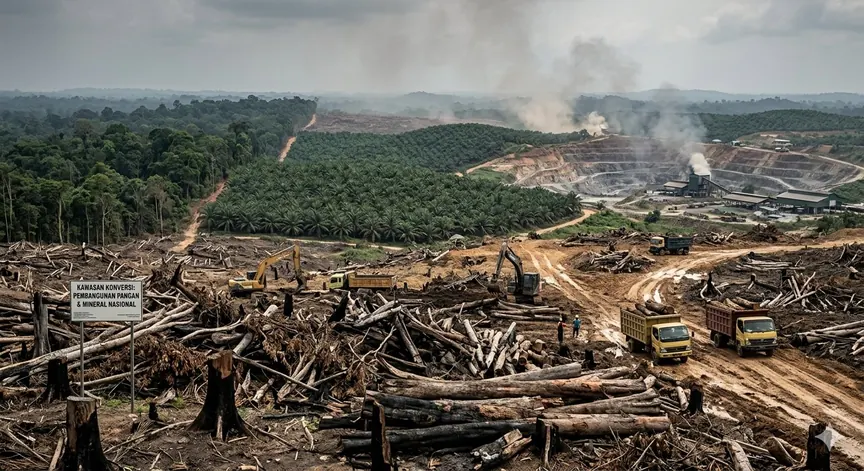
As Indonesia liquidates a decade of conservation to fuel a new era of industrial growth, the resulting 66 per cent spike in deforestation reveals a dangerous truth. A nation cannot build a secure future by destroying its own life-support systems. This surge is not progress; it is a global warning.
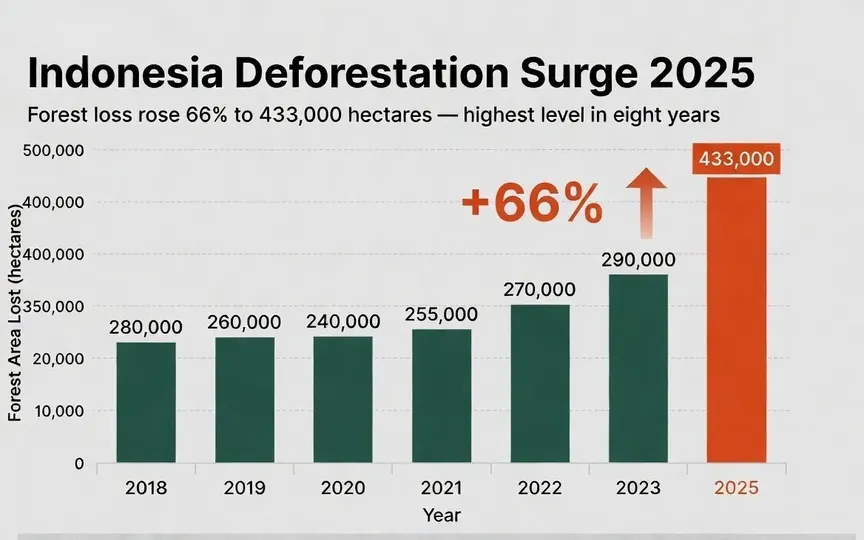
According to the latest data from Global Forest Watch and satellite monitoring reports, forest loss in Indonesia rose by 66 per cent in 2025, marking the highest level in eight years. With 433,000 hectares cleared in just one year, a figure confirmed by independent monitoring groups, this rapid ecological destruction threatens the planet’s most vital carbon infrastructure and biodiversity reserves. The scale of this loss carries consequences far beyond national borders. Indonesia’s forests act as primary biological regulators. Every hectare cleared releases stored carbon and weakens global climate regulation, proving that this is one of the most significant environmental shifts in the world today.
To understand the crisis, we must look at how it developed. For years, Indonesia was a success story in conservation after a strict 2015 ban on clearing primary forests. This progress is now being dismantled by government-led industrial control, a policy where a government takes absolute control over its natural wealth to prioritize national industry over global environmental goals. Supporters of the expansion argue that food resilience and mineral security are essential to national growth. Historically, the pressure for quick growth treats forests as "empty land" instead of essential infrastructure. This habit of chasing short-term gains has led to forests being destroyed for rice farms, mining, and palm oil expansion.
We are trapped in a vicious cycle of overlapping threats, where today’s solution is often tomorrow’s disaster. In a desperate rush for food security, we accelerate climate collapse. In the race to mine "green" minerals for batteries, we wipe out the ecosystems that regulate the very air we breathe. It is a collision of overlapping threats, where fixing one emergency simply triggers a more critical failure elsewhere. This reveals the fundamental flaw of the prevailing neoliberal paradigm: a system where timber sold is counted as "growth," while the lost oxygen, water filtration, and climate cooling are ignored as "debt." Under this logic, the environment is not a living system to be protected, but a warehouse to be liquidated for immediate market liquidity.
This is not just a local tragedy; it is a direct threat to regional stability. This vast island chain serves as the central thermal regulator for the Indian Ocean. When these forests vanish, the moisture patterns that fuel the monsoons are disrupted, and the natural cooling that regulates continental heatwaves is lost.
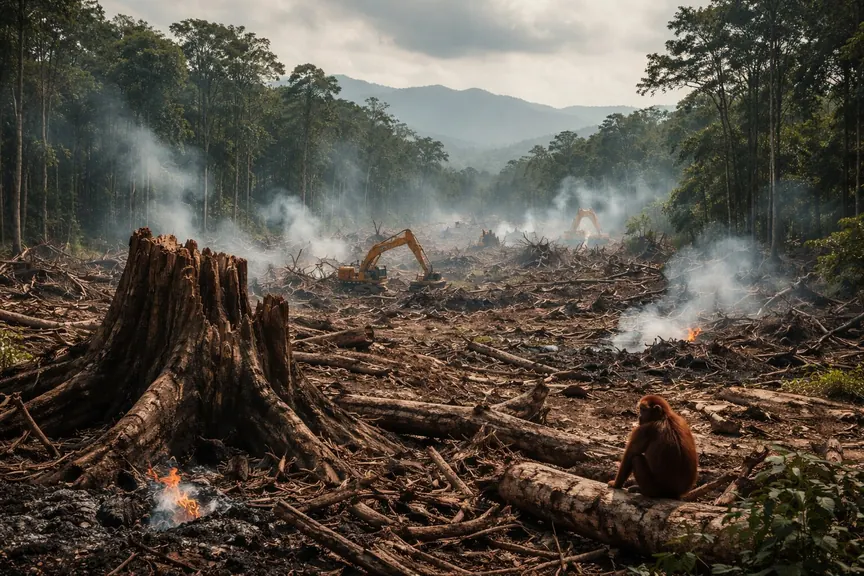
The shield is thinning.
For the common man in the Indian subcontinent, this means that the price of food and the safety of health are being decided thousands of miles away. Deforestation in Southeast Asia translates directly into failed harvests, drying wells, and heatwaves that push the limits of human endurance. We are not just losing trees; we are losing the atmospheric regulation that keeps our homes cool and our fields watered. Survival in this environment requires a disciplined rejection of extremes. It is a refusal to follow the path of endless consumption, but also a refusal to accept complete economic stagnation. By choosing this point of balance, a society can meet human needs without liquidating the natural systems that make life possible.
It is a strategic realization that true stability is found only when human progress moves in harmony with the environment. It is time to recognize that "less is more." This perspective challenges the habit of excess that defines modern development. We often think solving a national problem requires more: more extraction, more land, or more spending. But often, "less" is the true cure. By reducing our reliance on constant expansion and minimizing the poisonous excess generated through deforestation, we allow natural systems to breathe. Truly, less is more because the most sustainable damage is the destruction that never happened in the first place.
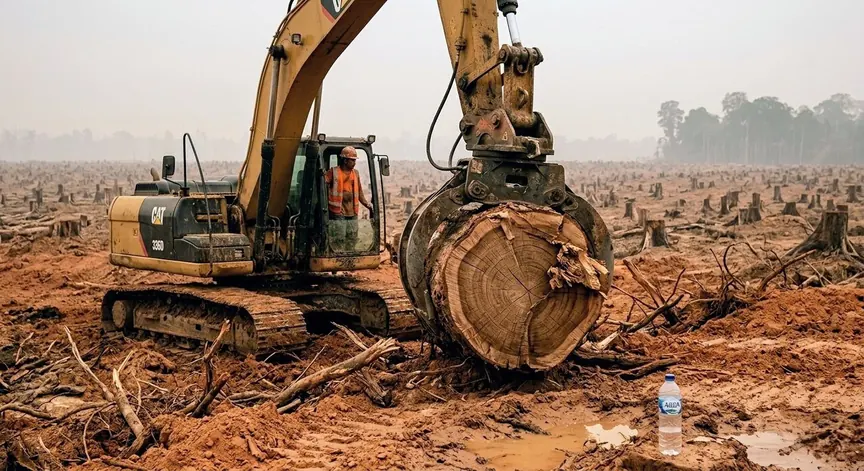
The significance of this neglect is felt in our social and intellectual lives. It challenges the old idea that nature is just a resource to be used up. We must realize that every forest, river, and wetland possesses its own inherent worth. They are not passive objects but active participants in our survival. If the environment is allowed to thrive as a living system, we, as an inseparable part of that system, will also survive. Socially and psychologically, the cost of ignoring this returns quickly as heatwaves, floods, and crop failures. These ecosystems are the very foundation of the society they serve. When the forest falls, the community follows.
This story matters now because a decade of conservation was traded for immediate industrial demands. As global temperatures rise, losing these forests removes our best shield against instability. What happens next depends on whether leaders realize that a standing forest provides more security than a stump. Without a return to protecting our living infrastructure, Indonesia risks a future crippled by the very disasters that clearing accelerates. In the end, true wealth is measured by how little a nation depends on the destruction of its own life-support systems.




My name is Eric and I’m betting you’d like your website Thedegrowth Com to generate more leads.
Here’s how:
Web Visitors Into Leads is a software widget that works on your site, ready to capture any visitor’s Name, Email address, and Phone Number. It signals you as soon as they say they’re interested – so that you can talk to that lead while they’re still there at Thedegrowth Com.
Visit https://blastleadgeneration.com to try out a Live Demo with Web Visitors Into Leads now to see exactly how it works and even give it a try… it could be huge for your business.
Plus, now that you’ve got their phone number, with our new SMS Text With Lead feature, you can automatically start a text (SMS) conversation quickly… which is so powerful because connecting with someone within the first 5 minutes is 100 times more effective than waiting 30 minutes or more later.
The new text messaging feature lets you follow up regularly with new offers, content links, even just how are you doing? notes to build a relationship.
Everything I’ve just described is extremely simple to implement, cost-effective, and profitable.
Visit https://blastleadgeneration.com to discover what Web Visitors Into Leads can do for your business, potentially converting up to 100 times more eyeballs into leads today!
Eric
PS: Studies show that 70% of a site’s visitors disappear and are gone forever after just a moment. Don’t keep losing them.
Web Visitors Into Leads offers a complimentary 14-day trial – and it even includes International Long Distance Calling.
You have customers waiting to talk with you right now… don’t keep them waiting.
Visit https://blastleadgeneration.com to try Web Visitors Into Leads now.
If you'd like to Want to receive fewer emails, or none whatsoever? Update your email preferences by visiting https://blastleadgeneration.com/unsubscribe.aspx?d=thedegrowth.com
My name is Eric and I’m betting you’d like your website Thedegrowth Com to generate more leads.
Here’s how:
Web Visitors Into Leads is a software widget that works on your site, ready to capture any visitor’s Name, Email address, and Phone Number. It signals you as soon as they say they’re interested – so that you can talk to that lead while they’re still there at Thedegrowth Com.
Visit https://blastleadgeneration.com to try out a Live Demo with Web Visitors Into Leads now to see exactly how it works and even give it a try… it could be huge for your business.
Plus, now that you’ve got their phone number, with our new SMS Text With Lead feature, you can automatically start a text (SMS) conversation quickly… which is so powerful because connecting with someone within the first 5 minutes is 100 times more effective than waiting 30 minutes or more later.
The new text messaging feature lets you follow up regularly with new offers, content links, even just how are you doing? notes to build a relationship.
Everything I’ve just described is extremely simple to implement, cost-effective, and profitable.
Visit https://blastleadgeneration.com to discover what Web Visitors Into Leads can do for your business, potentially converting up to 100 times more eyeballs into leads today!
Eric
PS: Studies show that 70% of a site’s visitors disappear and are gone forever after just a moment. Don’t keep losing them.
Web Visitors Into Leads offers a complimentary 14-day trial – and it even includes International Long Distance Calling.
You have customers waiting to talk with you right now… don’t keep them waiting.
Visit https://blastleadgeneration.com to try Web Visitors Into Leads now.
If you'd like to Want to receive fewer emails, or none whatsoever? Update your email preferences by visiting https://blastleadgeneration.com/unsubscribe.aspx?d=thedegrowth.com