



India closes the southwest monsoon with its reservoirs well below normal and its aquifers overdrawn where it matters most. The rain was short. The deeper deficit is in the way we govern water.
Ganesh Ghodake sowed cotton on his land in Kurla village, in Beed, on 8 July. By now the plants should stand about four and a half feet tall. His don’t reach his knee. Last October, floodwater carried away six acres of his farmland. This year the rain arrived a month late, in showers of ten or fifteen minutes that never got below the surface. In another Beed village, Ambesavali, the deputy sarpanch, Dhananjay Gundekar, estimates that half the residents have already left for Karnataka and Tamil Nadu to look for work. “There is no agricultural work left and no money to survive,” he told Down To Earth, whose reporter Himanshu Nitnaware documented both.
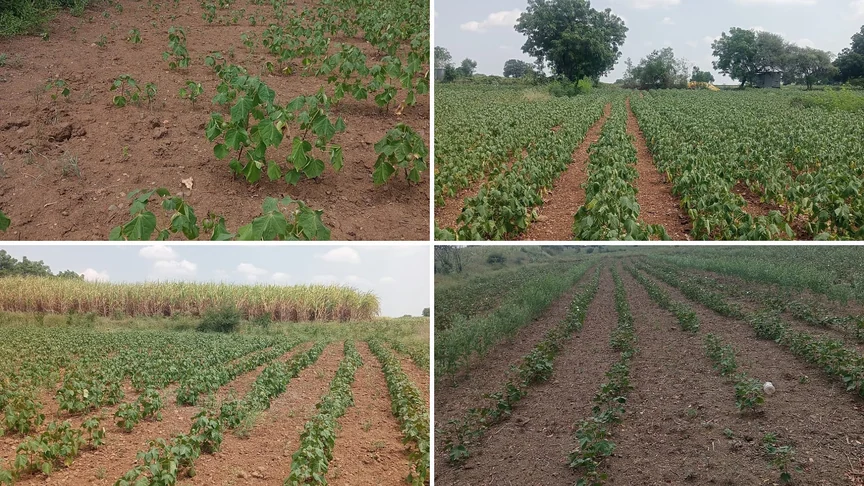
Ganesh Ghodake’s farm in Kurla village, Beed district, Maharashtra, where the cotton plants had not even reached knee height. (Courtesy - DownTo Earth)
That is what the monsoon leaves behind. As it ends, the bill has arrived.
As of 24 September, the Central Water Commission’s 178 major reservoirs held about 70 per cent of capacity, against a ten-year average of 76.62 per cent and last year’s 79. Reports describe this as a ten-year low. South India stands at roughly 50 per cent, against 87 per cent a year ago. Seasonal rainfall is 12 per cent short nationally and about 23 per cent short in the South. India has not “lost 30 per cent of its water.” It has lost margin, the strategic buffer between one monsoon and the next, and in a country that spends its buffer every year, margin is the only thing standing between a hard summer and a catastrophic one.
Where the number lands
Storage percentages don’t get thirsty. On 26 September Maharashtra declared drought in 265 of its 358 tehsils, about three-quarters of the state, after a rainfall deficit of around 18 per cent. Demand for work under the Employment Guarantee Scheme has climbed from 402,493 households in July to 493,169 in September. In Marathwada, 54 of 76 small irrigation projects were below a quarter of their capacity on 11 September. Tankers are already running: 171 of them, government and private, were supplying 94 villages across four districts, 70 tankers in Beed alone. A farmer in Kumshi told Down To Earth that his village had never seen tankers in August or September before.
The reservoir figures hold a quieter warning. Storage across Gujarat, Maharashtra and Goa is still near 85 per cent, and yet three-quarters of Maharashtra is in drought. Water behind a dam is not water in a field or at a tap. Every question in this piece is about who ends up at the back of that queue.
The rain is the alibi
A weak monsoon is a convenient culprit. It is also the least interesting one.
India pulls 247.22 billion cubic metres from the ground every year, and 215 billion of that, 87 per cent, goes to irrigation. Of 6,762 assessment units, 730 are over-exploited. That is 10.8 per cent, down from 17.2 per cent in 2017, a real gain that recharge work deserves credit for. But the hotspots are stubborn, concentrated in the northwest, the west and the South, where this year’s rain has failed hardest. Groundwater is the country’s true reservoir, drawn on without a bulletin and without a budget. Rainfall decides how much water arrives. Cropping patterns, power tariffs, procurement and concrete decide how much is still there when it matters.
Follow one raindrop to see the whole system. It falls on a catchment, and if the forest or wetland there has been cleared, it runs off instead of soaking in. It reaches a river that industry and cities are already claiming. It fills a reservoir already drawn down by irrigation demand. The fraction that reaches an aquifer meets a pump running on cheap or free electricity, feeding a crop the state has promised to buy. At every step a policy decides, and the drop never gets a vote. A shortage that passes through these many decisions is a design.
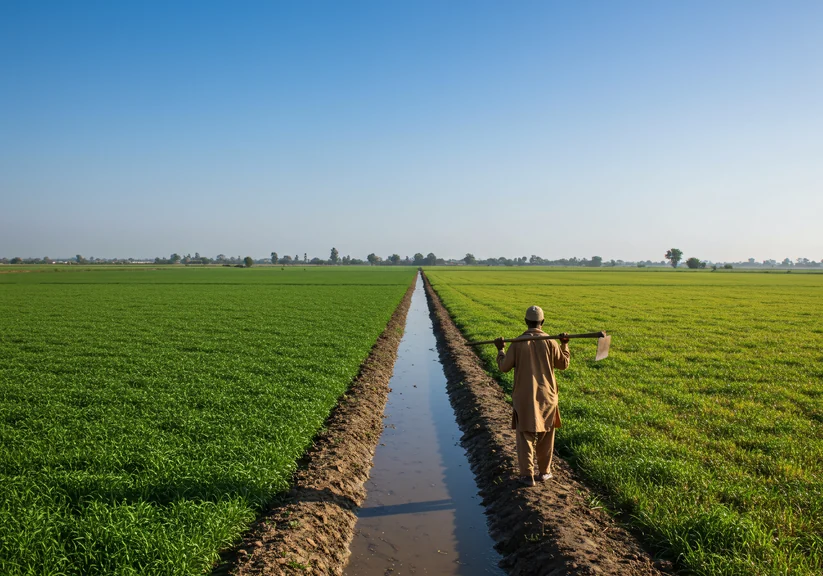
Symbolic Image By - Alfian Antono
The city that floods and dries at once
Gurugram has brought this contradiction before the Punjab and Haryana High Court, in Sunil Singh v Ministry of Environment & Forests. The Court has recorded that the city faces a persistent shortage of drinking water, that groundwater has been falling for decades under indiscriminate borewell use, and that monsoon waterlogging is not being put to work replenishing the aquifer. It has summoned the Deputy Commissioner and the heads of the civic bodies to answer. The same city floods and thirsts because rain that lands on sealed ground, built-over wetlands and blocked drains never becomes recharge. It becomes a flood in August and then a tanker bill by May, and the two are the same failure of design seen in different months, each paid for by residents who never chose either.
Farmers are not the villain
With irrigation taking 87 per cent of extraction, it is tempting to point at the field. That gets the story backwards. Farmers respond to what the state makes rational: assured procurement for water-hungry crops, cheap or free power for pumps, canals that reward those already at the head. Telling farmers to use less while leaving that machinery untouched is a way of billing the powerless for the choices of the powerful.
Climate is a multiplier, not a defence
Warming sharpens rainfall variability, heat and drought risk, and a strengthening El Niño is part of this year’s story. But wetland fills, sewage in rivers, floodplain townships and mined aquifers are decisions made in land-use offices and cabinet rooms, and they would be decisions with or without a changing climate.
What the dry season must demand
The months between monsoons are the only window in which policy can move faster than the next crisis. So the demands should be specific, and they should be addressed to someone.
To the Ministry of Jal Shakti and the Central Ground Water Authority: make the groundwater assessment binding. Where a unit is classed over-exploited, new extraction permissions, industrial and agricultural alike, should stop until recharge is demonstrated, with the data public and published unit by unit.
To state governments and electricity boards: reprice farm power and tie subsidy to water-efficient cropping, but pair it with assured procurement for less thirsty crops, so that farmers are offered a safe alternative before they are asked to change. Reform without an alternative is punishment.
To municipal bodies and state planning departments: treat wetlands, natural drains and catchments as protected water infrastructure, off-limits to clearance. Any project that seals recharge land should have to replace that capacity in kind.
To the courts: let the Gurugram proceedings set a standard rather than become a footnote. Make recharge and drainage enforceable conditions of urban permission across the region.
And to every public utility: publish treated-wastewater reuse targets with dates, and report progress the way we report reservoir levels.
The reckoning
India’s ecological crisis begins where its accounting ends. Extraction is booked as growth, and depletion is postponed into someone else’s future, usually someone poorer, younger or downstream.
The monsoon has left. The water crisis has not. What we do before the next rains will show whether we heard a warning about rainfall, or an indictment of a system that spends the future to fund the present.
Sources:
-
NEXT IAS, “India’s Reservoir Storage At 70%: At 10-Year Low,” 29 September 2026. Summarises the Central Water Commission live reservoir storage report dated 24 September 2026 (storage, ten-year average, regional figures, rainfall deficits), crediting the Indian Express. https://www.nextias.com/ca/current-affairs/29-09-2026/india-reservoir-storage
-
WION, “Maharashtra declares drought in 265 of 358 tehsils, covering three-fourths of state,” 26 September 2026. https://www.wionews.com/india-news/maharashtra-declares-drought-in-265-of-358-tehsils-covering-three-fourths-of-state-1790410799492
-
United News of India, “Maha declares drought in 265 tehsils across nearly three-fourths of state,” 26 September 2026. https://www.uniindia.com/west-india/weather-maha-drought/193387
-
Down To Earth, “Maharashtra earmarks Rs 6,728 crore for rural employment as drought grips nearly three-quarters of state,” September 2026. Source for the 18 per cent rainfall deficit and Employment Guarantee Scheme demand. https://www.downtoearth.org.in/climate-change/maharashtra-earmarks-rs-6728-crore-for-rural-employment-as-drought-grips-nearly-three-quarters-of-state
-
Himanshu Nitnaware, Down To Earth, “Twin crises in a year: Drought forces families to leave Maharashtra’s Beed district, months after devastating floods,” 28 September 2026. Source for the accounts of Ganesh Ghodake, Dhananjay Gundekar and the Kumshi farmer, the tanker counts and the 11 September irrigation storage data. https://www.downtoearth.org.in/climate-change/twin-crises-in-a-year-drought-forces-families-to-leave-maharashtras-beed-district-months-after-devastating-floods
-
Press Information Bureau, Ministry of Jal Shakti, “Dynamic Groundwater Resources Assessment, 2025.” Source for extraction of 247.22 BCM and the fall in over-exploited units from 17.2 to 10.8 per cent between 2017 and 2025. https://www.pib.gov.in/PressReleasePage.aspx?PRID=2220203®=3&lang=1
-
Press Information Bureau, Ministry of Jal Shakti, “Groundwater Depletion, Over-Exploitation and Quality Monitoring,” 15 December 2025. Source for 730 of 6,762 assessment units classed as over-exploited. https://www.jalshakti-dowr.gov.in/static/uploads/2025/12/5f947a1239dbd77322a75e36c4a0a186.pdf
-
Press Information Bureau, Ministry of Jal Shakti, “Findings of Dynamic Groundwater Resources Assessment,” 18 December 2025. https://www.pib.gov.in/PressReleasePage.aspx?PRID=2206073®=3&lang=1
-
ANI, “India’s groundwater extraction at 60.63%; 281 districts above national average, Jal Shakti Minister says in Parliament,” 10 August 2026. Source for the 215 BCM (87 per cent) irrigation share of extraction. https://aninews.in/news/national/general-news/indias-groundwater-extraction-at-6063-281-districts-above-national-average-jal-shakti-minister-says-in-parliament20260810202136/
-
LiveLaw, “Gurugram Facing Persistent Water Crisis, Rainwater Not Used Effectively: P&H High Court Seeks Remedial Measures, Summons Deputy Commissioner,” 28 September 2026. https://www.livelaw.in/high-court/punjab-and-haryana-high-court/punjab-haryana-high-court-seeks-remedial-measures-summons-dc-gurugram-facing-persistent-water-crisis-552030
-
Bar & Bench, “Punjab and Haryana High Court calls for aggressive measures to tackle Gurugram water crisis,” 26 September 2026. Source for the case title, Sunil Singh v Ministry of Environment & Forests. https://www.barandbench.com/amp/story/news/punjab-and-haryana-high-court-calls-for-aggressive-measures-to-tackle-gurugram-water-crisis
-
The Week, “How groundwater extraction for export crops is draining Bundelkhand’s poorest villages,” 29 May 2026. Source for the link between subsidised pump electricity and agricultural groundwater extraction. https://www.theweek.in/news/india/2026/05/29/how-groundwater-extraction-for-export-crops-is-draining-bundelkhands-poorest-villages.html

Discussion 1 comment