


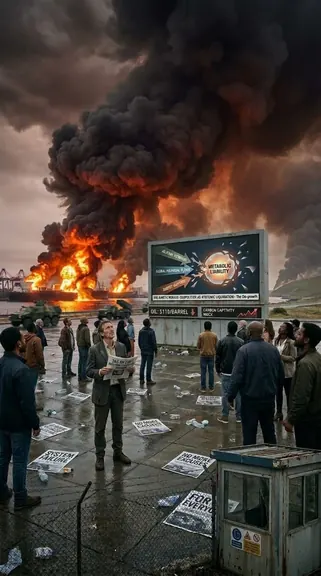
The world rarely announces its turning points in advance, but it often misinterprets them when they arrive. As the confrontation between Iran, Israel, and the United States transitions from a shadow war into an overt theater of attrition, the international press has retreated into its traditional fortress of terminology: "strategic triangles," "escalation logic," and "supply chain vulnerability." They observe the Strait of Hormuz and the psychologically significant $110-per-barrel mark as the primary stressors of a "World on Edge." Yet, this analysis remains a sophisticated distraction. By framing this crisis solely through the lens of energy prices and military retaliation, the global media houses are participating in a grand technocratic deception. They treat the global order as a series of abstract lines and market graphs, willfully ignoring that the current escalation is not an isolated struggle for power. It is a convergent collapse—a moment where the bankruptcy of the global financial architecture, the terminal exhaustion of the biosphere, and the madness of the military-industrial complex have fused into a single, inescapable Metabolic Liability.
The "invisible hand" of energy is no longer shaping political decisions; it is strangling the possibility of a sovereign future. International standard reporting laments that a world heavily dependent on fossil fuels remains "hostage" to instability, yet they fail to identify the captor. We are witnessing the peak of Carbon Captivity, where the survival of a population—and the very legitimacy of the state—is artificially tethered to the volatile flow of crude. In this theater, the unconditional endowment of the Earth—its very geological and atmospheric integrity—which the strategic and economic discourses that rule these global summits (unfortunately) consider to be (merely) a theater for extraction and a target for destruction—remains the fundamental, ignored victim. When the media calculates the "tax on global growth" caused by Gulf instability, they are performing an accounting of the void. They ignore the Architecture of Silence—the reality that every missile strike is not just a tactical move, but a permanent assault on the physical integrity of the habitat itself. The "humanitarian emergency" we see in the rubble of Lebanon or the protests in Tehran is the physical evidence of Habitational Sovereignty being liquidated to fund a kinetic mirage. What makes this moment particularly perilous is the total loss of Sovereign Equilibrium. The post-Cold War order, built on the "Illusion of Infrastructure" and the assumption of interdependence, has no mechanism to account for the Proportional Integrity of life. Traditional mediators remain fragmented because they are trapped in a Technocratic Trap, attempting to solve a systemic shock with the same unilateral power politics that triggered the conflagration. They speak of "de-escalation" while their domestic industries profit from the very defense spending they claim to regret. This is the Funding Paradox of modern war: the actors accustomed to brinkmanship are the same ones tasked with prioritizing stability. We are seeing the limits of a system that views stability as a "contested outcome" to be achieved through the victory of one side over another, rather than a shared metabolic requirement. This is the logic of the vacuum, where every action is a reaction, and every reaction is a step closer to a wider conflagration that no one truly desires but everyone is structurally programmed to accelerate.
To frame this crisis solely in terms of oil prices or strategic calculations would be to miss its most urgent dimension. Beneath the abstractions of policy and power lies the rapidly deteriorating metabolic persistence of the region. As strategic infrastructure—ports, energy facilities, transport corridors—comes under threat, the "Tax on Global Growth" is revealed to be a tax on life itself. Governments from Japan to Europe are considering emergency measures, including the release of strategic reserves, yet such interventions are, at best, temporary buffers against a structural rot. The deeper issue is that a world hostage to geopolitical instability is a world that has forgotten the unconditional nature of its foundation. We have allowed the "invisible hand" of the market to become a "visible fist" of the state, and in doing so, we have sacrificed the long-term innovation and growth of our civilizations for the short-term advantage of the bunker.
Beyond the immediate theater of war, the ripple effects are already reshaping global priorities in a way that further deepens our collective liability. Defence spending is rising, alliances are being recalibrated, and supply chains are once again under the forensic scrutiny of "security." At the same time, the crisis is accelerating a shift where governments divert resources away from the essential preservation of the habitat and toward the preservation of the machine. This is the ultimate "Systemic Shock." As investment patterns change, they create long-term implications for the very innovation we need to escape our Carbon Captivity. We are building a world that is technologically advanced in its ability to destroy, but primitive in its ability to sustain. The post-Cold War order, once built on assumptions of institutional cooperation, now appears as a fragile mask for a landscape where unilateral actions and power politics have regained their brutal prominence.
For a nation like India, the implications are particularly complex and demand a departure from the "International Standard" response. As a major energy importer with strategic ties across the Middle East, India finds itself navigating a delicate balance. However, the true challenge lies not just in responding to the immediate crisis of rising oil prices, but in anticipating the longer-term consequences of a world that has lost its balance. True leadership in 2026 requires a forensic rejection of the "A World on Edge" narrative. It requires the courage to forge The Integral Axis—a refusal to be pulled into the binary of retaliation, choosing instead to anchor the state in the metabolic preservation of its own people and their environment. This is not a position of passive compromise; it is a centered persistence that neither yields to aggression nor participates in the cycle of destruction. It is the recognition that the only true sovereignty is that which can be sustained without the liquidation of the future.
History also shows that moments of acute crisis can catalyze breakthroughs—if the political will to rethink the underlying dynamics exists. De-escalation will require more than just negotiations; it will demand a rethinking of the very concept of "Resource" and "Security." It will demand restraint from actors accustomed to brinkmanship and leadership willing to prioritize the habitat over the headline. For now, however, the trajectory is deeply concerning. The convergence of military escalation, economic disruption, and humanitarian distress creates a volatile mix with no easy resolution. We must stop burning the ground we stand on to protect the pipelines that lead to nowhere. Clarity in these times is essential. The stakes are not confined to any single region or actor. What unfolds in the coming weeks will shape not only the future of the Middle East, but the resilience of the global habitat itself. The world is not merely witnessing another regional conflict; it is confronting a systemic choice between the mirage of power and the reality of survival. The window for this course correction is narrow, and the horizon remains dangerously uncertain.



Discussion 3 comments