



In the semi-arid heartland of Bundelkhand — a plateau straddling Madhya Pradesh and Uttar Pradesh, scarred by fifteen failed monsoons since 2000 and chronic farmer suicides — the Indian government has staked its most ambitious water bet yet. Ken-Betwa Link Project (KBLP), conceived in 1995, formally approved in 2021 at Rs 44,605 crore ($5.3 billion), and launched with fanfare by Prime Minister Modi in Khajuraho on 25 December 2024, is more than an engineering scheme. It is India’s inaugural river interlinking project — a blueprint, if it succeeds, for 30 more such links under the National Perspective Plan [Rau’s IAS, 2024; PWOnlyIAS, 2024]. If it fails — ecologically, hydrologically, or socially — the failure will be written in forests, in displaced lives, and in rivers permanently altered.
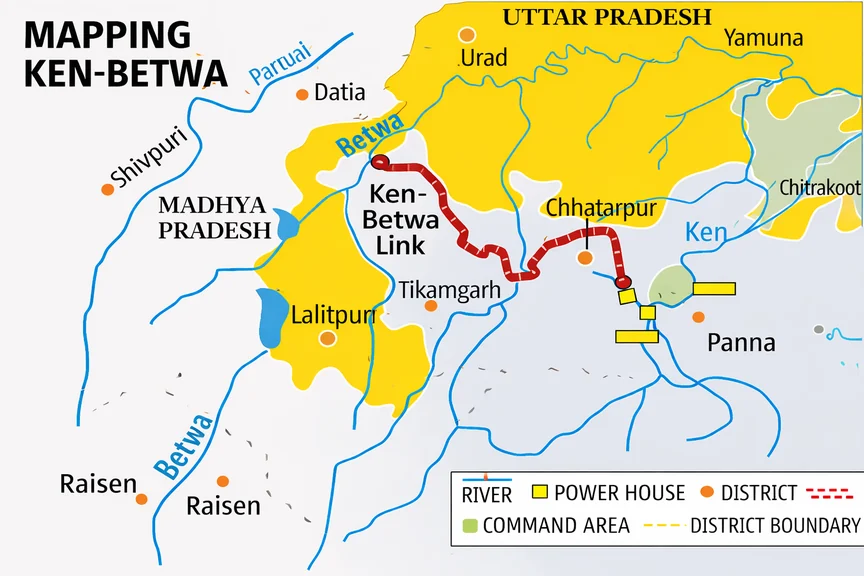
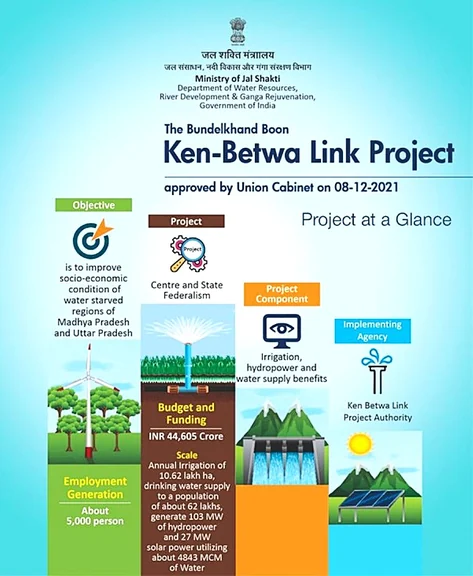
The project’s logic is deceptively simple: the Ken River in Madhya Pradesh has “surplus” water; the Betwa, running into Uttar Pradesh, does not. A 77-metre Daudhan Dam will be built on the Ken inside the Panna Tiger Reserve, and a 221-km canal will carry the diverted flow to the Betwa basin. Official projections are substantial: irrigation for 10.62 lakh hectares across ten districts, drinking water for 62 lakh people, and 103–130 MW of hydropower, with completion expected by 2033 [NextIAS, 2025; Down to Earth, 2024].
A Surplus That May Not Exist
Before a single canal is dug, the project’s foundational premise deserves scrutiny — and that scrutiny is damning.
Himanshu Thakkar, coordinator of the South Asia Network on Dams, Rivers and People (SANDRP) and a former member of the Ministry of Water Resources’ own expert committee, puts it bluntly: “There is no justification for the project, not even hydrological justification. To begin with, the Ken does not have surplus water” [SANDRP, 2024]. More alarmingly, when Thakkar requested the hydrological data underpinning this claim, he was told it was classified — because the Ken is part of the Ganges basin, classified as an international basin, making its flow figures a “state secret” [Dialogue Earth / The Third Pole, 2024].
Ravi Chopra, founder of the People’s Science Institute, adds a geographic argument that is hard to dismiss: the Ken and Betwa basins are adjacent. They share similar weather patterns. They experience droughts and floods simultaneously. Calling one “surplus” and the other “deficit” is, in this context, scientifically meaningless [Countercurrents, 2024]. A former Panna district collector made the same point in official correspondence: the Ken appears water-rich at Daudhan primarily because the upper basin has not yet developed its own water infrastructure — and the project, paradoxically, would lock in that underdevelopment permanently [SANDRP, 2017].
Shashi Shekhar, former Secretary of the Ministry of Water Resources, was equally direct at a 2025 public forum in Delhi: “They have justified it by manipulating data. If you consider the correct data, the ground reality and ecological factors, this project should not have gone through”. He also added, “The claim of irrigation over more than one million hectares is a number pulled out of thin air. And was any alternative arrangement ever considered? His answer: ‘As far as I know, there was no discussion about alternatives.” [SANDRP, 2025]. Critically, Thakkar has pointed out that the project’s own Detailed Project Report admits its primary beneficiary is not Bundelkhand at all, but the upper Betwa districts of Vidisha and Raisen in Madhya Pradesh — which are neither the poorest nor the most drought-stricken areas in the region [IndiaSpend, 2021].
Panna: A Conservation Success Story Under Threat
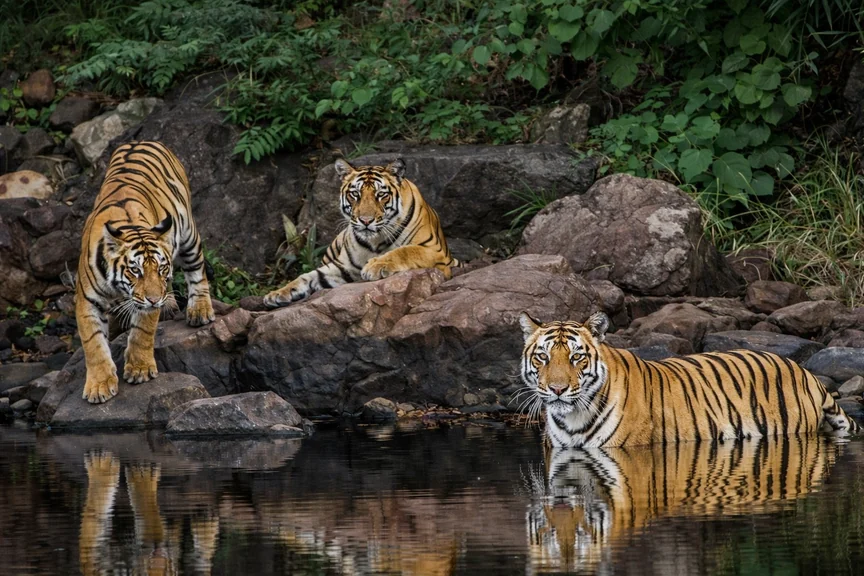
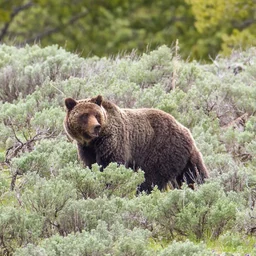
If the hydrology is contested, the ecology is not. The Daudhan Dam reservoir will submerge over 6,000 hectares — more than 10% of the core area — of the Panna Tiger Reserve [Anantam IAS, 2025]. This is the same reserve whose tiger population was completely wiped out by 2009, only to be brought back through a landmark reintroduction programme that is now celebrated globally as one of conservation’s great recoveries. Panna today has 65–90 tigers, including cubs [The Wildlife India, 2021; BusinessToday, 2024].
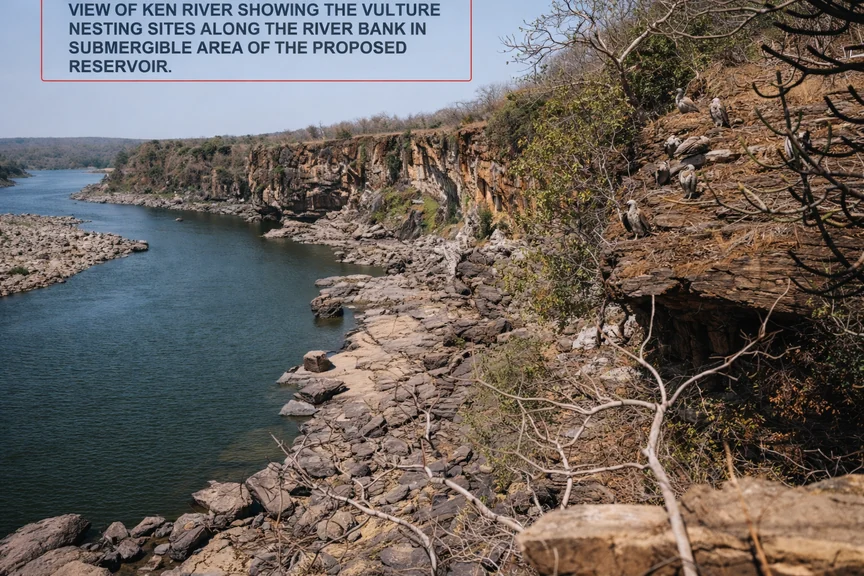
Congress MP Jairam Ramesh, on the day Modi laid the foundation stone, called the project “a serious threat to the biodiversity-rich Panna Tiger Reserve,” noting that not only tiger habitat but vulture colonies, gharials, and over 400 plant species would be lost, and that more than 23 lakh trees would be felled [BusinessToday, 2024]. The National Tiger Conservation Authority (NTCA) itself has raised concerns about forest degradation and prey scarcity as construction-related road-cutting began in March 2025, already triggering herbivore migrations northward and driving monkeys and birds from the affected zones [Drishti IAS, 2025].
By mid-2025, the Madhya Pradesh government was quietly preparing to relocate tigers from Panna to newly declared Sarbhanga and Parsamaniya Conservation Reserves — reserves that are not yet ready to receive them, lack sufficient prey bases, and have not completed community consultations [Prakriti Darshan, 2025]. The question conservation biologists are asking is a stark one: why was the dam site not re-aligned to avoid the reserve entirely? That alternative was apparently never seriously considered [Prakriti Darshan, 2025].
The project’s Environmental Impact Assessment (EIA), the document that should have answered such questions, has been widely condemned. SANDRP’s review found it listing mammal species — including a pangolin variety not found anywhere in India — that have never been recorded in the area. It listed tourism activities like boating and picnicking inside a protected area where such activities are legally prohibited. A letter signed by 30 experts and former officials, including a former Forest Advisory Committee member and a former Water Resources Secretary, described the EIA as “plagued by sloppy, intentionally misleading and inadequate impact assessments, procedural violations and misinformation at every step of the way” [SANDRP; Countercurrents, 2024].
Displacement and Resistance
The human cost falls almost entirely on those with the least power to resist. Twenty-four villages are directly affected; eight will be submerged entirely. Estimates suggest between 5,000 and 10,000 families — predominantly Gond, Kol, and Sahariya Adivasis — face displacement, their livelihoods rooted in mahua flowers, tendu leaves, river fisheries, and forest produce that cannot be relocated to a resettlement colony [NewsGram, 2026; TwoCircles, 2025].
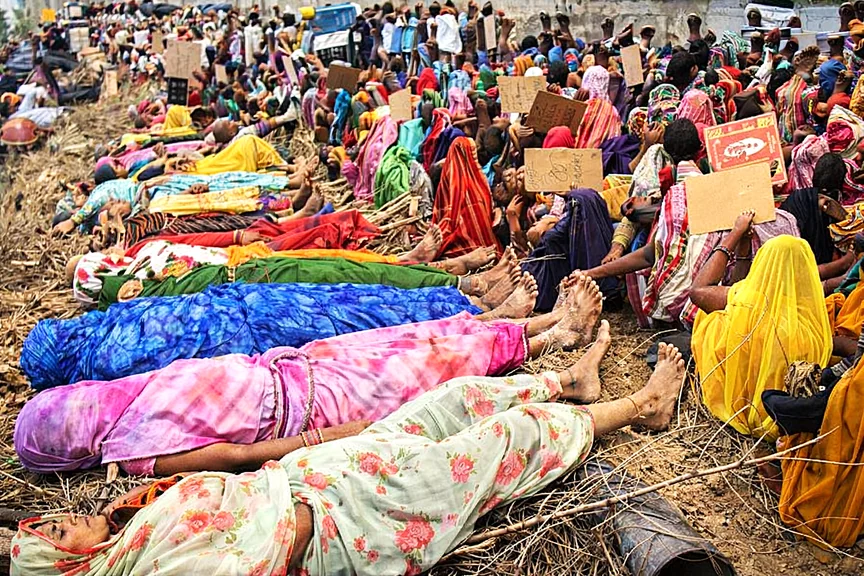
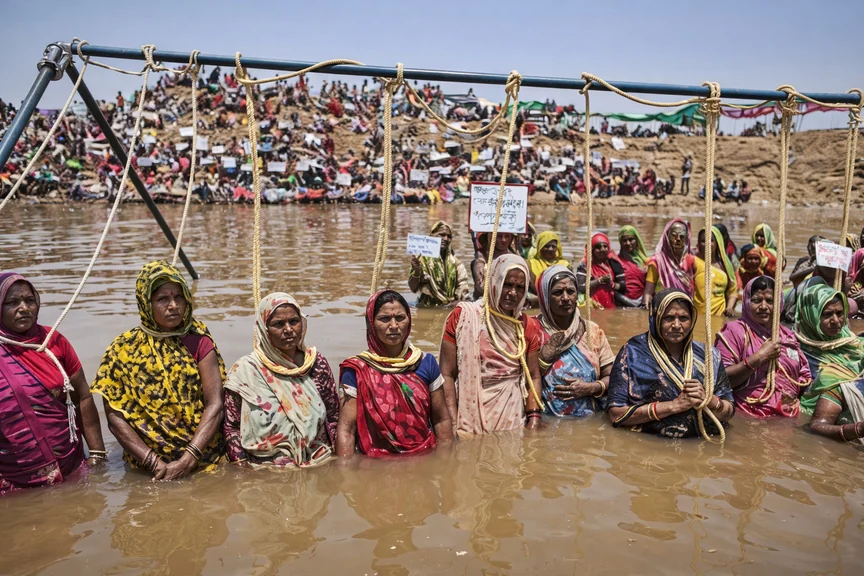
What began in 2023 as petitions and objections has become, by April 2026, one of the most sustained acts of civil resistance in contemporary India. Hundreds of tribal women have stood chest-deep in the Ken River in the “Panchtatva Movement” — to express their inseparable bond with water, soil, air, fire, and sky — invoking the five sacred elements — while tribal families staged the “chita andolan,” laying on symbolic funeral pyres before construction machinery, led by activist Amit Bhatnagar of the Jai Kisan Sangathan [ANI, 2026; Free Press Journal, 2026]. For them, eviction and death mean the same thing. By day eleven of continuous protest, with over 5,000 people gathered in Chhatarpur in direct sunlight, no government official had visited the site [ANI, 2026].
Their demands are specific and constitutional: fair compensation, genuine gram sabha consent as required under the Forest Rights Act, and independent review of the project’s legal and hydrological basis. The Madhya Pradesh High Court has issued relevant rulings on forest rights that the project administration has yet to implement [Down to Earth, 2026]. The National Green Tribunal (NGT) accepted SANDRP’s petition challenging the environmental clearance in 2017; it remains pending [IndiaSpend, 2021].
What Bundelkhand Actually Needs
There is no shortage of alternatives — only a shortage of political will to pursue them. Bundelkhand’s traditional water systems — the johads (earthen check dams), step-wells, and tank networks — once sustained the region through far worse droughts. Tikamgarh district alone had a thousand ponds barely four decades ago [SANDRP, 2024]. Watershed restoration, rainwater harvesting, and soil health programmes can deliver water security at one-tenth the cost of mega-engineering, without displacement, without deforestation, and without gambling a tiger reserve on contested hydrology [Drishti IAS, 2019].
The Ken-Betwa project will be built — or it will not. But the communities standing chest-deep in the river it threatens have already answered the question that its architects never seriously asked: whose water is this and whose future does it serve?

প্রকল্পের যে গুপ্ত উদ্দেশ্য যে বুন্ডেলখান্ড নয় মধ্যপ্রদেশের বিদিশা এবং রায়সেন অঞ্চলে জল পৌঁছানো এই কথা বেশি করে প্রচার করা উচিৎ
Если вы хотите быстро и эффективно создать уникальные материалы для своего проекта, обязательно посетите <a href=https://sitehui.ru>контент завод посмотреть</a>.
В результате контент завод превращается в важный инструмент для разных профессионалов.
Если вам нужен качественный и надежный <a href=https://servis-toyota-moskva.su/remont-toyota-v-moskve/> автосервис Toyota</a>, мы предлагаем широкий спектр услуг для вашего автомобиля.
Для Тойота необходим высокий уровень квалификации. Мастера сервиса постоянно повышают свою квалификацию для качественного обслуживания.
В нашем сервисе используются современные технологии и оборудование. Наличие современного оборудования существенно упрощает процесс диагностики.
Наш автосервис обеспечивает надежность и долговечность вашего автомобиля. Мы ценим каждого клиента и стремимся к его удовлетворенности.
Если вам нужен качественный и надежный <a href=https://servis-toyota-moskva.su/remont-toyota-v-moskve/> автосервис Тойота</a>, мы предлагаем широкий спектр услуг для вашего автомобиля.
Работа с автомобилями этой марки требует особого подхода. Каждый механик проходит специальное обучение и сертификацию.
В автосервисе установлено современное оборудование. Наличие современного оборудования существенно упрощает процесс диагностики.
Наш автосервис обеспечивает надежность и долговечность вашего автомобиля. Ваше доверие для нас — наивысшая награда.
Открой для себя новые возможности с <a href=https://t.me/moneyx_tg>мани икс</a> и начни зарабатывать уже сегодня!
Для начала работы с Мани Икс достаточно пройти простую регистрацию.
Additionally, regular updates keep the game fresh and exciting.
Besides, livejasmin_video and livejasmin-stream options give consistent and superior playback moments that elevate audience involvement. It's great to diving into these elements to take full advantage of your visit on the site and enjoy smooth live broadcasts.
Users can read extensive information and client reviews on <a href=https://iqbrokerfaq.com>iqbrokervip</a> where the platform reviews various subjects from IQ Brokers to iq_broker investment results. It's always helpful to collect as broad information as available before settling on your pick.
Para los que tienen intencion de explorar modalidades de alojamiento burbuja en los alrededores de Madrid, Catalunya o Alicante, hay multiples propuestas como habitaciones burbuja, camping burbuja y cabanas transparentes. Tienes la opcion de hallar amplia informacion y valores sobre estancias en burbuja en diferentes regiones a continuacion: <a href=https://dormirburbuja.top>bubble hotel catalunya</a> . Definitivamente, es una propuesta optima para escapar y maravillarse de vistas impresionantes.
Asimismo, si te interesa unir la aventura con la descoberta, las aventuras en jet ski en Tenerife incluyen vistas espectaculares y la opcion de atravesar la linea costera de una forma especial activa y agradable. Para ver mas informacion sobre renta y aventuras en lanchas en el sur de Tenerife, accede a este portal [url=https://motosdeaguatenerife.top]excursiones motos de agua tenerife sur[/url] , donde es posible estudiar ofertas y conseguir las mas recomendadas tarifas.
Para quien necesitan consultar tarifas y opciones, te animo a revisar tarifas de prestadores que brindan tours y alquiler en motos acuaticas en Tenerife, incorporando servicios como jet ski tour o alquiler de motos de agua en la zona de Santa Cruz. Mas datos y especificaciones sobre itinerarios y tarifas puedes encontrar en este enlace: [url=https://motoaguatenerife.top]costa adeje jet ski safari[/url] . ?Estupendo para organizar un dia distinto y aprovechar del entorno costero canario!
When it relates to hair color for the gentle summer palette, options like soft summer hair color and light winter hair colors can deliver a stunning contrast while upholding harmony with your authentic tones. If you're hesitant which hair color matches you best, experimenting with a virtual hair color simulation free tool can be a brilliant way to try things out without pressure before implementing changes. For broader information on hair color assessment and the best hair color for light summer types, read this resource.
For those fighting to fix Suno listening quality or upgrade Suno sound quality, AI-powered audio tools can be a total godsend. You can access free AI music cleaner options that let you remove flaws from Suno tracks and even facilitate mastering your tracks via web tools. If you're wondering, explore this link which provides a great platform to fix Suno vocals and enhance your audio without stress.