


For decades, the global climate discourse has been trapped in a state of suspended animation, favoring the abstract geometry of carbon credits over the visceral reality of survival. This theater is orchestrated primarily through the Conference of the Parties (COP)—the supreme decision-making body of the United Nations Framework Convention on Climate Change. While COP is ostensibly the ultimate arbiter of global climate governance, the conclusion of COP 30 in Belém, Brazil, in late 2025, signaled a decisive rupture. Branded as the “COP of Implementation,” Belém attempted to reposition climate adaptation as a measurable, accountable discipline. Yet, for the seasoned observer, this shift raises a more cynical question: after three decades of treaties and high-voice rhetoric, where is the ground-level reality? The history of COP is largely a history of the Implementation Gap—a widening chasm between the polished prose of international agreements and the parched earth of the Global South. At the epicenter of this implementation push is water, moving from the margins of infrastructure planning to the core of survival. This is the silent arrival of Habitational Sovereignty. A state’s legitimacy in the 21st century is increasingly defined not by the static lines of its borders, but by the dynamic integrity of its hydrological cycle. However, this transition is increasingly caught in a Technocratic Trap. The narrative emerging from summits like Belém leans heavily toward capital-intensive, technology-driven solutions—desalination plants, digital grids, and massive pipe networks. This approach prioritizes market interests and corporate "solutions" over ecological ones, leaving the actual effectiveness of these interventions in doubt. We must ask a difficult question: Under the guise of environmental governance, are we inadvertently entering a new era of systemic captivity—a form of “Green Bondage” where the survival of a population is tethered to the profit margins of technology providers?
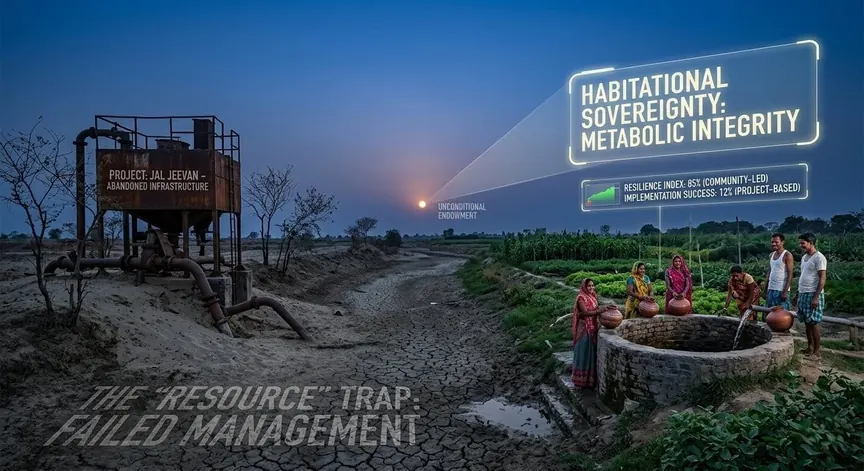
The “Illusion of Infrastructure” provides a cautionary tale. Consider the Jal Jeevan Mission: a project where thousands of crores were spent, pipe and cement companies profited, and contractors were handsomely paid. Yet, in many regions, the unconditional endowment of nature—water—which the scientific and environmental discourses that rule such COP summits (unfortunately) consider to be (merely) a resource—remains missing. It is a system where the process thrives while the purpose fails. This raises the spectre of Marginalization in Water Governance. Is the global focus on water truly intended for the marginalized, or is it a blueprint to further curtail public water rights? There is a legitimate fear that water will be commodified and diverted from the poor to urban centers under the banner of “efficient management.” This suspicion is reinforced by the Funding Paradox of the COP process itself. A significant portion of the financial backing for these global summits comes from corporations whose core operations are fundamentally anti-environment, creating a conflict of interest that taints every resolution. We are witnessing the birth of a new “Biological Debt”. Every time a government expands infrastructure without ensuring its climate-resilience, it is taking out a high-interest loan on the future survival of its citizens. The 59 Belém Adaptation Indicators represent the first forensic attempt to measure this debt. By integrating water, sanitation, and hygiene (WASH) into climate accountability, the international community is finally addressing the water-food-climate nexus.
But for a nation like India, the stakes of this implementation are unparalleled. Initiatives like NAQUIM 2.0 (National Aquifer Mapping) have moved the needle from simple mapping to hydrogeological policy action. However, the “Belém Standard” demands a transition from the vanity of coverage figures to the rigor of Proportional Integrity. Progress is measured not by how many taps are installed, but by how many of those taps continue to run during a prolonged drought. This path is blocked by three systemic fractures. First, water scarcity remains acute and unevenly distributed. Second, the fragility of adaptation finance remains an existential hurdle; while rhetoric speaks of mobilizing $1.3 trillion by 2035, the operational pathways remain clouded. Third, a persistent digital fragmentation prevents India’s vast hydrological data from being integrated into real-time governance. The “Architecture of Silence”—the gap between data collection and local action—must be bridged, but not at the cost of public sovereignty. True statecraft in 2026 is the preservation of the habitat that allows society to exist. Water must anchor climate action, and that action must be swift, equitable, and technologically robust. India stands at a pivotal moment. Resilience is measured not by infrastructure built, but by systems that continue to serve people when the next flood arrives. We must stop burning the ground we stand on—and drowning the systems we depend on—in the name of progress. Only by aligning missions, metrics, and money can ambition be converted into measurable resilience. At best, we can hope that a fraction of these high-level discussions yields tangible benefits for the common person. However, whether these promises will ever manifest, or if they are simply the latest iteration of a technocratic illusion, is a question only time can answer. The horizon remains uncertain.



Very well written as well as informative.
In this Millennium managing carbon credits and Go Green concept is one of the most challenging issues that you framed in a very simple way that everyone able to connect.
Thank you for raising your voice for the common man and for highlighting the real ground reality. Please keep writing such helpful articles.