


In the village of Manikapur, tucked five kilometers off the arterial flow of National Highway 16 in Odisha’s Ganjam district, prosperity is measured in concrete and steel. The main road is a gallery of flashy, double-storey houses—architectural outliers in a rural landscape usually defined by mud-brick and thatch. To a passing economist, these structures are a triumph of human capital; to the families within, they are the fruits of a "dollar dream." Yet, for the past fortnight, these homes have felt less like sanctuaries and more like illuminated bunkers. As missiles trace lethal arcs across the skies of the Middle East, the flashy façades of Ganjam betray a profound, hidden instability. Inside, the only light comes from the frantic glow of smartphone screens—the digital umbilical cords connecting mothers in Odisha to sons in war zones.
This "migration machine" is as efficient as it is predatory. In villages like Maheswapur, Kaneipur, and Manikapur, the exodus of young men is now a standardized export. Almost every one of the 750 households in Manikapur has at least one member working in the Gulf. This is the result of a local economy that has been systematically hollowed out, leaving marginal farming families with no option but to scrape together consultancy fees ranging from ₹70,000 to ₹1 lakh to buy a one-way ticket into the unknown. They go to stitch, to weld, and to stand guard, trading thirteen-hour workdays for a monthly remittance that fluctuates between ₹20,000 and ₹60,000.
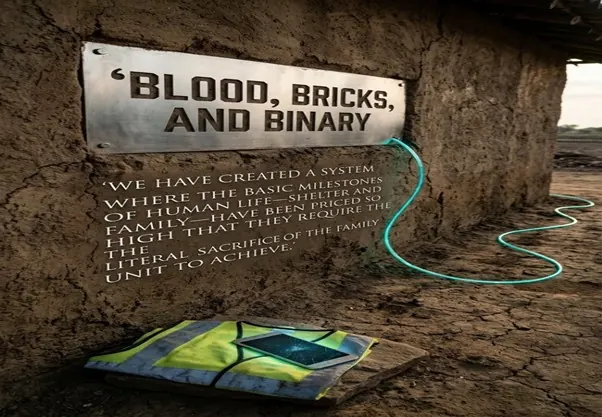
Yet, we must look beneath these figures to understand why these men endure the "mechanical reality" of industrial labor in a conflict zone. The engine of this exodus is a phenomenon of Social Inflation. In Manikapur, the income earned abroad is funneled into two primary sinks: the construction of concrete houses to "impress" and the financing of exorbitant marriages. Dowries now range from ₹1 lakh to ₹5 lakh, further burdened by gold ornaments and community feasts. One village elder, Mukta Gouda, recalls spending ₹16 lakh to marry off two daughters—a debt so massive it required the labor of two sons and a grandson, currently scattered from Dubai to Russia, to repay. This is the cycle of a civilization that has mistaken social mobility for an endless race, pricing the basic milestones of human life—shelter and family—so high that they require the literal sacrifice of the family unit to achieve.
This is where the third element of our anatomy—the Binary—takes hold. In the absence of physical presence, the family unit is forced into a digital mimicry of life. Love is reduced to a data packet; fatherhood is a pixelated image on a cracked screen; and the "Home" exists only as a flickering video call between two time zones. This Binary Existence is the ultimate irony of Ganjam: a man builds a house of heavy stone and permanent brick, yet his only real connection to it is through the most fragile, ethereal strings of code. He lives as a ghost in his own palace, a human being converted into a remittance stream and a digital flickering. The "Binary" allows the migration machine to keep running—it provides just enough of a digital "fix" of connection to keep the worker welding in a war zone, while the physical "Bricks" back home remain cold and empty.
We are building better-looking tombs for a social fabric that is being shredded in real-time. The state’s response remains predictably reactive, with political leaders expressing "fear and anxiety" on social media while the underlying engine remains untouched. By dangling the bait of material security, the current developmental model has detached the populace from their Habitational Sovereignty—the right to exist with dignity in one’s own soil. The "loss of fear" mentioned by some villagers is a dangerous illusion; a video call can confirm that a son is alive after a missile strike, but it cannot restore his physical freedom or his passport, which is often held captive by an employer.
To save the Manikapurs of the world, we must move beyond technocratic fixes and the reactive management of "stranded subjects." The solution lies in a radical re-centering of our values—a return to a Path of Conscious Balance. This is not a call for a return to primitive poverty, but an invitation to a sophisticated stability. It begins with the dismantling of the assumption that the export of human life is a valid economic strategy. If the social cost of entry—the ₹16 lakh wedding or the multi-storey status symbol—remains the benchmark for a "successful life," no amount of local job creation will ever be enough. We must foster a community consciousness that de-escalates this social inflation.
True well-being is found in a "Middle Way" where the requirement for a dignified life is not tethered to the volatility of a foreign war zone. This path demands a redirection of local resources. Instead of village capital being extracted by predatory consultancy agents to fuel foreign construction, that same capital must be anchored in the rejuvenation of the local habitat. A balanced economy would prioritize "Habitational Sovereignty"—creating local circular economies where the value produced by a welder or a tailor stays within the community, rather than being remitted from a bunk bed in Jordan. This requires a psychological shift from "Expansion" to "Integrity." We have been conditioned to believe that more is always better—more tiles, more gold, more floors. But the empty palaces of Ganjam prove that "more" can often lead to "less" human connection.
The Path of Conscious Balance advocates for an Economy of Presence, where the presence of a father at the dinner table is valued as a greater asset than the remittance he sends from a missile-range. It is a philosophy that seeks to bridge the emotional vacuum by lowering the social "thirst" that creates it. We must recognize that the "dollar dream" is a high-interest loan on the future of our children. By choosing a path of moderation and local resilience, we reclaim our right to live without fear. We transform the village from a labor-extraction hub into a self-sovereign home.
This is the only way to break the cycle of Gilded Displacement and ensure that the next generation of Ganjam’s youth does not have to sell their freedom to buy a steel door. We stand at a crossroads. We can continue to fuel this migration machine, celebrating the "dollar dream" until the next war or the next economic collapse brings the house down. Or, we can finally prioritize the Integrity of the Home over the Prestige of the House. The information is clear; the statistics of social discord are evident; the fragility of the "dollar dream" has been exposed. The question remains: When? When will we stop treating our youth as a commodity for export and start building a world where staying at home is not a plea of desperation, but a viable, dignified, and prosperous choice? If we do not address this now, we are merely building better-looking tombs for a civilization that has forgotten how to live together.




ভোগবাদী সমাজ যেদিন থেকে সৃষ্টি করা হয়েছে এমনি স্বর্ণ মৃগয়ায় অসংখ্য মানুষ যাত্রা শুরু করেছে।