



India is destroying some of its last great rainforests. The corporate interests are identified. The proximity to power is documented.
The forests are being cleared. Nobody is being held accountable. On the southernmost tip of India, where the Bay of Bengal meets the Andaman Sea, there is a rainforest that has existed for millions of years. It has survived ice ages. Tectonic shifts. Tsunamis. It has outlasted empires and colonisers and every catastrophe the planet has thrown at it.
It will not survive us.
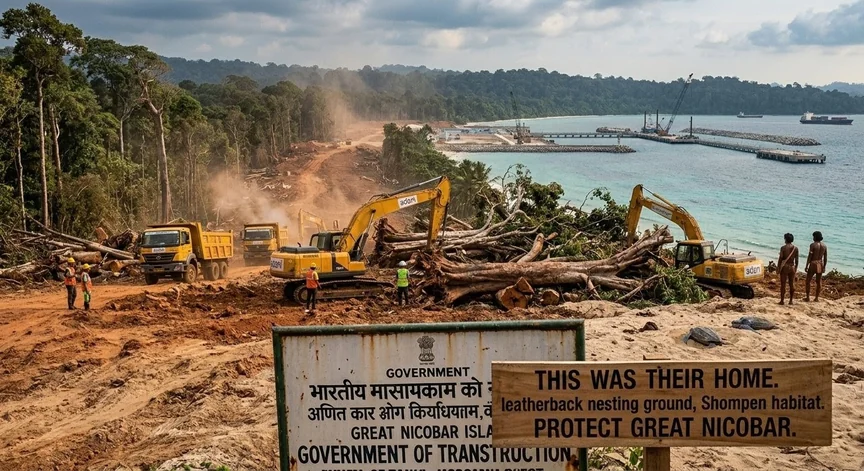
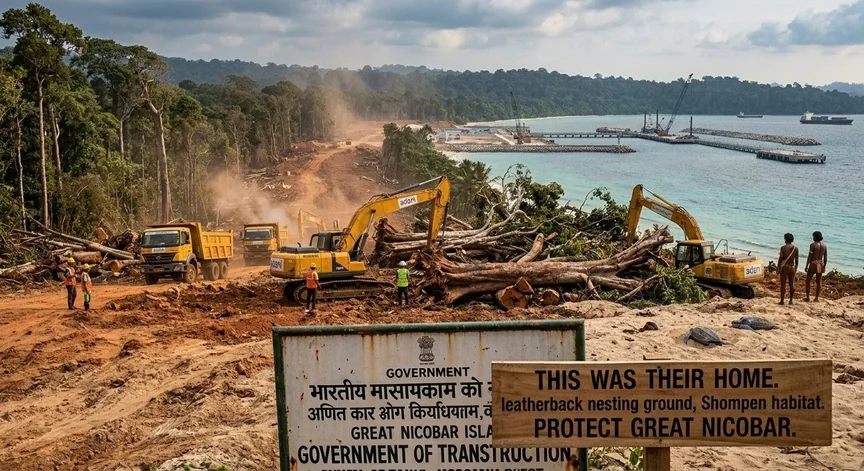
The Indian government has approved a plan to clear 130.75 square kilometres of this forest. It is one of the most biodiverse ecosystems on Earth. In its place: a transshipment port, an airport, a power plant, and a new city on Great Nicobar Island.
Preparatory work has already begun. Tree-felling contracts have been issued. The machinery is moving.
Among the eleven companies that formally expressed interest in developing the port at Galathea Bay is Adani Ports and Special Economic Zone Limited. It is India's largest private port operator. Its chairman, Gautam Adani, has been described by multiple international publications as one of the individuals whose business fortune has risen in closest parallel with Prime Minister Narendra Modi's political ascent.
On the day Modi was sworn in as Prime Minister in 2014, he flew to New Delhi in Adani's private aircraft. The Indian flag was on one side of the aircraft. The Adani Group logo was on the other.
This is not the backdrop to the story. This is the story.
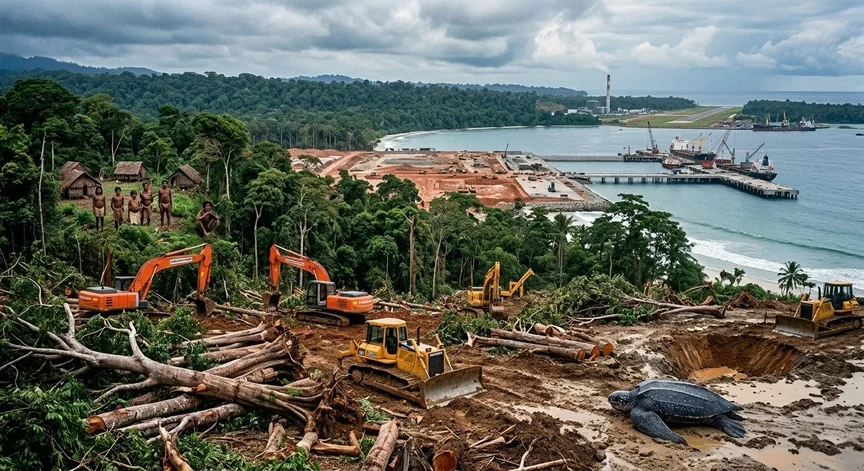
Great Nicobar is not a generic patch of trees. It is a UNESCO-designated Biosphere Reserve. A globally recognised biodiversity hotspot. Home to hundreds of endemic species that exist nowhere else on this planet. The leatherback sea turtle is the world's largest. It is critically endangered. Between May and January each year, females return to Galathea Bay on this island. They are guided by evolutionary memory stretching back millions of years. The proposed port sits directly on their primary nesting ground. Once permanent infrastructure occupies that bay, the leatherback's return does not get disrupted. It ends.
The Shompen people number fewer than 500. They have lived in this forest since before recorded history. Their world and the forest are not separate things. They are the same thing. The project will bring thousands of construction workers into an environment where the Shompen have no immunity to common pathogens. Every historical precedent tells us what follows. Across continents. Across centuries. Catastrophic population decline.
This is not a risk assessment. It is a historical pattern being knowingly repeated.
The government's own Impact Assessment states it plainly: "Any disturbance or alteration in the natural environmental setup where they live may cause serious threat to their existence" and "once infections spread among the tribal Shompen, the whole community may face extinction." Those words appear in official documents. The project continues regardless.
Official estimates claim around 964,000 trees will be felled. Researchers who have actually studied forest density on these islands put the real figure at several times higher. The discrepancy is not a technicality. It is the oldest trick in the infrastructure playbook. Make the destruction appear manageable until it is irreversible.
When a rainforest is cleared, the trees are not the first thing that dies. The fungi connecting root systems across hectares die first. Then the soil organisms. Then the water retention. Then the microclimate. By the time the last tree falls, the ecosystem has already been destroyed.
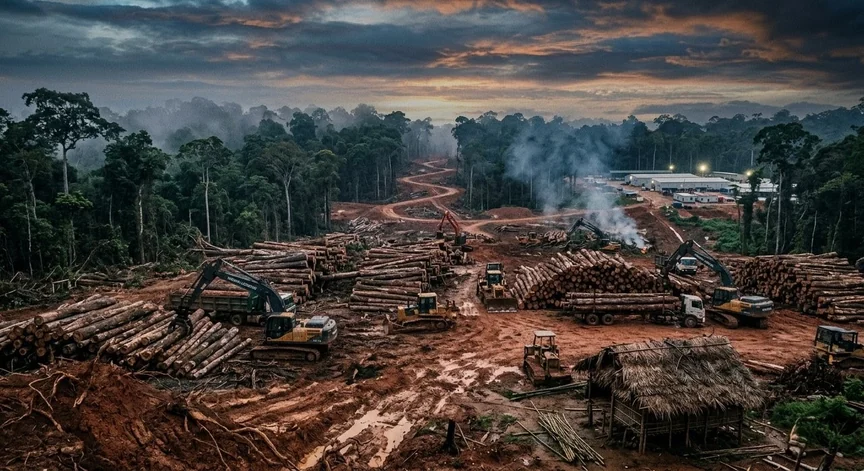
What remains is not a cleared forest. It is a wound in the planet. The government's case rests on three claims: strategic positioning near the Strait of Malacca, reduced dependence on foreign transshipment hubs, and job creation. Each one fails.
The Andaman and Nicobar archipelago has 836 islands. Great Nicobar is among the most ecologically fragile. There is no public record that alternative sites were seriously evaluated and rejected. That absence is not administrative oversight. It is a choice. It demands explanation.
A transhipment port is not a naval base. If military presence is the objective, it can be achieved at a fraction of the ecological cost. If commercial viability is the claim, the economics must be faced honestly. Cargo moved via feeder vessels before reaching deep-sea routes increases total costs by 15 to 25 percent. That figure alone erases every projected advantage of this project. As for jobs: the pattern is well established. Construction relies on migrant labour. Long-term operations generate few local positions. The communities displaced by the project do not become its beneficiaries. They become its casualties.
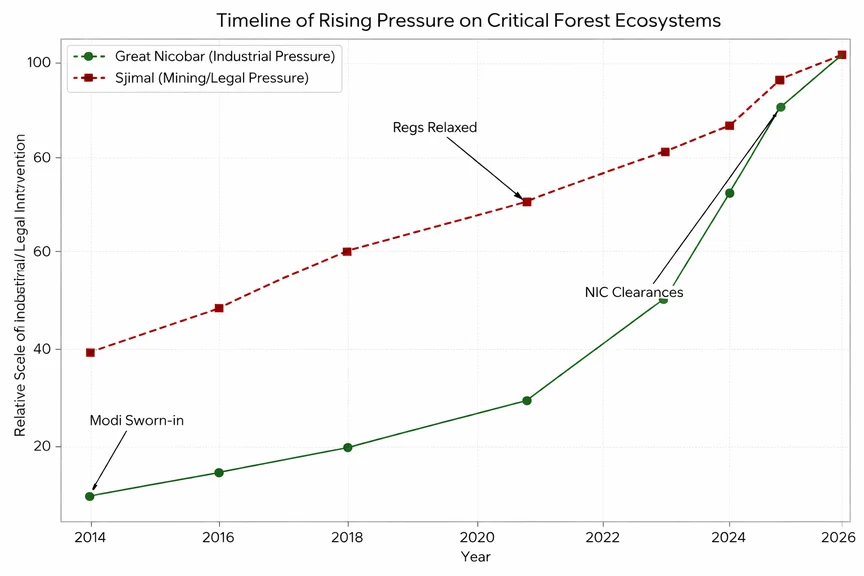
India's environmental clearance process is not designed to prevent ecological harm. It is designed to enable approval while creating the appearance of scrutiny. When the agencies overseeing compliance are the same agencies driving implementation, oversight becomes performance. Due diligence becomes paperwork. The project has been challenged in the courts. Serious concerns have been raised by researchers, ecologists, and lawyers. The response has been to continue regardless. To outrun the objection. To ensure that by the time any argument is conclusively won, the forest is already gone.
There is no compensatory mechanism for an extinct species. There is no afforestation programme that recreates a million-year-old rainforest. A plantation is not a forest. It is a photograph of a forest. Presenting one as the equivalent of the other is not environmental policy. It is a lie with official letterhead.
The company at the centre of the Great Nicobar port bid has a record that demands to be stated plainly. The US Department of Justice charged Gautam Adani and associates in November 2024 with paying over $250 million in bribes to Indian government officials to secure energy contracts. The US Securities and Exchange Commission filed parallel civil charges the same day.
When Adani's empire faced mounting debt in 2025, an investigation by The Washington Post revealed that senior Indian government officials drafted a plan to channel nearly $3.9 billion from the Life Insurance Corporation of India, a state-owned insurer funded by ordinary citizens' premiums, into Adani Group companies. The stated objective of the plan, as recorded in internal documents, included "signaling confidence in Adani Group." The Indian government has consistently backed Adani's interests. Internationally. Domestically. Through coal blocks. Through port contracts. Through airport concessions spanning continents. Through a relationship that began in Gujarat and has grown, uninterrupted, across every year of national power. This is the company that has formally expressed interest in the port that will end the leatherback turtle's return to Galathea Bay. That will bring construction workers into the last world of the Shompen. That will replace a million-year-old rainforest with concrete and cargo.
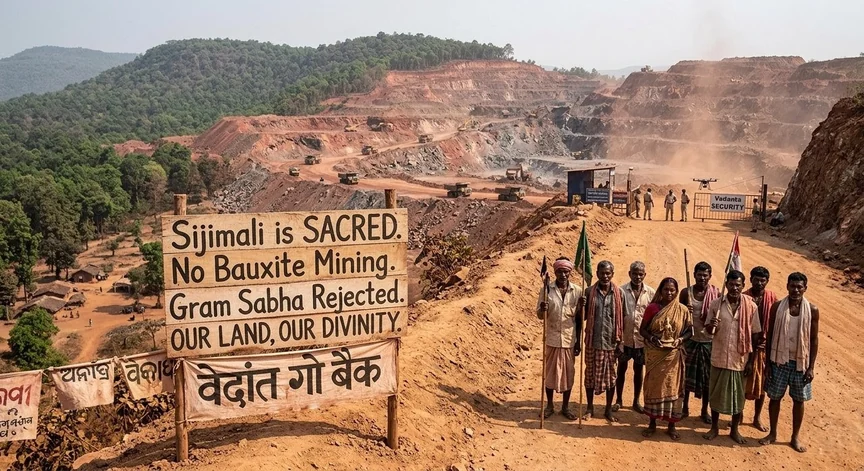
Eight hundred kilometres away, in the hills of Kalahandi and Rayagada in Odisha, the same pattern is playing out. With a different forest. And a different corporation equally close to the same machinery of power. Sijimali is a range of pristine biodiverse hills. They are sacred to the Adivasi communities who have lived there for generations. Their deity, Teej Raja, resides in a cave at the summit. Beneath the surface lie 311 million tonnes of bauxite.
Vedanta Limited holds the mining lease. It is a London-headquartered conglomerate owned by billionaire Anil Agarwal. It donated ₹457 crore to Indian political parties through the now-unconstitutional electoral bonds scheme, declared so by the Supreme Court of India in February 2024. It was the single largest donor to the Congress party. It donated consistently to the BJP. Across the entire democratic spectrum. So comprehensively that no election result could threaten its interests.
Academic research published in peer-reviewed journals has named this mechanism precisely: Chanda do, dhanda lo. Give the donation. Take the business. The Delhi High Court found both the BJP and Congress guilty in 2014 of illegally accepting donations from Vedanta, ruling it a foreign company prohibited from funding Indian political parties. The court directed the Home Ministry and Election Commission to take action within six months. Neither was prosecuted. Instead, the government inserted a retrospective amendment into the Finance Bill of 2016, rewriting the law to erase the guilt. When that amendment proved insufficient, a second amendment in 2018 extended the retrospective protection all the way back to 1976. A court found them guilty. They rewrote the law. Then Vedanta donated again. This time through electoral bonds. The Supreme Court struck those down too.
The same corporation. The same parties. The same forests paying the price. In 2021, Vedanta lobbied the government to relax environmental regulations for mining companies. The government obliged. Mining companies were permitted to increase production without new environmental clearances.
The Gram Sabha process is mandatory under the Forest Rights Act of 2006. It requires the free and prior consent of communities whose forests are being taken. In Sijimali, it was allegedly conducted in a single day in December 2023. Local communities say the consent resolutions were fabricated. They held their own Gram Sabhas in August and September 2024. Every single one rejected the mining proposal. The response was not reconsideration. It was escalation. Police arrived at villages in the middle of the night. Electricity was cut. Doors were broken open. Residents were detained. Drones were deployed for surveillance. Women were prevented from leaving their homes to collect drinking water. The springs that provide that water flow because bauxite holds rainwater and releases it through natural channels throughout the year. Mine the bauxite and you mine the water system itself.
In October 2025, Naring Dei Majhi, a tribal woman leader in her fifties, was arrested and jailed. She had gone to hospital to take her pregnant daughter-in-law for delivery. That is the state of democracy in Sijimali. At a public hearing organised for Vedanta's environmental clearance, an Adivaswoman named Pushpa Majhi stood before company officials and district administrators and said: "You call us illiterate Adivasis. But you are educated and yet you are unable to understand when we say that the Sijimali hill is sacred to us. So tell us, who is a greater fool? You or us?" Nobody answered her. The clearance process continued. In April 2026, clashes between tribal communities and police left seventy people injured. Activist leaders were arrested. Medha Patkar was detained at a railway station. Over 125 lawyers across India signed a petition. Stage-I forest clearance was granted on 31 December 2025. Vedanta waits. Having donated ₹457 crore. Having received relaxed environmental regulations. Having allegedly obtained community consent through documents the community says are forged.
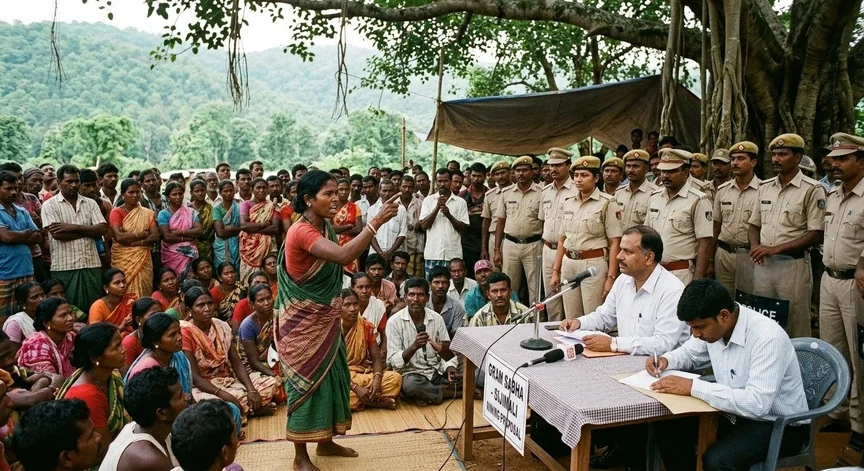
One question goes unanswered. When a corporation has purchased influence across every major political party, who is left to represent the forest?
Great Nicobar and Sijimali are not two isolated stories. They are two chapters of the same book. In one, a corporation whose chairman flew the incoming Prime Minister to his swearing-in ceremony seeks the contract to build a port on a critically endangered species' only nesting ground. In the other, a corporation that donated ₹457 crore across every major political party mines sacred tribal land, with alleged forged consent, under police enforcement.
The mechanism is identical. The template is identical. Only the forest changes. The destruction of these forests is not an environmental story. It is a story about what a society believes the world is for. About who it protects. And who it sacrifices. Ecology is not a department of development. Development is a subset of ecology. This is not a semantic distinction. It is everything.
The planet's capacity to sustain human life is entirely ecological. Clean air. Rainfall. Fertile soil. Fresh water. These are not background conditions. They are the infrastructure on which all other infrastructure depends.
Without functioning ecosystems, there are no ports. No airports. No cities. No economy. Nothing. Every international climate conference held while governments simultaneously clear rainforests for corporations is not a response to the crisis. It is a performance staged above it.
Biodiversity is nested within ecology. Destroy the ecology and biodiversity collapses. Destroy enough biodiversity and the ecological system begins to fail entirely. There is no recovery from that. No technology replaces a collapsed water cycle. No engineering solution exists for a planet that has crossed enough ecological thresholds to no longer support human civilisation.
This is not a future risk. It is a present process. And it is being accelerated. Forest by forest. Clearance by clearance. Corporate interest by corporate interest. Here is what is being destroyed. A rainforest with no ecological equivalent in India. The only nesting ground of a critically endangered species. Indigenous peoples who survived millennia but may not survive what is coming. Water systems built across geological time. Biodiversity archives that science has not finished reading.
Once these are gone, they do not return. Not in a decade. Not in a century. Not in any timeframe that means anything to the human beings who will inherit this planet.
There is no port worth a species. No airport worth a people. No cargo terminal worth a rainforest that took a million years to build and will take one generation to erase.
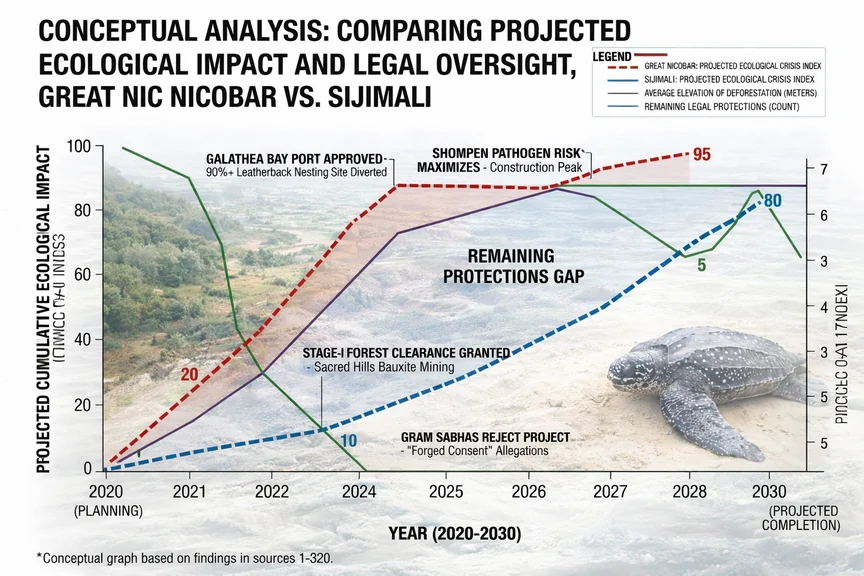
The data is public. The corporate connections to power are documented. The clearances, the contracts, the police deployments, the forged consent forms. All of it is on the record. All of it is being ignored. The problem is not lack of information. The problem is a system structurally incapable of saying: not here. Not this forest. Not these people. Not at any price. Until that system exists, Great Nicobar and Sijimali will not be the last forests sold. They will be the template for every forest that follows.
The planet is not dying of ignorance. It is dying of impunity. Impunity paid in electoral bonds. In state funds steered to favoured conglomerates. In police boots on tribal land. In forged Gram Sabha resolutions. In clearances signed at midnight on the last day of the year.
Impunity paid, ultimately, in forests. And the bill is being charged to people not yet born.
Sources:
Publicly available data released under Supreme Court order, reporting by The Washington Post, Al Jazeera, The Wire, Adani Watch, and field documentation from Great Nicobar and Sijimali.



প্রতিবেদকের দৃষ্টি আকর্ষণ করছি।
প্রতিবেদনের জন্য ধন্যবাদ।
Drawing the attention of the reporter.
Thanks for the report.”