




Madhya Pradesh has cleared 156,319 sal trees for felling to stop a beetle whose return one of its own officers had forecast. Nothing in the reporting ties the outbreak to a corporation, a mine or a highway, which makes it easy to shrug off. A catastrophe with no villain still needs someone to answer for it, and the record shows an early estimate that fell far short of the toll, beetle collectors paid by the piece, and successive epidemics met with largely the same measures.
Around four or five one morning, Ground Report reported, Kunwarvati Bai and Lalli Bai walked into the sal forest near Chauradadar village in Dindori with buckets in their hands. Fine brown sawdust lay beneath the trees. It looked like ordinary wood dust, but it was the borer's signature: the larvae were already inside the trunks, eating toward the heartwood. However green a tree looks from outside, Kunwarvati Bai said, its death has already begun within. A villager, Vishnu Marawi, was blunter. Covid took human lives, he said, and this insect is taking the forest.
The Centre has now cleared 146,784 trees in Dindori and 9,535 around Amarkantak. The axes will follow, and the word “management” is already waiting for them.
A forecast is not a defense
Dindori's forest officer said in December 2025 that sal borer outbreaks follow a natural cycle of about 30 years, that the last major one came in 1997, and that its impact was expected to rise again in 2026-27. The department, in other words, knew the calendar. Whether its preparations matched it is a question the public record leaves open.
The signs were on the ground as well. On November 30, 2025, the department began marking infested trees in a 119-hectare forest near Sontirath. By December 3, an official speaking anonymously told Down To Earth, 3,113 had been marked in just three hectares, and the total for that forest could reach 100,000. Dindori's forest officer acknowledged that the number of affected trees had been rising steadily for two to three years. A study of Dindori division had already recorded an earlier surge, from 699 affected trees in 2012 to 6,139 in 2013 and 29,382 in 2014. The pest was no stranger to the district.
Yet in December 2025, local media were citing forest officials who put the number of infested trees in Dindori at about 5,000. Down To Earth found that figure unreliable after visiting the forest, and villagers told it the official number badly understated the problem. Officials were reluctant to comment and said they were awaiting instructions from above, and the Karanjia ranger said she was not authorised to speak. Seven months later, the department asked the Centre to approve the felling of 147,380 trees. The cycle and the rain explain why the beetles came back. They do not explain why an early public estimate was a small fraction of that figure.
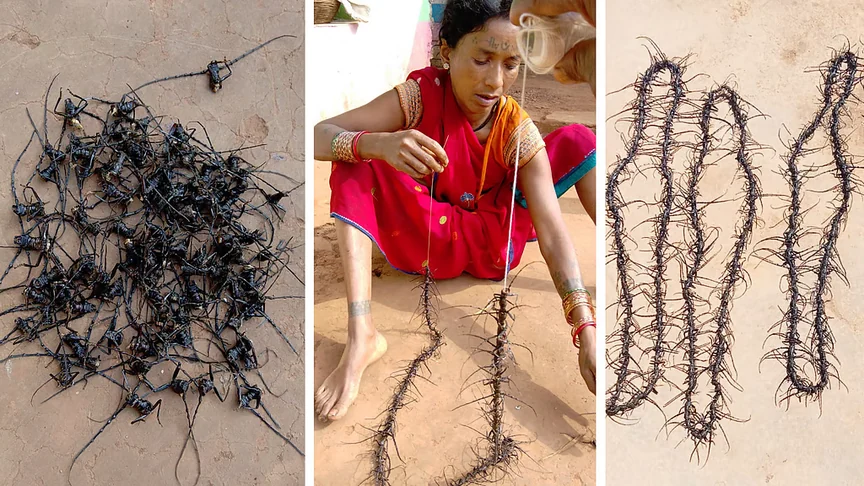
Sal borer insects collected in Madhya Pradesh’s Dindori district. Local tribal residents are stringing the insects into garlands of 100 each before selling them to the Forest Department, which is paying Rs 2 per insect as part of a control campaign. images courtsey - Surendra Jatav, Sub-Divisional Officer of the Dindori Forest Department. We take this picture from DownTo Earth website.
The same tools, again
In 1923-24, the borer tore through Mandla and Dindori, and the response was to kill about 428,000 beetles and fell 387,500 trees. In the 1990s, about 3.5 million trees were infested, and 1.59 million had to be felled in the Dindori and Mandla divisions alone. A paper presented to the 2003 World Forestry Congress noted that the latest epidemic had been fought with previously known measures only, that there had been no breakthrough, and that cyclic epidemics demanded immediate, coordinated research. In 2026, the answer is again a bounty and an axe.
The department says felling is meant to control the outbreak and stop its spread, and that natural regeneration will be protected afterwards. That is a defensible aim. But a response that has changed so little across a century is not vindicated by its age. It suggests a system that has not built much else.
The trap-tree technique, in use since 2000, means cutting down a healthy sal to lure the beetles, and Down To Earth describes it as the only effective control. After twenty-six years, the best available remedy is to sacrifice trees to save trees.
Rs 200 a garland
The most visible weapon in this campaign is a bounty. Villagers string beetles into garlands of 100, and each garland earns Rs 200. About 1.9 million beetles have been bought for roughly Rs 38.5 lakh, while Ground Report put the expected cost of felling and transport at Rs 8 to 10 crore. Officials say communities take part because it provides work and because they want to protect the forest. That is plausible. It is also true that the people who live beside this forest are paid by the piece to fight its deadliest pest.
In August, officials, scientists and lawmakers met at a university in Amarkantak, inspected infested forest in the Karanjia range and called for early-warning systems and regular monitoring. It is the right list. On a known 30-year cycle, it is also a list that might have been drawn up before the beetles emerged rather than after.
The costs still to be counted
According to Ground Report, recovery could take 20 to 30 years. A child who watches the axes at ten may be thirty or older before the canopy closes. Villagers near Sontirath have warned that the sal canopy is fading and temperatures are rising. Part of the affected forest lies at Amarkantak, where the Narmada begins. A commentary in Down To Earth warns that the gap between epidemics may be narrowing under climate stress. If so, a shortening clock is being managed with a century-old toolkit.
The department has estimated that the affected area will yield about 46,390 cubic metres of timber and 43,940 cubic metres of firewood, Ground Report reported. None of the reporting reviewed for this piece says who will buy it, or at what price. Nothing in that reporting suggests impropriety. But a sale of that size should be public.
Nothing in the reporting ties this outbreak to a corporation, a mine or a road. That makes it harder to campaign against, because there is no one to serve notice on. It does not make it unanswerable. The state should publish the number of trees in every infestation category, from T1 to T6, range by range. It should publish every timber sale, with buyer and price. It should pay the people holding the line a wage, not only a bounty. It should release an independent review of whether felling at this scale is warranted. And it should build permanent early-warning monitoring before the next monsoon, not after the next epidemic.
The beetles will fly again with the rains. They have kept their schedule for a hundred years, and they are the only party in this story that has.
Sources
-
Down To Earth: https://www.downtoearth.org.in/wildlife-biodiversity/permission-granted-to-cut-more-than-156000-sal-trees-in-madhya-pradesh
-
Down To Earth: https://www.downtoearth.org.in/forests/coordinated-efforts-needed-for-effective-and-permanent-solution-to-sal-borer-experts
-
Down To Earth: https://www.downtoearth.org.in/wildlife-biodiversity/sal-forests-in-madhya-pradesh-face-alarming-die-off-as-borer-infestation-spreads
-
Down To Earth: https://www.downtoearth.org.in/forests/sal-borer-waiting-to-strike
-
Down To Earth: https://www.downtoearth.org.in/forests/sal-borer-gap-between-epidemics-narrowing
-
Ground Report: https://www.groundreport.in/groundreport/how-is-madhya-pradesh-trying-to-stop-the-spread-of-sal-heartwood-borer-in-its-forests/
-
Ground Report: https://www.groundreport.in/latest/dindori-1-46-lakh-sal-trees-to-be-felled-after-borer-outbreak/
-
FAO (XII World Forestry Congress): https://www.fao.org/4/XII/0739-B1.htm
-
ResearchGate (Dindori Forest Division study): https://www.researchgate.net/publication/334051428_SAL_HEARTWOOD_BORER_Hoplocerambyx_spinicornis_NEWMAN_ITS_RECENT_EMERGENCE_IN_MADHYA_PRADESH_AND_ROLE_OF_CLIMATIC_FACTORS
-
MP Tourism (Amarkantak): https://www.mptourism.com/destination-amarkantak.php

Be the first to join the discussion.