



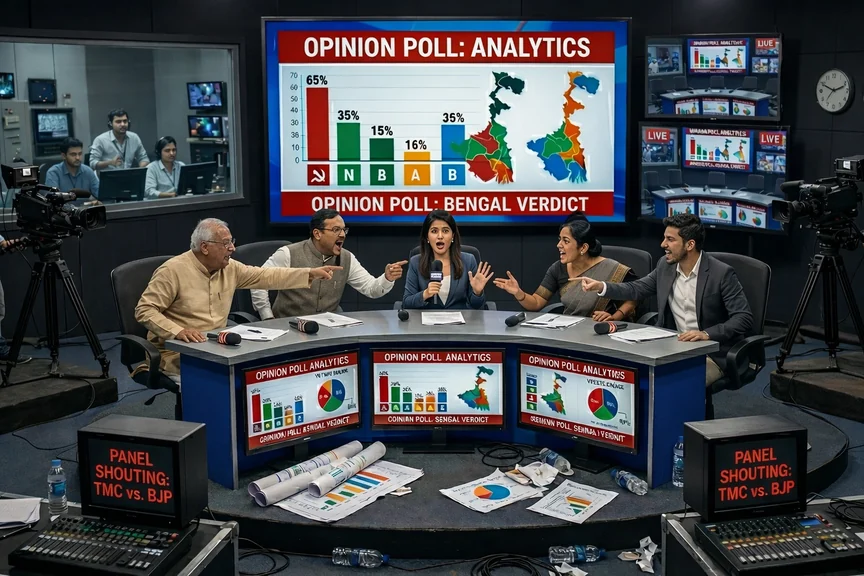
In election after election, India's exit poll agencies claim the miracle when they are right and vanish when they are wrong. The 2026 Bidhan Sabha elections in West Bengal have exposed something more troubling. It is not just inaccuracy, but a system where established agencies go silent, newcomers fill the vacuum with confidence, and no one is ever asked to explain themselves.
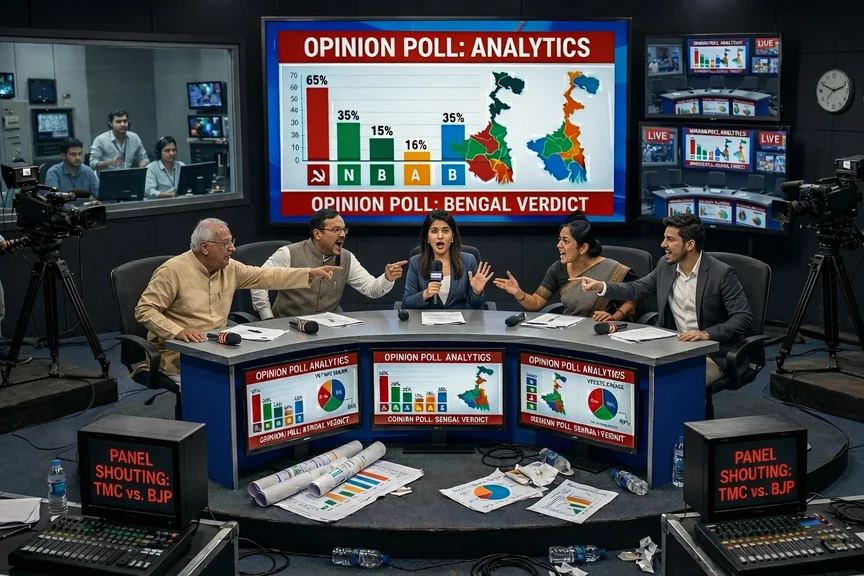
There is an old saying: when a storm kills a heron, the fakir claims it as his miracle. Few metaphors capture India's exit polls better. Every election cycle, the pattern repeats. Agencies predict winners with confidence. If they are right, they claim foresight; if they are wrong, they disappear. The miracle is always theirs. The silence never explained.
History is littered with these "miracles" and disappearances. In the 2021 West Bengal elections, multiple major outlets projected a fiercely competitive contest, with several giving the BJP a narrow edge or predicting seat tallies in the 100-120 range. The TMC won over 213 seats.
The agencies did not misread the margin, they misread the mandate entirely. No methodology was released. No correction was offered. The numbers simply vanished from conversation.
The 2026 Bidhan Sabha elections in West Bengal have added a new and telling chapter to this story. Two of India's most established polling agencies, CVoter and Axis My India did not release exit poll projections for West Bengal. Axis My India's head Pradeep Gupta publicly confirmed that voters across both phases remained reluctant to share their choices, making credible projections impossible. CVoter offered no public explanation at all.
Into this vacuum stepped a wave of lesser-known and relatively newer agencies like Matrize, Peoples Pulse, P-Marq, Poll Diary, JVC, and Janmat Polls - each releasing confident seat-by-seat projections for the state. The seasoned agencies stepped back. The newcomers stepped forward. And the television screens filled regardless.
This pattern deserves scrutiny. When established agencies withdraw without full public explanation, and newer ones rush to fill the space with projections, the credibility gap does not shrink, it widens. It raises a question the industry has never been made to answer: if experienced pollsters found Bengal's voters too reluctant to survey, how did the others manage to do so? Were the same reluctant voters suddenly forthcoming? Or were the projections built on something other than fieldwork?
Exit polls present themselves as instruments of democratic insight. In reality, they operate in a fog of opacity. Methods remain unclear. Sampling is not meaningfully disclosed. Major national agencies often treat their methodologies like trade secrets rather than scientific protocols. We see the final seat counts on television, but the raw data: the actual responses from the booths remain locked away. The process stays shielded from public scrutiny.
We are told these surveys are "scientific". That word implies rigor and transparency. Yet neither is visible. Science, without scrutiny, becomes power without accountability.
What we are watching may not be measurement of democracy, but its rehearsal.
The problem is not that exit polls are sometimes wrong. It is that we are never allowed to see how they arrive at being right. The logic is simple: a small sample can represent the whole. The execution is not. In a constituency of two lakh voters, perhaps a thousand are surveyed. But who are these thousand? Where are they found? How are they selected? These are not procedural questions — they are the difference between science and theatre.
After decades of exit polling, these questions remain unanswered in the public domain. Most citizens have never encountered an exit poll surveyor. Many have never heard of someone who has. A process that claims to reflect the public feels absent from public experience.
No major Indian polling agency currently publishes its raw data, demographic weights, or booth-level sampling rationale. The Election Commission does not mandate margin-of-error disclosures at the constituency level. Independent audits of fieldwork do not exist in any structured, public form. The absence of verifiable methodology makes it impossible to distinguish genuine field research from projection built on assumption. It raises an uncomfortable possibility: are these surveys speaking to voters, or manufacturing a public that may not exist?
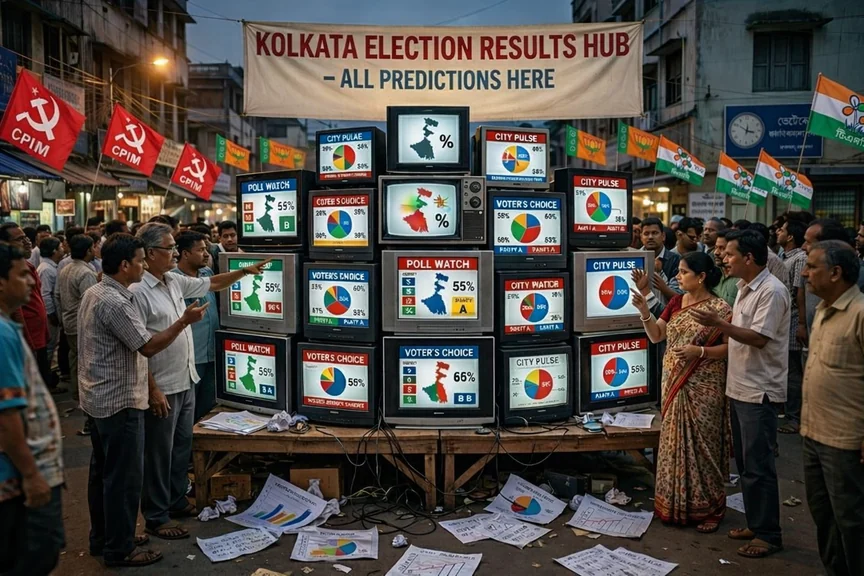
Timing raises further concerns. The Election Commission of India restricts publication until voting ends at 6 p.m. Yet at that exact moment, projections flood television screens, even as voters in some places are still in queue. Conclusions appear ready before participation is complete. It begins to feel less like measurement and more like a script revealed on cue. Geography adds another layer and it is worth pausing on. Many of the agencies releasing projections for Bengal, Kerala, Tamil Nadu and Assam are headquartered in Noida and Delhi. They are measuring the mood of a farmer in Murshidabad, a fisherman in Alappuzha, a mill worker in Coimbatore from the same air-conditioned offices.
The issue is not distance alone. It is what distance does to accountability. When an agency that has never set foot in a constituency releases seat-by-seat projections for it, and is never required to show its fieldwork, geography becomes not just a logistical gap but a democratic one. What emerges is a deeper unease: projections may be shaped in advance and unveiled at the appointed hour. When prediction begins to resemble premeditation, trust quietly disappears. The consequences are real. Exit polls do not just reflect opinion; they shape it. They influence markets and media narratives. They move public sentiment.
They trigger celebration for some and despair for others before a single official result is declared. In the age of social media, distortion multiplies. Unofficial forecasts blur the line between analysis and imagination. Speculation outruns verification. What is presented as measurement begins to function as influence.
This is not an argument against data; it is an argument against opacity. If exit polls claim scientific credibility, they must meet scientific standards: transparent methods, clear sampling, verifiable fieldwork, and openness to scrutiny.
A credible disclosure would mean moving beyond colorful graphics to provide the raw data, the demographic weights used for balancing, and the margin of error for every sub region. Without these, they remain closer to performance than research.
This is not an impossible standard. In the United States, exit poll consortiums are required to publish their methodology, sampling rationale, and margin of error as a matter of public record. In Germany, polling agencies face regulatory scrutiny over sampling transparency before results are broadcast. In the United Kingdom, exit polls are conducted by a single authorised consortium answerable to a clear editorial and methodological standard. India is the world's largest democracy. It deserves at least the same.
Democracy is not strengthened by confident guesses. It is strengthened by credible processes. To that end, three reforms are worth demanding:
First, mandatory public disclosure of raw sampling data and demographic weights within 48 hours of result declaration.
Second, independent third-party audits of fieldwork methodology before each election cycle.
Third, regulatory requirements for constituency-level margin-of-error reporting, enforced by the Election Commission.
The verdict does not belong to pollsters. It belongs to the voter standing in queue, whose choice is being narrated back to them before it has even been counted.
In a democracy, the result is not a prediction. It is a reckoning.
Certainty without transparency is not insight. It is power, claimed without consent.




প্রণয় রায়, যোগেন্দ্র যাদব ইত্যাদি অনেকেই ছিলেন।
পরবর্তী কালে pre poll বন্ধ হয়ে যায়।
সেই সময় ও আজকের exit poll এর উদ্দেশ্য পুরোপুরি বিপরীত।
বিশেষ করে এই রাজ্যে।
Exit poll এ যে sample opinion নেয়া হয় বলে বলা হয় তা প্রায় পুরোটাই ড্রয়িং রুমে বসে।
রাস্তায় দলীয় সমর্থকদের পরিচয় জানার পর।
কারণ উদ্দেশ্য বিভ্রান্ত করা আগুন লাগানো ও ছড়ানো।
পূর্বে পদ্ধতি অনুরূপ ছিল না এতটা।
ধীরে ধীরে বাকি সব স্তম্ভের সাথে এই স্তম্ভটি বিকিয়ে যাওয়ার পর আজ যা দাঁড়িয়েছে প্রতিবেদক তার রূপ যথার্থ ভাবেই তুলে ধরেছেন।
One should stay calm,because on 4th. Dude ka Dudh pani ka pani hogaiga.