


The transformation of the Persian Gulf from a rhythmic sanctuary of salt-pans and oyster beds into a high-stakes arena of global energy extraction represents a profound rupture in the relationship between humanity and the living earth. Formed only 3,000 to 6,000 years ago, this semi-enclosed sea is a remarkably young and shallow basin, averaging a depth of just 30 meters. It is not merely a static body of water or a shipping lane; it is a breathing entity defined by extremes, where summer temperatures regularly exceed 35°C and salinity levels reach double those of the open ocean. Yet, the fragile equilibrium that once allowed coral reefs, mangroves, and the world’s second-largest population of dugongs to thrive as sovereign inhabitants is now being systematically dismantled by a singular, human-centric "progress" that fails to recognize the sea’s own biological personhood.
The "When" of this crisis is rooted in a specific historical pivot. In the early 20th century, the Gulf’s economic pulse was synchronized with its biological health. The oyster beds of the region once supported a thriving economy that supplied nearly 80% of the world’s pearls. This was a form of "living wealth"—a harvest that depended entirely on the continued vitality of the marine ecosystem. The collapse of this industry in the 1920s served as a silent pivot point for West Asia. It marked the moment the region’s economic focus turned away from the surface and the tides, diving deep into the earth for the "dead wealth" of fossil fuels. This shift was not merely economic; it was a transition from a partnership with the living to an extraction from the ancient.
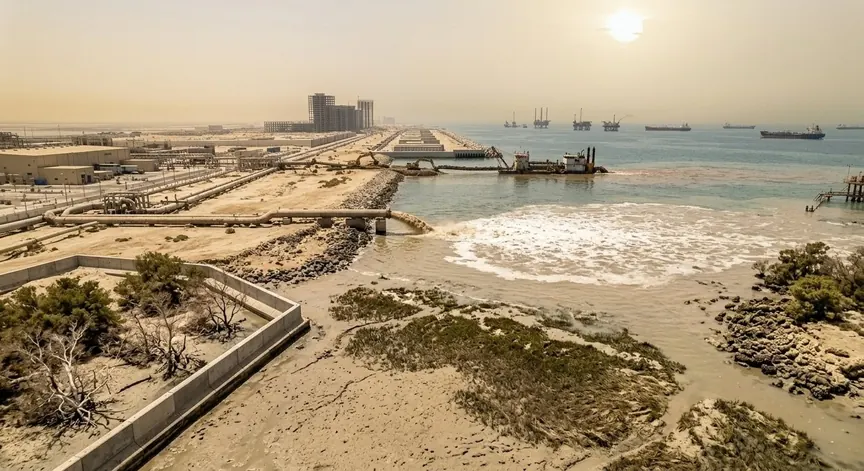
The "Where" is defined by a dangerous concentration of human activity. The subsequent, unending drive for accumulation has birthed a hyper-urbanization that is as unsustainable as it is aggressive. By the 1970s, oil had made West Asia one of the world’s fastest-growing regions, but this growth came at the cost of the coast itself. In modern hubs like Dubai, over 83% of all economic activity is now concentrated within a thin 100 km strip of coastline. This treats the shore not as a living, protective edge, but as a blank canvas for high-intensity engineering. Such expansion has necessitated massive land reclamation and dredging projects that have buried nearly two-thirds of the region's saltflats and seagrass meadows—the very lungs and nurseries of the Gulf.
The "What" is a mathematical and moral impossibility. This obsession with growth has created a circular trap of environmental degradation. To sustain these artificial megacities, the region has turned to desalination on an unprecedented scale, discharging 11 million cubic meters of chemical-laden, hyper-saline brine back into the Gulf every single day. Because the water exchange with the open ocean is so limited, this brine does not dissipate; it sits in the shallow basin, raising temperatures and salinity further. This is the mechanical reality of a system that views nature as a resource to be exhausted rather than a living relative to be respected. The "wealth" generated by coastal expansion is a net loss when weighed against the destruction of the "natural capital"—the carbon sequestration of mangroves and the water filtration of oysters—that makes habitation possible.
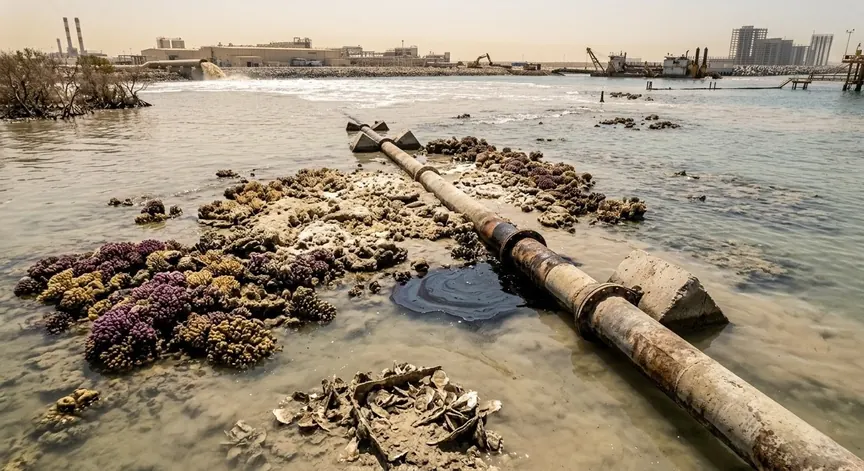
The "How" is an interlocking convergence of failures. The resulting convergence of military conflict, ecological decay, and industrial obsession creates a state of permanent crisis where every technological "solution" triggers a new biological failure. The legacy of the 1991 Gulf War oil spill remains a haunting benchmark, where billions in financial compensation failed to capture the irreversible loss of species. Today, the modern reality is a continuous, invisible erosion driven by 800 offshore platforms and the passage of 25,000 tankers annually. These stressors are an assault on the collective life-force of the region. When industrial intake systems remove the plankton and larvae that form the foundation of the food web, the damage is structural. The conflict is not merely geopolitical; it is a structural war against the biophysical systems that allow for any life at all.
The narrowing window for survival demands a radical departure from this extractive path toward a balanced, restorative stewardship that prioritizes the health of the whole over the unending growth of the part. This requires a deliberate cooling of the destructive appetites that have characterized the last century, opting instead for a stabilized state of existence that respects natural limits. True security in West Asia cannot be achieved through the lens of petroleum output or GDP; it requires a humble recognition that the biological integrity of the Gulf is a non-negotiable partner in our own existence. To protect the coastal swamps, the ancient oyster beds, and the coral systems is to honor the sea's right to persist as a living entity. Moving away from a centralized, extractive governance toward a quiet, effective harmony with the biophysical limits of this shallow basin is the only viable future.
The transition from the era of "dead wealth" must be a conscious step toward a path that sustains both the water and the people who depend upon its grace. Ultimately, we must recognize that when we diminish the livingness of the sea, we inevitably diminish ourselves.



Discussion 7 comments