



How India's unemployed graduates are rewriting the grammar of dissent, and why the ruling class is right to be afraid.
Disclosure: The author writes independently and holds no institutional affiliation with any political party, government body, or organisation mentioned in this piece. No funding was received in connection with its preparation.
Using the word "cockroaches" to describe political activists is an intentional slap in the face. But look past the shock value and the choice of word reveals something more diagnostically precise than its speaker intended. It describes a mode of political action that is hyper-adaptive, decentralised, and structurally impervious to the tools a traditional state reaches for when it wants to make a problem disappear.
These actors do not live fully inside the system, nor have they abandoned it. They occupy the walls. They feed on its decay. And they reproduce fastest in the very conditions designed to exterminate them.
This is not a theoretical observation. On May 15, 2026, Chief Justice of India Surya Kant, speaking from an open Supreme Court bench, articulated exactly what the Indian establishment thinks of this new generation of accountability-seekers:
"There are youngsters like cockroaches, who don't get any employment or have any place in the profession... Some of them become media, some of them become social media, RTI activists and other activists, and they start attacking everyone."
The court issued a clarification the following day claiming the remarks had been misrepresented. The clarification itself was revealing. When power scrambles to explain away its candor rather than defend it, you can be certain the candor was genuine. What the Chief Justice exposed in those sentences was not a personal failing of temperament. It was the institutional logic of a system that has come to experience democratic accountability not as a feature of the republic, but as a vector of contamination.
The Economic Terrain
To understand why that contempt has calcified at the highest levels of the judiciary, you have to understand the economic terrain on which this generation came of age. India produces roughly nine million graduates annually. According to data published by the Centre for Monitoring Indian Economy, approximately 29 percent of graduates aged 20 to 24 were without formal employment as of 2025, a figure that sits far above the national unemployment average and reflects a structural mismatch between the output of the higher education system and the absorptive capacity of the formal economy.
That aggregate number, however, conceals significant variation. Graduate unemployment in northern and central states, including Rajasthan, Uttar Pradesh, and Madhya Pradesh, runs considerably higher than in southern and western states where manufacturing and service sector growth has been more sustained. The problem is not uniform misery distributed evenly across a subcontinental economy. It is concentrated, geographically patterned, and disproportionately felt in precisely the states whose young men and women have historically depended most heavily on competitive public examinations as their primary route to economic stability.
It is also a trend, not a static condition. Graduate employment in the formal sector contracted relative to graduate output for four consecutive years leading into 2025, meaning each successive cohort entered a market slightly less capable of absorbing them than the one that preceded it. These graduates have done everything the meritocracy asked: they studied for years, sat for competitive examinations, paid coaching fees their families could not afford. Then they watched paper leaks invalidate those examinations, watched appointments made through networks of patronage, and watched the promise of upward mobility retract in real time.
This is not simply an economic problem. It is an epistemological rupture. When an entire generation simultaneously realises that the meritocracy was always partly fictional, the political consequences extend well beyond the unemployed themselves. It delegitimises the entire institutional apparatus that promised meritocracy as its organising principle: the courts, the universities, the civil services, the press. The rage is not merely about jobs. It is about being lied to with great formality for a very long time.
An Operating System, Not a Movement
The question a serious political analyst must then ask is: given the scale of that rupture, why has it not produced a more organised, more durable political challenge? The answer has everything to do with the nature of the system being challenged and very little to do with the will or intelligence of those doing the challenging.
Anyone who has attempted to reform a government institution from within can describe the specific texture of that defeat. It does not arrive as a dramatic confrontation. It arrives as a slow recalibration of ambitions. The reformer begins by wanting structural overhaul, settles for procedural improvement, and eventually counts it as a victory to have changed a single clause in a single document. The institution outlasts them. This is not incidental to how large bureaucracies function; it is fundamental to how they survive. They do not defeat challengers so much as they metabolise them.
Walking away entirely solves nothing either. Movements that place themselves completely outside institutional frameworks discover that purity of opposition does not translate into leverage. You can sustain the anger, but you cannot direct it toward specific policy outcomes without eventually re-entering the structures you abandoned.
The political response that has emerged from this impasse is best described not as a movement but as an operating system. It has no headquarters, no general secretary, and no platform that can be voted down or bought out. It is constituted by speed, mobility, and a sharp focus on single, legible injustices. It forms temporary coalitions, executes targeted actions, and dissolves before the state's enforcement machinery can orient itself. Its practitioners have, largely without theorising it, arrived at the same tactical doctrine that leaderless protest movements in Hong Kong, Chile, and elsewhere developed under similar conditions of concentrated state power and fragmented civil society.
In Hong Kong in 2019, protesters developed the "Be Water" strategy: using encrypted applications to converge on a subway station, block a road, or surround a government building, then disperse before riot units could deploy containment lines. The tactic was effective not because it defeated the police in any engagement, but because it made each engagement irrelevant. There was no occupation to clear, no leadership to arrest, no manifesto to discredit. The West Virginia teachers who launched wildcat strikes in 2018, bypassing their own union leadership to organise through private Facebook groups and shut down schools across all fifty-five counties, operated on similar logic: use the infrastructure of everyday life rather than the infrastructure of formal organisation, because formal organisation is where leverage goes to be managed and diluted.
The Cockroach Janta Party
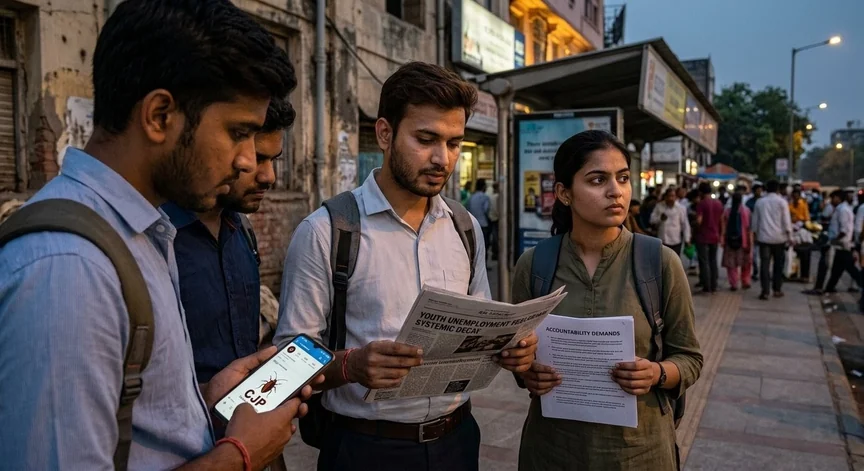
The Cockroach Janta Party, launched by activist Abhijeet Dipke and a loosely coordinated network of digital creators within forty-eight hours of the Chief Justice's remarks, is a local instantiation of precisely this doctrine. It did not emerge from strategic planning. It emerged from the same reflexive, distributed creativity that characterises cockroach politics in every context. The platform was deliberately satirical: a mock political party with self-deprecating eligibility criteria declaring its members a union of secular, socialist, and unemployed vermin. Within five days it had accumulated more than twenty million Instagram followers, a figure that dwarfs the digital audience of the ruling Bharatiya Janata Party, itself the world's largest political party by membership.
That number deserves analytical respect rather than dismissal. More than twenty million followers is a measure of identification, not entertainment. It tells you how many people recognised themselves in the insult and chose to wear it rather than dispute it. That is a qualitatively different political gesture than signing a petition or attending a rally. It is an act of collective identity formation that traditional parties, with their gatekeeping structures and ideological litmus tests, cannot manufacture at any speed, let alone in five days.
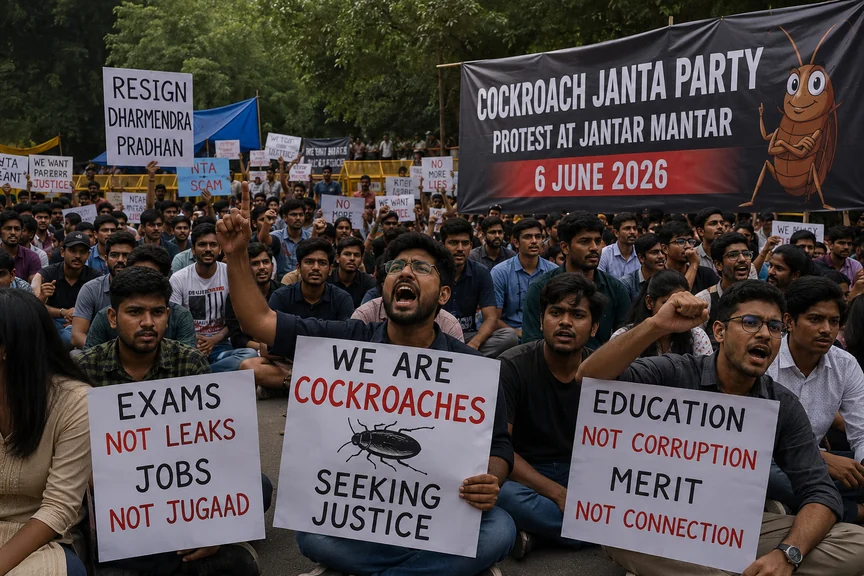
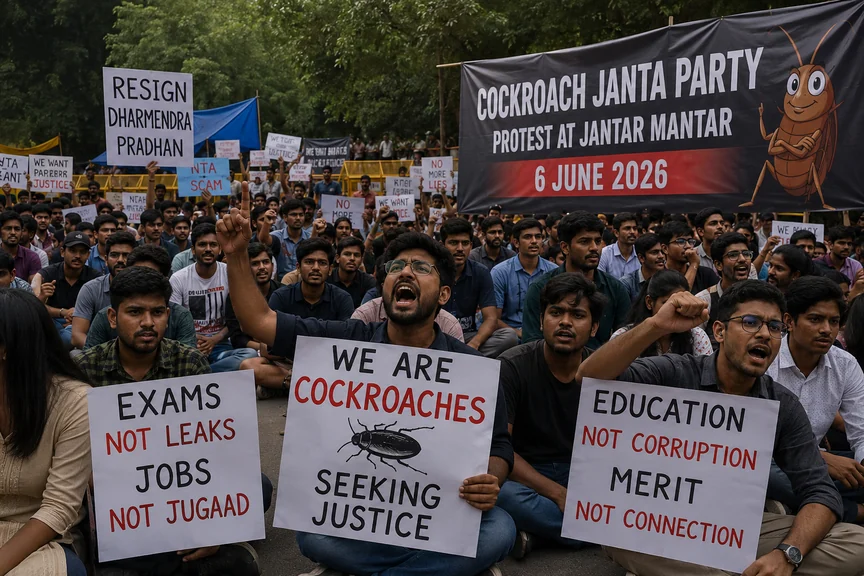
The transition from digital identification to physical mobilisation became visible on June 6, when thousands gathered at Jantar Mantar in New Delhi for the movement's first major offline protest. The demonstration was not organised around symbolic outrage alone. Protesters advanced a concrete demand: the resignation of Union Education Minister Dharmendra Pradhan, holding him politically accountable for the controversies surrounding recent CBSE and NEET examinations. Whether one agrees with that demand is ultimately less important than what it signifies. A formation that began as a satirical response to institutional contempt was now attempting to translate diffuse anger into specific political claims. That shift, from expression to demand-making, is the point at which dissent begins testing its capacity to become a political force.
The friction has already outgrown India's borders. On June 4, 2026, during an academic lecture at Birkbeck, University of London, the Chief Justice was directly confronted by an attendee over his remarks and over international concerns regarding India's growing hostility toward dissent. When a panicked moderator aggressively cut the questioner's microphone, parts of the audience erupted in protest. The High Commission of India in London quickly issued a statement scolding the crowd for "indecorous audience behaviour," but the damage was done. The viral clip, instantly weaponised online by the Cockroach Janta Party, demonstrated that the establishment can no longer travel abroad to speak abstractly about legitimacy without being pursued by the network of digital accountability-seekers it tried to suppress.
Grievance Is Not Enough
The twenty million figure, however, carries a caution that the movement's admirers tend to elide. Shared grievance is a powerful accelerant. It is a poor binding agent. The historical record on this point is not encouraging for formations whose identity rests primarily on a common enemy rather than a common programme.
The CJP's current coalition contains at least three distinct political temperaments that will eventually require reconciliation. There are those who want accountability within the existing constitutional framework, a more honest meritocracy, cleaner examinations, and transparent appointments. There are those who read the dysfunction as evidence that the framework itself is captured and requires structural replacement. And there are those whose primary motivation is expressive, who wish to be seen refusing shame, but who have not yet formed settled views on what should replace the institutions they distrust. These are not interchangeable constituencies. Managing them simultaneously, while avoiding the factional ruptures that have historically neutralised Indian civil society formations, will be the CJP's central organisational challenge.
The question of what, beyond contempt for the powerful, binds this coalition is one the movement has not yet been forced to answer, because it has not yet attempted anything that requires internal agreement. Satire is frictionless in a way that policy platforms are not. The first serious test of the CJP's ideological coherence will arrive not in confrontation with the state, but in the first internal disagreement about what it is actually for.
What the State Cannot Fix
The Indian state, like most contemporary states facing this kind of distributed dissent, finds itself in a structurally paradoxical position. Its coercive capacity is formidable. It can deploy paramilitaries, suspend internet access in entire regions, invoke sedition law against journalists, and demonetise the financial platforms that fund independent media. What it cannot do is solve the problems that produce the dissent in the first place.
Fixing competitive examination corruption requires dismantling the patronage networks through which significant portions of the political class recruit and reward their loyalists. Providing formal employment for nine million annual graduates requires an economic model that prioritises labour absorption over capital concentration. Genuine judicial independence requires the judiciary to stop functioning as a branch of the executive during politically sensitive cases. None of these are technical problems awaiting technical solutions. They are the load-bearing columns of the existing political economy. The state cannot remove them without collapsing the structure it was built to protect.
This is the crucial insight that the cockroach framing, for all its satirical brilliance, tends to obscure. The dysfunction being protested is not a failure of will or competence at the top. It is a feature. The paper leaks benefit someone. The opaque appointments benefit someone. The judiciary's reluctance to challenge executive overreach benefits someone. Dissent that treats these as correctable errors, rather than as rational outputs of an incentive structure, will consistently find itself surprised when reforms are announced and nothing changes.
The Problem of Pipes
The deepest limitation of gather-and-scatter politics is not that it lacks courage or creativity. It is that it lacks pipes. Intense, decentralised pressure is extraordinarily effective at preventing things: preventing a bill from passing, preventing a narrative from consolidating, preventing the powerful from acting without cost. It is considerably less effective at building things.
Writing new laws requires sustained coalition-building across interests that do not naturally align. Staffing regulatory agencies with people who will actually regulate requires years of patient institution-building. Changing the curriculum in ten thousand schools requires someone to negotiate with state governments, teacher unions, and textbook publishers across multiple electoral cycles. None of this maps onto the gather-and-scatter tempo.
The historical record on this point is unambiguous. The labour movement in the early twentieth century was built by people willing to do the unglamorous work of organisational maintenance between strikes: collecting dues, training shop stewards, developing legal capacity, building relationships with sympathetic politicians. The civil rights movement in the United States was not only the Birmingham marches and the Montgomery buses; it was also a network of HBCU-trained lawyers who had spent decades building the legal architecture that made those campaigns actionable in court. The visible confrontations were the tip of an iceberg of institutional infrastructure that took thirty years to build.
India's cockroach generation has not had thirty years. It has had the internet, mass unemployment, and a state that treats accountability as infestation. It has, under those conditions, built something genuinely remarkable: a distributed network with real emotional reach, cultural fluency, and tactical creativity that no conventional political actor can replicate. The question of whether that network can survive the transition from reactive insurgency to proactive institution-building is the most important political question in India today, and it does not have an answer yet.
The Question of Legitimacy
There is a dimension of this conflict that purely structural analysis tends to miss: the question of whose contempt matters. When a Chief Justice of the Supreme Court of India describes unemployed graduates seeking accountability as vermin, he is not merely insulting them. He is communicating to them, with the full weight of institutional authority, that their participation in democratic life is unwelcome. That the state views their use of its own transparency mechanisms as a kind of attack. That the formal architecture of the republic was not designed with them in mind and would prefer they find somewhere else to be.
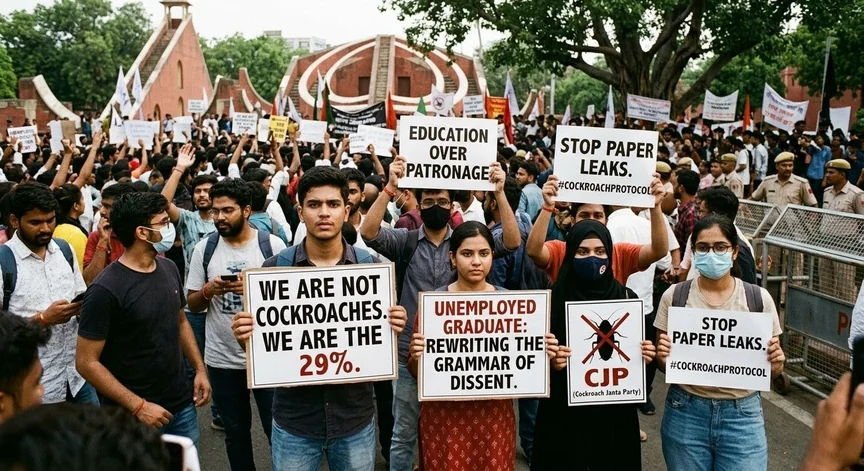
The CJP's response, and the more than twenty million people who joined it within days, is the answer to that communication. It is not primarily a policy platform. It is a refusal of shame. And that refusal, whatever its organisational limitations, is politically foundational in a way that no amount of tactical sophistication can substitute for. You cannot build a durable political movement out of people who have accepted the legitimacy of their own marginalisation. You can build one, though it takes time and structure and patience, out of people who have decided that the contempt of the powerful is evidence of the powerful's failure, not their own.
The ruling class is not wrong to be anxious. They are wrong about the reason. The danger is not the cockroaches. The danger is the rot that made the walls habitable for them in the first place, and the growing number of people who have stopped believing the walls are worth preserving. Systems often collapse not from a single massive blow, but because thousands of localised pressures eventually exceed the machine's capacity to cope. We are in the accumulation phase. Whether it leads anywhere depends on what gets built in the intervals between eruptions, and on whether a generation defined by its refusal of shame can find, in that refusal, something more durable than fury.
Sources:
The CJI's Remarks and Clarification
https://en.wikipedia.org/wiki/Cockroach_Janta_Party
https://www.britannica.com/topic/What-Is-the-Cockroach-Janta-Party
The Cockroach Janta Party — Launch, Followers, Demands
Birkbeck London Confrontation
https://www.siasat.com/cji-surya-kant-faces-backlash-over-cockroach-remark-in-london-3483715
Graduate and Youth Unemployment Data (CMIE / PLFS)
https://360info.org/indias-youth-boom-promise-or-pressure-point
https://indiamacroindicators.co.in/resources/blogs/indias-unemployment-rate-in-2025
https://www.theglobalstatistics.com/unemployment-rate-in-india
https://pwonlyias.com/unemployment-rate-in-india
West Virginia Teachers' Strike 2018
https://en.wikipedia.org/wiki/2018_West_Virginia_teachers%27_strike
https://www.buzzfeednews.com/article/carolineodonovan/facebook-group-west-virginia-teachers-strike



The way the system is functioning it heads almost nowhere hence we need fresh ideas to move our system in the right direction and I feel that it's only the youth who can lead us forward.