



What the new BJP government's station evictions reveal about capital, dispossession, and which economy the city has decided to see.
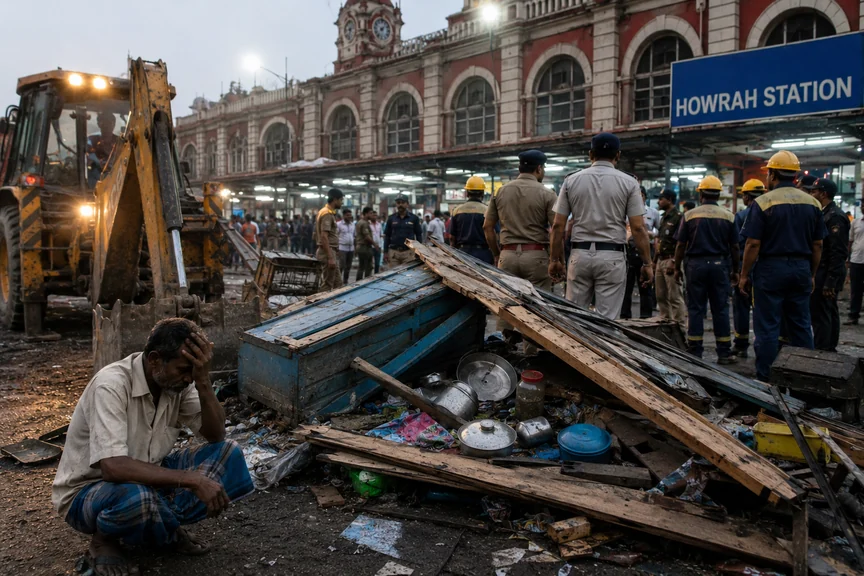
The machines arrived before dawn.
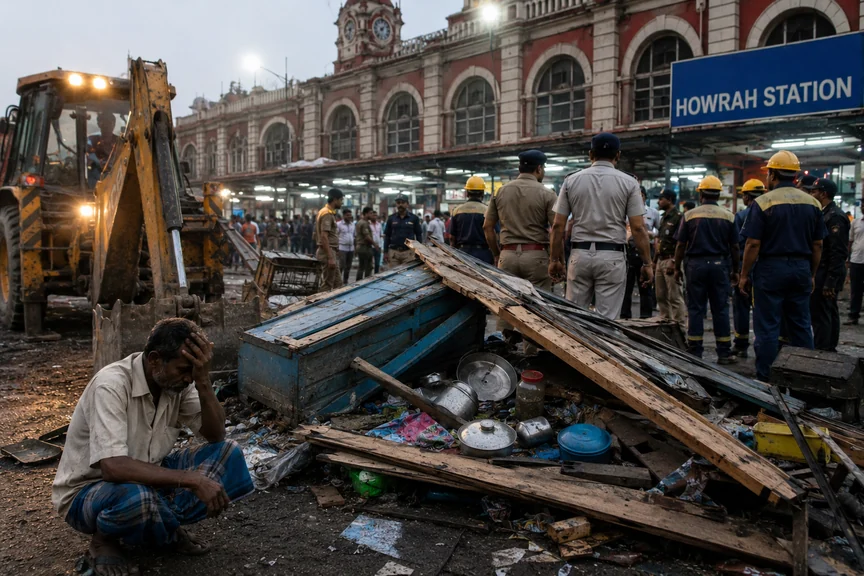
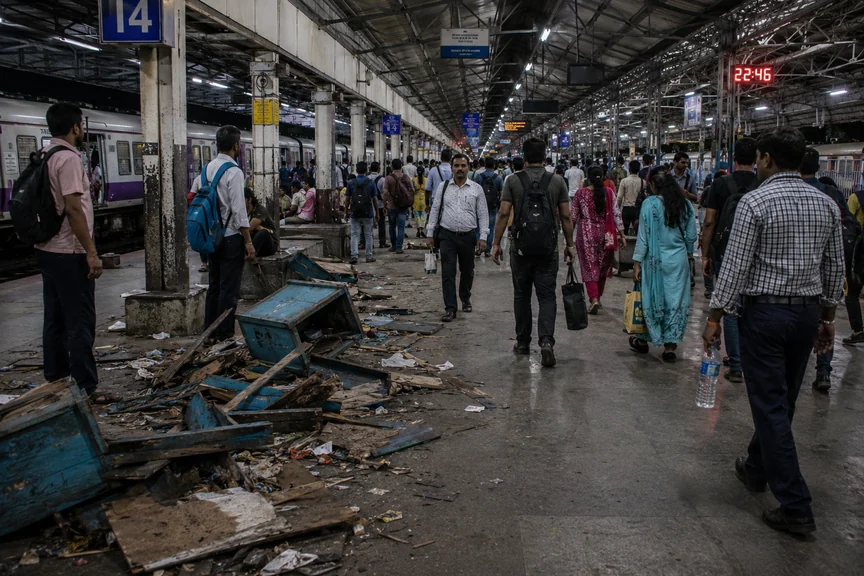
On the night of May 17, 2026, barely nine days after Suvendu Adhikari's BJP was sworn into power in West Bengal for the first time in its history, bulldozers began operating at midnight along the Howrah waterfront. By the time the sun came up, roughly 150 stalls and makeshift shops along the stretch from the Ganga ghat to the station premises were gone.
The midnight hour was not chosen for administrative convenience. It was chosen because darkness is the oldest instrument of governance by humiliation. You demolish what people built with their lives at a time when they cannot gather, cannot resist, and cannot make you look at what you are doing to them.
No Town Vending Committee had convened. No biometric survey had been completed. No Certificate of Vending had been issued to a single affected hawker. What the Street Vendors (Protection of Livelihood and Regulation of Street Vending) Act of 2014 describes as a mandatory participatory process was compressed entirely into the roar of a diesel engine and the silence of a city still asleep.
The BJP won 208 seats in the 2026 West Bengal assembly elections against TMC's 80, (Business Standard) ending decades of uninterrupted Left and then Trinamool rule. What followed the mandate was swift. At Howrah station, the joint operation by the Railway Protection Force, Government Railway Police, and Howrah City Police removed hawkers selling food items, fruits, toys, and daily essentials from the station approach, the bus stand area, and the Ganga ghat stretch. Within days, anti-encroachment drives at Sealdah cleared hundreds of hawkers and roadside stalls, with all 21 platforms made hawker-free. By the end of May, the Dum Dum railway station area had also been swept of hawkers and makeshift stalls.
Three of the city's busiest railway stations. Hundreds of hawkers. Overnight.
The official framing arrives in the language that administrations across the world have learned to deploy when they need the removal of inconvenient people to sound like progress. Public space is being reclaimed. Platforms are being restored to passengers. Transit infrastructure is being modernised under the Amrit Bharat project. Order, long deferred, is finally arriving.
The language is civic, technical, forward-looking. It is also performing a specific sleight of hand, and that sleight of hand deserves to be named before anything else in this story is examined.
What is being called a cleanliness drive is, in economic terms, a transfer.
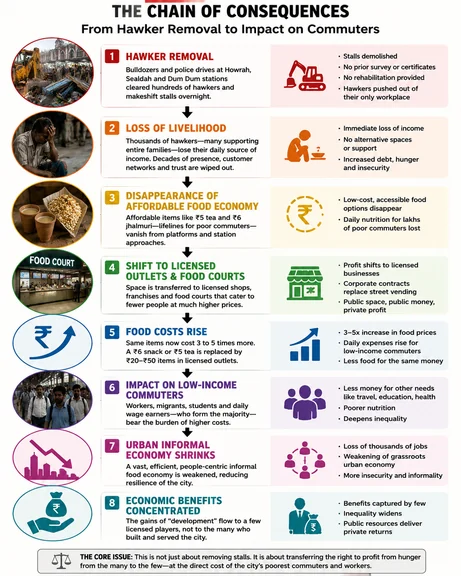
The masala muri hawker who sold his jhalmuri for six rupees outside platform seven has been removed. The licensed food outlet that sells a sandwich for fifty rupees inside the station has not been touched. The woman who dispensed chai in clay bhaands at five rupees a cup to workers arriving on the first local from Barasat has been cleared. The branded tea counter charging twenty-five rupees for the same cup is open for business this morning, as it was the morning before the bulldozers came, as it will be tomorrow.
Howrah station's large food court and its licensed food shops remain fully operational and entirely untouched.
Sealdah station's IRCTC food court, its licensed counters, its formally contracted food stalls inside the building, all continue to function without interruption.
"What has been transferred is not space. It is the right to profit from hunger."
That right has been moved, by bulldozer, from those who held it through presence and daily labour and a knowledge of their commuters accumulated over decades, to those who hold it through a licensing contract with the railways. The distinction between these two forms of claim is not hygiene. It is not safety. It is not public order. It is capital.
One kind of claim is backed by capital and is therefore legible to the state. The other is backed only by the body that shows up every morning and the customers who depend on it. In the administrative imagination, that second kind of claim is no claim at all.
This is how development operates when it is not interrogated. It does not create value from nothing. It relocates value, systematically and with great force, from the economy that sustains the many to the economy that is measurable by the few.
The masala muri hawker was sustaining a food system that served tens of thousands of the city's poorest commuters at a price they could actually afford. That economy was real. It was functioning. In any honest accounting it was more efficient at the task of feeding urban workers than anything the railways' licensed contractors have ever managed.
But it was not legible. It did not appear in a licence registry or a tax filing or a corporate revenue statement. It could not be photographed as progress. And so, in the accounting that governs how cities decide what to keep and what to remove, it did not fully exist.
Sealdah alone handles over 1.5 million passengers every single day, (Wikipedia) making it the second busiest railway station in India.
Howrah is the largest and busiest railway complex in India, handling over a million passengers daily. (wanderlog) The overwhelming majority of these passengers are not the urban middle class for whom a fifty-rupee sandwich registers as a mild inconvenience. They are workers, migrants, daily labourers, students, and families arriving from rural Bengal. Many of them have spent on their train ticket most of what they had for the day. For them, the masala muri at six rupees and the clay cup of tea at five was not a comfort. It was a meal.
Research on West Bengal's railway hawkers has established that on many trains without pantry cars or food services, hawkers are the only source of food available to passengers. Studies confirm that hawkers are among the most marginalised of the urban poor, predominantly migrants from rural areas for whom street vending represents one of the few accessible paths to income in the face of structural unemployment.
What was demolished at Howrah and Sealdah was not an encroachment on a food system. It was the food system itself. The one that actually worked for the people who most needed it to work, replaced by a food system that works for the people who already had other options.
Passengers at Sealdah admitted, when asked after the clearances, that they already miss buying tea, snacks, and essentials during their commute. A commuter who has used the Sealdah route daily for nineteen years said there was not a huge problem with the hawkers. Rather, there are many other problems that need to be addressed.
This is not ideology speaking. This is nineteen years of lived material experience. He is telling you that the problem the administration chose to solve was not the problem he was experiencing on the platform. He is telling you that what was presented as a solution to congestion was experienced, by the people inside it, as the removal of something they needed.
The administration did not hear this before the midnight operation. It would not have changed the decision if it had.
One hawker, unwilling to be named, said from a corner near the cleared platforms: where are we supposed to go now? We sit at a corner without disturbing passengers. (MillenniumPost) Another, watching his stall being dismantled, said: we will have to resort to suicide if no rehabilitation is provided.
These two sentences, held together, constitute the full moral weight of what has happened at Howrah and Sealdah.
The first is a question about belonging. Where in this city, which we helped build and which we have fed every morning for thirty years, do we have the right to exist? The second is the answer that arrives when that question receives no response. The arithmetic of survival without income runs in only one direction.
Both sentences were reported. Neither changed anything.
Now track the geography of what the machinery did not touch, and the operating principle of this entire exercise becomes visible.
Gariahat market remains open. The hawkers of Behala trade without interruption. Burrabazar, north Kolkata's historic commercial artery, proceeds with its daily density entirely undisturbed. The difference between these zones and the approaches to Howrah, Sealdah, and Dum Dum is not the nature of the vending. It is the political economy of what stands behind it.
The legacy commercial districts of the city are backed by decades of unionised collective power and deep integration into the middle-class consumer economy. Their organised capacity to trigger civic shutdowns carries real electoral consequence. The railway station hawker carries a bag of fruit and a thirty-year knowledge of his commuters.
The bulldozer finds the two very easy to distinguish between.
The 2014 Street Vendors Act exists precisely to prevent this kind of distinction from being made by machine in the middle of the night. It requires Town Vending Committees with at least forty percent elected vendor representation before any spatial decision is made. It mandates a biometric survey and individual Certificates of Vending before any eviction proceeds. It requires a thirty-day written notice and the prior identification of a commercially viable alternative vending zone.
None of this happened at Howrah. None at Sealdah. None at Dum Dum.
The Act was not amended. It was not challenged in court. It was simply ignored, which is a more efficient form of contempt than repealing it.
The Calcutta High Court found that an eviction notice issued near Howrah station was unsigned and bore no identification of the statutory authority under which it had been issued.
A blank threat, legally speaking, backed by machinery that did not wait for a reply. Justice Hiranmay Bhattacharya placed an interim stay on the eviction drive near Howrah Station, observing that hawkers facing eviction should be given a fair opportunity to present their arguments before the court. The next hearing was fixed for June 10. The stay, however, does not pertain to hawker eviction drives outside other railway stations.
One station won a temporary reprieve. The administration had already cleared three.
The court observed that even if a structure is illegal, a specific legal process must be followed, and the administration cannot take unilateral action without providing due process.
That a sitting government requires a High Court to restate this to it tells you everything about how completely administrative velocity had displaced constitutional obligation in the urgency to produce a visible result.
The visible result is entirely legible to the audience it was designed for. The urban middle-class commuter who welcomes the cleared platform is not wrong that the platform is easier to walk through. That experience is real.
What it does not contain is any awareness of the price at which the clearance was achieved, who paid it, and what now stands in the space where the hawker used to be.
A fifty-rupee sandwich. A branded tea counter. A food court with sixty seats for a station that handles a million and a half passengers a day.
These are not alternatives to the hawker economy. They are monuments to its absence, priced at a level that tells the worker arriving on the first local exactly how welcome his hunger is in the new order.
It is necessary here to be precise about political responsibility across its full range, and not allow the BJP's current excess to absorb all accountability for a thirty-year failure.
On International Hawkers Day, Mamata Banerjee said she was astonished, angry, and deeply pained at the treatment of hawkers since the BJP came to power.
The astonishment is difficult to credit.
Trinamool governed West Bengal for fourteen years. In those fourteen years, not a single biometric survey mandated by the 2014 Act was completed. Not one functioning Town Vending Committee was constituted. The Certificates of Vending that would have given today's evicted hawkers a legal instrument to hold were never issued.
The hawker was politically useful to Trinamool as a mobilisable vote bank and a source of street-level party infrastructure. The hawker was apparently not useful enough to receive the one protection that would have made his presence at the platform legally unassailable: recognition under the law that already existed and was simply waiting to be implemented.
What Trinamool built was a system of patronage that kept the hawker dependent and grateful without ever making him secure. That system was efficient at producing loyalty. It was indifferent to producing rights.
Eviction drives are not new to this city. They began with Operation Sunshine under the Left Front in the mid-1990s and have been repeated since, yet hawkers always return. Previous attempts to clear the areas also failed, largely because proper rehabilitation was never carried out. (The Federal)
Three decades. Three governments. The hawker returns every time because the conditions that produced him were never addressed.
The masala muri vendor at Sealdah, the tea seller at Howrah, the fruit hawker at Dum Dum are not there by accident or sentiment. They are there because the formal economy cannot absorb them. Because millions of daily commuters need what they provide at a price the formal economy cannot match. And because the city has chosen, government after government, to treat this as an aesthetic problem rather than a structural one.
The formal economy did not fail these people and then feel embarrassed about it. It failed them and then sent a bulldozer to remove the evidence of the failure, leaving the branded food outlet standing in the cleared space as proof of what it calls progress.
Research on female railway hawkers between Barrackpore and Sealdah has documented women navigating extremely long working hours, constant legal precarity, and the double burden of vending and domestic labour simultaneously, with no legal security whatsoever.
These women did not appear in any government survey before the bulldozer came. They will not appear in any government survey after it.
They are part of the economy that does not count because it was never counted. The economy that sustains the city's daily life at its most basic level while remaining invisible to every instrument the state uses to measure whether the city is developing. When they are gone from the platform, no growth figure registers the loss. No productivity index dips. No government report notes the absence.
The station is cleaner. The photograph is better. The hunger is the same, and now costs five times more to address.
Development, as practised here, does not ask what these women were providing and to whom and at what price and with what consequences for the million commuters who depended on them. It asks only what the cleared platform looks like in a photograph, and whether the food court behind it has a valid licence.
The Calcutta High Court has done what courts are constitutionally required to do. It has inserted the rule of law between administrative impulse and the people most exposed to its force. Whether the June hearings extend that protection beyond Howrah alone will say something important about what this government understands by the word process.
But no court order can rebuild the masala muri stall outside platform seven.
No stay order can restore the woman selling chai in clay bhaands at five rupees to the workers who counted on her and who now stand in front of a laminated menu board, doing arithmetic that does not work out in their favour.
The deepest question this crisis poses is not about the BJP. Not about the TMC. Not about the railways or even the 2014 Act, though all of these matter. It is about what a city has decided to recognise as real.
The hawker's economy was real. It fed people. It employed people. It sustained livelihoods and households and daily survival across one of the most densely transited squares of urban space in the entire country. It was not measured, not registered, not certificated, not visible in any of the registers the state uses to tell itself the story of its own economy.
And because it was not measured, it was, in the administrative imagination, available to be removed.
The food court is licensed. The franchise is contracted. The branded outlet has a document. These are the forms of presence the state has decided to call legitimate. They cost three to five times more than what they replaced, which means they serve three to five times fewer of the people who need them.
This is not an accident of policy. It is the policy.
It is what cities look like when they decide that the economy worth protecting is the economy already legible to capital, and that everything existing outside that legibility is, by definition, an encroachment.
The hawker at Howrah fed the city at midnight, before the machines arrived, for one last time. Nobody saw it as feeding the city. The administration saw it as an encroachment. The licensed food court saw it as competition. The commuter who ate it saw it as breakfast.
Only one of these three ways of seeing it was demolished before sunrise.
Authentic Source URLs:
1. For Sealdah Station technical and passenger metrics:
https://en.wikipedia.org/wiki/Sealdah_railway_station
-
For Sealdah's socioeconomic role in Kolkata's mobility: https://cogindia.art/sealdah-railway-station-colonial-infrastructure-partition-urban-calcut/
-
For Howrah Junction operations, passenger data, and historic layout:
https://wanderlog.com/place/details/15379469/howrah-junction-railway-station
- For the comprehensive technical history and configuration of Howrah Station:
https://en.wikipedia.org/wiki/Howrah_railway_station
- For the legal mandates, Town Vending Committee parameters, and eviction protections under Indian federal law:
https://en.wikipedia.org/wiki/Street_Vendors_Act,_2014
- For analytical breakdowns on structural challenges regarding the implementation of the 2014 Act:
https://ccs.in/model-street-vendors-protection-livelihood-and-regulation-street-vending-act
Judicial and Statutory Portals:
1. For tracking case statuses, daily orders, and official judgments issued by the bench regarding transit-area evictions: https://calcuttahighcourt.gov.in
- For accessing the comprehensive, centralized database of high court orders across Indian states regarding urban vending disputes:
https://hcservices.ecourts.gov.in
- For the verified statutory text, constitutional provisions, and legal framework of the Street Vendors Act of 2014 via the official legislative repository:





আরো একটা কথা মাথায় আসছে। এই সব ঘটনা আত্মঘাতীও। এত শত শত মানুষের খাদ্য সুরক্ষা (কেউ অন্যকে খাবার জোগান দিয়ে বা অন্য কিছু বিক্রি করে নিজের খাবার ব্যবস্থা করছেন ) ভেঙে পড়লে রাষ্ট্রের ওপর চাপ বাড়ে। কখনো কখনো শাসকের ইচ্ছে না থাকলেও (যতক্ষণ না বিশেষ কোন উপায়ে গণহত্যা না করে একটা বিরাট জনসংখ্যাকে মেরে না ফেলা যাচ্ছে, আবার সেটা পারলেও সেটা সাময়িক, যেমন গণহত্যার পরেও ইহুদিদের আজকের যুদ্ধ) জনগনের quantitative pressure শাসকের ওপর এসে পড়ে। যতক্ষণ মানুষ নূন্যতমও খেতে পায়, অধিকার খর্বের কথা না ভেবে মানিয়ে নেবার চেষ্টা করে, কিন্তু পেটের ভাত না থাকলে তার animal killing instinct জেগে ওঠে। শাসক ক্ষমতার illusion এ বারবার এই তত্ত্ব ভুলে যায়।