


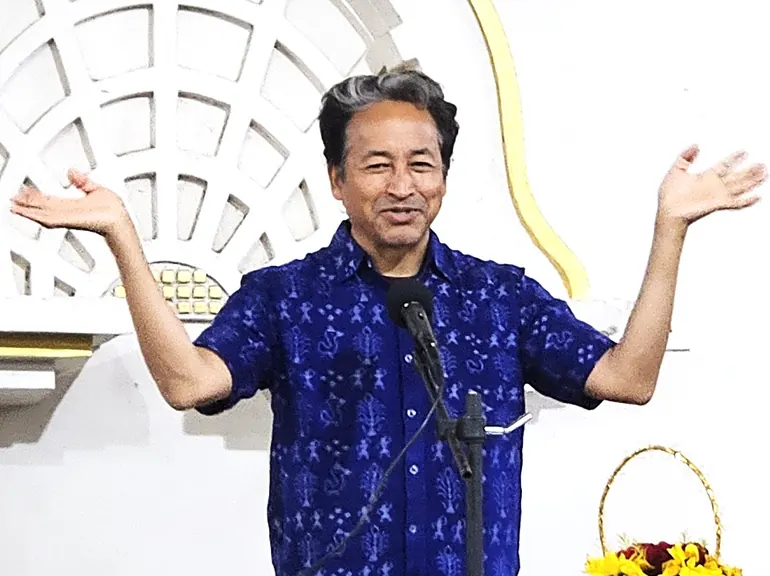
The cessation of Sonam Wangchuk’s incarceration in Jodhpur Central Jail on March 14, 2026, represents less a victory for civil liberties than a calculated recalibration of executive strategy. After 170 days of preventive detention under the National Security Act (NSA), the Union Government’s decision to revoke the order—utilizing the administrative bypass of Section 14—bears the distinct signature of a tactical withdrawal. To the casual observer, the educator and innovator’s return to the highlands of Ladakh might appear as a restoration of justice; to the critical analyst, however, it is a move designed to preserve the state’s discretionary power by evading a definitive judicial ruling. By lifting the veil of detention just seventy-two hours before the Supreme Court was poised to interrogate its legality, the state has effectively utilized a strategy of enforced quietude to neutralize a movement while successfully bypassing the finality of constitutional accountability.
The reportage of this case reveals a disturbing pattern of administrative overreach disguised as security necessity. Wangchuk, an asset of global stature in ecological restoration and the 2018 Rolex Award laureate, was spirited away on September 26, 2025. The state’s justification was rooted in an expansive and increasingly common interpretation of national security, characterizing his advocacy for Ladakh’s statehood and the Sixth Schedule as an incitement of "Gen Z" youth toward a disruptive agitation. For six months, the state maintained a rigid, almost mechanical worldview: a citizen was either a compliant participant in a centralized developmental narrative or a threat to be digitally and physically removed from the board. During the habeas corpus hearings, Justices Aravind Kumar and Prasanna B. Varale unraveled a tapestry of procedural fragility, flagging discrepancies where a three-minute address was recorded as seven minutes in transcripts. This was not merely a clerical error; it was the manipulation of evidence to justify the physical displacement of a figure whose primary crime was his refusal to be silenced.
Wangchuk represents a rare intersection of science and belonging. His life’s work—the engineering of Ice Stupas that provide water to parched high-altitude farms and solar-passive mud homes that defy the Himalayan winter—is an act of deep-rooted stewardship. These are not merely technical inventions; they are the physical manifestations of a community’s right to exist in its own landscape without external, predatory interference. To lock such a figure in a desert cell a thousand miles from the glaciers he protects is a form of exile that seeks to hollow out the leadership of a region, replacing the organic, physical presence of its most respected voice with a pixelated image in a court file. The government’s official statement that he has "already undergone nearly half of the period of detention" is a chilling admission; it suggests that the state has already extracted its penalty. In a democracy of international standards, the process should never be the punishment, yet here, the clock was weaponized to ensure that even a "victory" in court would come too late to prevent the seasonal erosion of the movement.
This phenomenon is part of a global, creeping trend where the "Emergency" is no longer an exception but a permanent tool of administrative governance. By utilizing preventive detention against environmental defenders, the state signals that ecological preservation is now viewed through the same lens as domestic instability. This is a profound category error. When a scientist like Wangchuk demands the protection of the Himalayan glaciers, he is not threatening the state; he is defending the very substrate upon which the nation exists. To treat this as a "law and order" crisis is to reveal a state that has become untethered from its own biological reality. The vision of industrial expansion and mining in the fragile Ladakhi ecosystem is a high-interest loan on the future of our water security, and Wangchuk was the one reminding us of the impending default.
The path forward requires a standard of accountability that rejects the false choice between absolute state security and absolute individual license. It demands that the state’s power to detain be kept in a state of constant, rigorous tension with its obligation to provide verifiable evidence. True authority is not a gift returned by the executive after it has served its purpose of silencing a critic; it is a fundamental right that must be guarded by a judiciary that refuses to let the state "release and retreat" to avoid a judgment. If the Supreme Court allows this "strategic revocation" to pass without a definitive declaration of the detention’s initial illegality, it risks signaling that the executive can pause a citizen's life at will, provided it hits "resume" just before the law catches up. A border region can never achieve stability if its residents are treated as inherent threats for demanding the very safeguards the Constitution promises.
The psychological toll of this forced absence cannot be overstated. When a leader is removed, the community enters a state of profound vacuum. The digital connection—the video calls and the pixelated news updates—is a poor substitute for the physical presence of a mentor. The state allows the citizen to exist as a "data point" or a "news item," but denies them the ability to exist as a physical force of change. By releasing Wangchuk only after the winter protest cycle had peaked and faded, the state utilized "time" as a silencer. It is a sophisticated form of censorship that does not burn books but simply delays the reader until the information is no longer actionable. We must ask: how do we quantify the loss to a democratic movement when its primary voice is silenced during a critical window of policy-making and dialogue?
Furthermore, the "mutual trust" the government now claims to seek cannot be built on the foundation of a 170-day forced separation. Trust is a function of integrity—the confidence that one can speak for their land without being exiled from it. If the state wishes to foster dialogue, it must first dismantle the machinery of fear that made the detention possible. It must recognize that the Sixth Schedule is not a threat to national sovereignty, but a reinforcement of it. A self-reliant, satisfied, and ecologically secure Ladakh is the strongest possible defense for a border region. When the state suppresses local voices, it creates a vacuum that external interests are all too happy to fill. Thus, the detention of Wangchuk was, in itself, a strategic blunder that weakened the very national security it claimed to protect.
The question remains: When? When will we stop treating the fundamental rights of our citizens as variables in a security equation? When will we recognize that the most stable borders are not those policed by the fear of detention, but those anchored by a satisfied and self-reliant populace? If we do not demand a full accounting of the 170 days stolen from this architect of resilience, we are merely building a more sophisticated cage for our collective liberties. We must prioritize the integrity of the habitat over the prerogative of the state, ensuring that the next generation of innovators does not have to choose between their laboratory and a prison cell.
The sun setting over the Himalayas today should light the path toward a future where "peace" is not the absence of dissent, but the presence of justice. We stand at a crossroads between a future of managed subjects and a future of sovereign citizens. The release of Sonam Wangchuk is not the end of the story; it is the beginning of a necessary interrogation into the dark corners of executive power. We must ensure that this silence is replaced by a transparent edifice of law where the dignity of the individual and the health of the earth are held as the ultimate metrics of a nation's greatness. Between the integrity of a citizen’s freedom and the prestige of an unchecked executive, the foundation of our future rests on the choice we make today.



Your framework of "Proportional Integrity" is a vital evolution in national security theory. As you correctly identify, defending a glacier is not a threat to the state; it is a defense of the very substrate upon which the nation exists. To treat such stewardship as a "security variable" is a category error of the highest order.
The tactic of "strategic revocation"—releasing detainees to evade judicial precedent—is a sophisticated attempt to bypass constitutional accountability. We further endorse your conclusion that a border’s strongest defense is a self-reliant populace. This principle of Habitational Sovereignty must become the new benchmark for developmental dialogue.
The De-growth has provided a vital lens for the coming decade of climate-legal tensions.
My best wishes to Dr Sonam.
Excellent presentation ❤️