



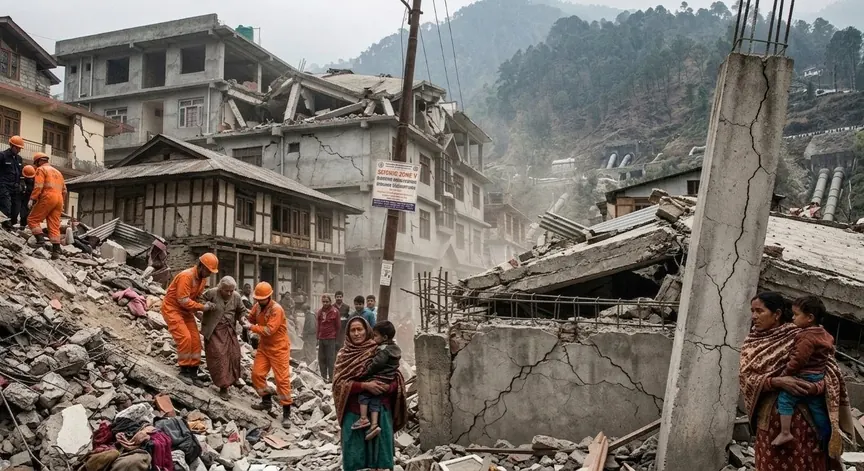
There is a particular kind of silence that precedes disaster. It is not the silence of nature, but the silence of omission—the quiet withdrawal of a report, the softening of a warning, the decision to set aside what is known because acknowledging it would be inconvenient. In India’s Himalayan and northeastern regions, that silence has now taken institutional form. The decision by the Bureau of Indian Standards to shelve the updated IS 1893 earthquake safety codes—after nearly a decade of scientific work—reveals more than a technical disagreement. The revised codes, based on data from over 160 seismic monitoring stations and extensive peer-reviewed analysis, indicated that several regions face significantly higher seismic risk than current regulations acknowledge. The problem was not uncertainty in the science. It was the cost of accepting it.
Stricter safety standards would require redesigning infrastructure, reinforcing existing structures, and increasing construction costs across both public and private sectors. Faced with these implications, the system chose delay. In doing so, it converted a scientific conclusion into an economic inconvenience—one that could be postponed, but not eliminated. This is the deeper pattern shaping development today: risks are not resolved; they are deferred. Instead of adapting to the physical realities of the landscape, policy frameworks attempt to manage them through accounting logic. The assumption is that exposure can be contained, that vulnerabilities can be absorbed later, that the future will somehow accommodate what the present refuses to confront.
Nowhere is this more dangerous than in the Himalayas. This is not a stable platform for expansion, but one of the most geologically active regions on Earth. The Indian tectonic plate continues to press into the Eurasian plate, storing energy that is released intermittently through earthquakes of unpredictable magnitude. This is not a distant possibility; it is an ongoing process. Any system built here must begin with that fact. Yet the dominant approach treats the region as if it were predictable. Roads expand, tunnels deepen, hydropower projects multiply, and urban settlements grow—often guided by standards that no longer reflect the best available knowledge. The gap between what is known and what is practiced is where risk accumulates.
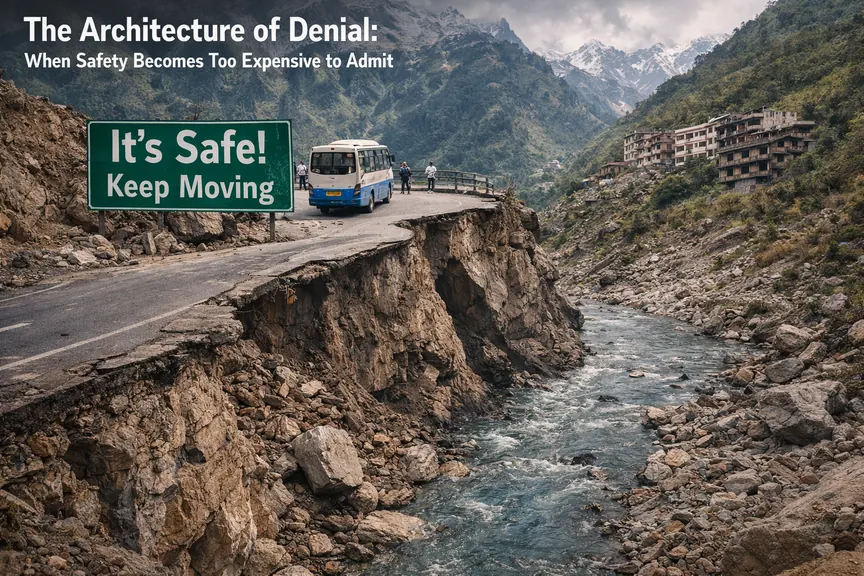
For those living in the foothills and seismic zones of the Northeast, this gap is not theoretical. It is structural. When safety codes remain outdated, the consequences cascade downward. Large projects may incorporate partial safeguards, but smaller residential buildings—where most people live—are constructed with minimal oversight. The result is a landscape where vulnerability is unevenly distributed, falling most heavily on those least equipped to manage it.
India does not lack historical warning. From the 1897 Shillong earthquake to more recent tremors across the region, the pattern is clear: the ground moves, often with little notice, and the damage is determined less by the force of the quake than by the strength of what stands upon it. Earthquakes do not kill buildings; poorly built structures do. To ignore updated seismic assessments in such a context is not caution—it is exposure. It is the quiet normalization of risk under the language of feasibility.
The logic behind this choice is familiar. Development is framed as urgent, budgets as constrained, and safety as negotiable within those limits. But this framing reverses the order of priorities. Safety is not a feature of development; it is its foundation. When that foundation is compromised, growth does not create security—it amplifies fragility. The consequences extend beyond immediate human loss. Earthquakes in densely built regions trigger cascading failures: collapsing transport networks, ruptured pipelines, disrupted water systems, and long-term economic dislocation. In ecologically sensitive zones, they can also accelerate landslides, deforestation, and river course changes, compounding environmental stress.
In this sense, the decision to delay stronger building codes is not contained within the domain of engineering. It is a systemic risk multiplier. It binds infrastructure policy, economic planning, and environmental stability into a single point of failure. At the heart of this problem is a persistent miscalculation: the belief that limits can be negotiated. That natural systems will tolerate incremental excess. That consequences can be managed once they arrive. But geological processes do not respond to policy timelines or fiscal adjustments. They operate on their own terms, indifferent to whether a structure was built cheaply or correctly.
This is where a more grounded form of reasoning becomes necessary—one that measures decisions not only by immediate cost, but by eventual consequence. The question is not whether safer construction is expensive. The question is whether the alternative is survivable. A simple comparison clarifies the stakes: the cost of reinforcing a structure today versus the cost of its collapse tomorrow. One is financial and immediate. The other is human, irreversible, and vastly greater. When framed this way, the notion that safety is “too expensive” begins to lose coherence.
Policy, however, often avoids this clarity. It operates within shorter horizons, where trade-offs can be justified and risks can be diffused across time. But earthquakes collapse those timelines. They compress decades of deferred decisions into a single moment of reckoning. To respond effectively, a shift in approach is required—not away from development, but toward a more disciplined form of it. This begins with reinstating the updated IS 1893 codes as a mandatory baseline, not a negotiable guideline. It requires targeted subsidies and technical support to ensure that safer construction is accessible, particularly in low-income and high-risk areas. And it demands that infrastructure planning be aligned with geological realities, rather than adjusted after the fact.
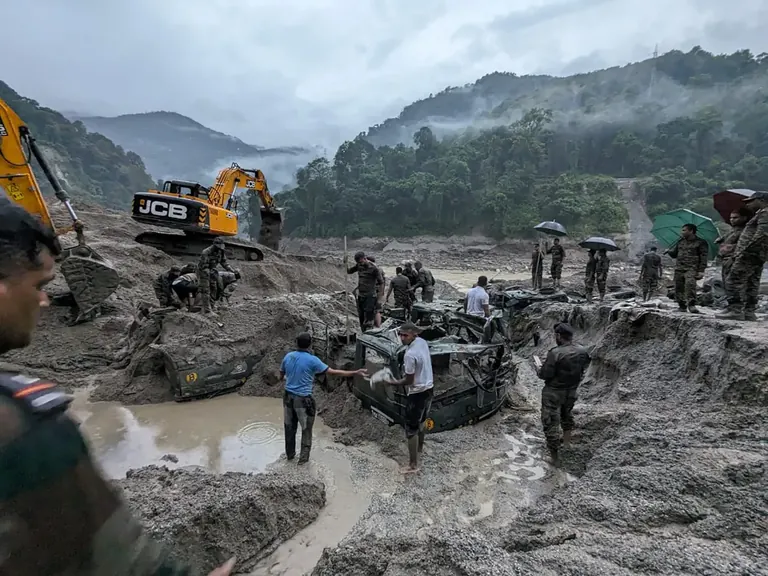
Such measures are not radical. They are corrective. They acknowledge that building in a seismic zone carries inherent responsibilities that cannot be offset through optimism or deferred through bureaucracy. More fundamentally, they reflect a different understanding of progress. Not as the speed of construction, but as the reliability of what is built. Not as expansion at any cost, but as continuity over time. The alternative is already visible. A system that prioritizes short-term affordability over structural integrity gradually accumulates hidden weaknesses. It appears efficient—until it fails. When it does, the costs are no longer manageable. They are borne in lives, in displacement, and in the long recovery that follows.
The Himalayas do not require recognition to assert themselves. Their movement is constant, whether acknowledged or ignored. The question is whether policy will align with that reality, or continue to operate in parallel, detached until the moment of impact. The architecture of denial is not sustainable. It depends on the assumption that consequences can be postponed indefinitely. They cannot. What is deferred returns—often abruptly, and without negotiation.
The choice, then, is not between development and restraint. It is between building in accordance with reality, or building against it. One path leads to resilience. The other leads to collapse. In the end, the strength of a society is not measured by how much it builds, but by how well what it builds endures when tested.


Discussion 4 comments