


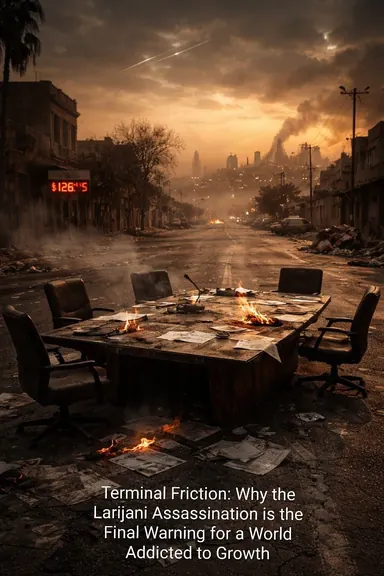
The confirmation of Ali Larijani’s death in a precision strike on the outskirts of Tehran marks more than a shift in the Middle East’s military balance; it is a forensic signal of a global order in a state of Caloric Bankruptcy, a condition where the energy and resources required to maintain a civilization’s expansion now exceed what its ecological and political systems can sustainably provide. Larijani was not merely the Secretary of the Supreme National Security Council; he was the "linchpin" of the Iranian establishment, a veteran operator who straddled the divide between the Revolutionary Guard's ideological fervor and the pragmatic necessity of international negotiation. By eliminating him, the US-Israeli alliance has not just removed a strategist; it has effectively liquidated the last remaining "middle ground" of the Iranian state.
What we are witnessing on this March 17 is the collapse of a world that has traded the quiet, regenerative space of diplomacy for the high-friction heat of absolute kinetic dominance. International reporting remains fixated on the "live" mechanics of the strike—the advanced fighter jets over Pardis and the subsequent vow of "decisive and regrettable" retaliation from the Iranian regular army. Yet, to view Larijani’s end through the narrow lens of a "successful operation" is to participate in a sophisticated form of intellectual camouflage. This is a moment of Syncretic Erosion, where the exhaustion of the biosphere, the fragility of global supply chains, and the escalating friction of hyper-kinetic growth have fused into a single, high-stakes reality.
The removal of a figure who understood the limits of escalation—and who was seen by many as a potential bridge for a transitional government—leaves the region in a state of forced diplomatic stagnation. We are now in a feedback loop where the very attempt to "secure" a future through decapitation strikes only entrenches us in a pace of conflict that guarantees our own destruction. When the "pragmatist" is silenced, only the "fire" remains. The tragedy of the Larijani killing is, at its core, a manifestation of a Desiccated Impulse—that relentless, unmoderated drive for expansion and total victory that treats the Earth’s delicate political and economic balance as a mere input for "deterrence".
This hollow thirst for "more"—more strikes, more territory, more control—has become so potent that it now overrides the basic instincts of civilizational survival. By treating the Iranian leadership as a map of targets rather than a complex political reality, the global actors involved have revealed the terminal flaws of a world order that views the planet’s original ecological foundation not as a foundation to be honored, but as a stockpile of strategic assets to be depleted. This drive for absolute security is, in fact, the primary source of our deepening global insecurity; it is a "thirst" that consumes the very water it seeks to protect.
As Donald Trump lambasts NATO for its "foolish mistake" in resisting a wider naval involvement in the Gulf and the world watches oil prices breach the $126 mark, the traditional technocratic responses appear increasingly fragmented and reactive. They seek to manage the crisis with the same tools that accelerated it—more strategic reserve releases, more naval escorts, and more unilateral force. They miss the Metabolic Inflection, the necessary point of change that exists between the terminal inertia of "business as usual" and the chaos of systemic collapse. True resilience in this roasting geopolitical landscape is not found in the "elimination" of an adversary, but in a Radical Equilibrium—a realignment of our civilizational metrics to prioritize internal stability and metabolic integrity over the transient velocity of the war machine.
This brings us to the uncomfortable justification for a total civilizational pivot. For decades, the global economic discourse has operated under the fallacy of infinite resilience, the belief that the Earth’s systems could indefinitely absorb the shocks of industrial acceleration and regional warfare without a fundamental rupture. The March 17 escalation is the forensic debunking of that myth. When the energy required to maintain a civilization—generated by its transport, its manufacturing, and its wars—becomes tethered to a single night of fire in a Tehran suburb, we have reached a point where we are no longer living on the planet, but burning through it.
The removal of a figure like Larijani is the loss of our "buffer zone," the period of grace that allowed the global system to reset between crises. Without this pause, the world is being forcibly accelerated toward a state of permanent, unmoderated stress. The current system’s "thirst" for energy security is, perversely, the very mechanism of its undoing. Every carrier strike group deployed and each missile launched represents a massive "caloric" expenditure—not just in terms of fuel, but in terms of the diplomatic and ecological credit of the planet. We are spending our future to defend a present that is already obsolete. The only logical way left is the pursuit of Autonomic Parity, where nations recognize that true power is measured by the stability of their own internal systems and their independence from the volatile, high-friction ghost-acres of foreign carbon. This is not isolationism; it is the recognition of physical limits. It is the understanding that a nation’s strength is found in its ability to persist within its own means, rather than its ability to dominate the means of others. Beyond the immediate human toll in Tehran and Beirut, the economic implications are a tax on the future that remains largely uncounted in traditional GDP metrics. This "Tax on Global Growth" is now being collected in the form of evaporated supply chains, scorched diplomatic trust, and the literal melting of the international order. To continue navigating the "delicate balance" between traditional expansion and military energy security is to remain a passenger in a vehicle whose engine is on fire.
True leadership in 2026 requires the courage to move toward a Homeostatic Axis—a refusal to be pulled into the binary of "victory or defeat," choosing instead to anchor the global community in the preservation of the human habitat. This is the Centered Vector, the path that avoids both the terminal inertia of the status quo and the explosive chaos of total war. The justification for this shift is not merely moral; it is mathematical. Our current trajectory of "growth" is predicated on the assumption that we can continue to frictionally rub against the boundaries of our geopolitical and ecological limits without generating heat. But the heat is here. It is in the 40°C Marches of India and it is in the $126 barrels of oil resulting from the Larijani strike. We have reached a point of metabolic parity where the costs of maintaining the machine now exceed the benefits the machine provides. To continue on this path is to engage in a form of systemic suicide. The only way to survive is to slow down, to de-link our survival from the high-velocity requirements of global extraction, and to seek a Median Equilibrium.
The window for this course correction is narrow. As the rhetoric of "blood revenge" intensifies across the Middle East, the social fabric of both the "North" and "South" begins to fray under the pressure of broken logistics and a closed Strait of Hormuz. The "live updates" that now dominate our digital feeds are the early sirens of a wider systemic failure. If we do not find that Metabolic Inflection—that courageous decision to thrive within our physical and political means—we will be automated into a cycle of permanent crisis. The death of Larijani is a signal. It is an invitation to stop treating the world as a map of resources and start treating it as the only home we have. Clarity in these times is essential. The stakes are not confined to a single border or a single oil price; they are the resilience of the human habitat itself. As we move into an uncertain April, the question is no longer how we will win the war for the Strait, but how we will redefine our existence so that the peace of the seasons might one day return.



تسجيل 888starz <a href=https://www.world-cuisine.com/>https://world-cuisine.com/</a>
Компания «Пластик» предлагает [url=https://spb.oknafactoria.in/]производитель пластиковых окон[/url] отличного качества с гарантией и профессиональным монтажом по Москве.
Команда профессионалов произведёт замеры и подберёт оптимальную комплектацию с учётом климатических условий и архитектуры здания.
Разработчики регулярно интегрируют свежие слоты и улучшенные версии классических игр.
Посетите <a href=https://casino7k133.buzz/>7k casino регистрация</a> для быстрого доступа к играм и бонусам.
Сайт поддерживает обновления, добавляет новых поставщиков контента и улучшает работу платформы.
Условия участия публикуются на сайте и доступны для ознакомления до старта акций.
При признаках зависимости служба поддержки направляет к профессиональной помощи и ресурсам самопомощи.
Для привилегированных клиентов организуются специальные мероприятия и уникальные предложения.
Все больше людей выбирают шарики с доставкой для оформления своих торжеств. Такая услуга предоставляет удобство и экономит время заказчиков. Воздушные шары всегда дарят радость и создают неповторимое настроение.
Есть множество причин выбрать доставку шариков для праздника. Самое главное — не нужно тратить личные ресурсы на поиск и покупку шаров. Во-вторых, профессионалы гарантируют качество и аккуратность упаковки. Наконец, доставляют шарики прямо к дверям.
Разнообразие ассортимента шариков также впечатляет. Доступны модели с блестками, рисунками и надписями. Зачастую компании выполняют заказы по персональному эскизу. Индивидуальный подход помогает сделать праздник действительно особенным.
Чтобы заказать шарики с доставкой, нужно всего лишь выбрать нужный вариант. Далее оформляется заказ на сайте или по телефону. Потом с вами связывается курьер для уточнения информации. Организованная логистика гарантирует своевременную доставку.
Если вы хотите сделать праздник ярким и оригинальным, закажите доставку шариков. Вы получаете качественные украшения без лишних усилий. Заказав шарики с доставкой, вы точно не пожалеете о своем выборе.
---
Сейчас доставка шариков пользуется большой популярностью среди тех, кто готовит праздник. С помощью доставки можно легко украсить любое событие без лишних забот. Воздушные шары всегда дарят радость и создают неповторимое настроение.
Есть множество причин выбрать доставку шариков для праздника. Во-первых, это экономия времени и сил. Также можно не сомневаться в надежности и безупречном состоянии заказанных шариков. Наконец, доставляют шарики прямо к дверям.
Клиенты могут выбрать из множества вариантов оформления. Предлагаются уникальные композиции и индивидуальные дизайны. Мастерство дизайнеров позволяет создавать уникальные украшения по запросу. Это особенно удобно для тематических праздников и свадеб.
Процесс заказа очень простой — выбирайте и оформляйте заявку. Обычно заказы принимаются онлайн или по телефону. Менеджер связывается для согласования времени и адреса. Благодаря такой системе вы получаете свой заказ в удобное время.
Доставка шариков — это удобный способ оживить любое торжество без лишних хлопот. Такой сервис позволяет сосредоточиться на других важных моментах праздника. Попробуйте и убедитесь, что шарики с доставкой — это удобно, выгодно и красиво.
Большой плюс — показывает дешевые авиакомпании, которые обычные сервисы обычно не показывают. Скажем, в феврале взял авиабилет из Москвы в Варшаву за супер цену — даже не ожидал. Стоит обратить в