



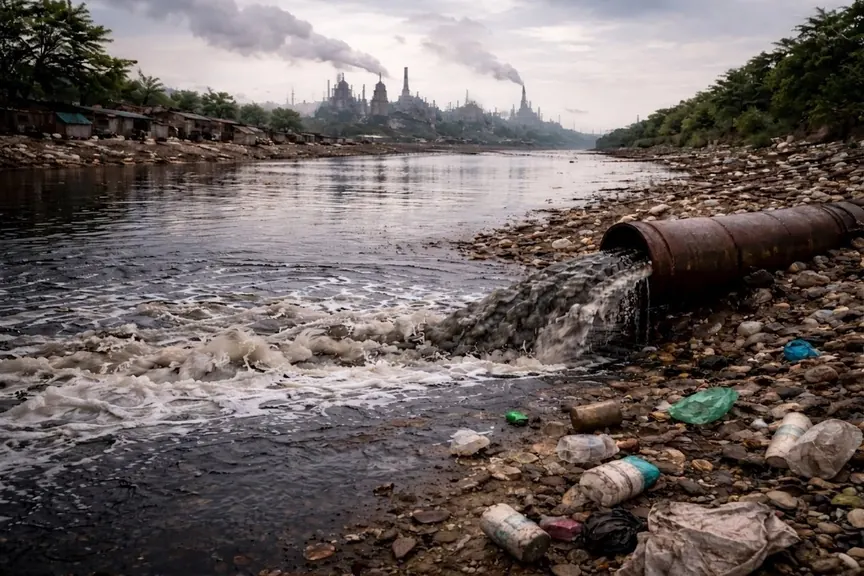
There was a time when rivers in India were invoked not merely as resources, but as living entities—sacred, sustaining, and civilizational. To view them through that lens is to understand that their current state is a profound diagnosis of an interlocking and accelerating system failure. Today, many of these lifelines have been reduced to slow-moving carriers of waste, their innate ecological vitality replaced by a crushing chemical burden. This tragedy is not sudden; it is incremental, forensically visible in stretches of blackened water, in the absence of biological life, and in the quiet resignation of communities that have been forced to internalize this contamination as a daily reality.
From the heavily burdened Yamuna in the North to the increasingly stressed Phalguni in the South, the pattern is unmistakable. This is not the consequence of a single failure, but of an architecture of neglect—a system effectively designed to look away. Industrial effluents flow into waterways with inadequate treatment, municipal sewage systems remain critically underdeveloped, and regulatory oversight oscillates between moments of intervention and prolonged indifference. While institutions like the National Green Tribunal, Pollution Control Boards, and dedicated river rejuvenation missions exist, their impact is systematically blunted by weak enforcement, bureaucratic inertia, and political compromise. Compliance is treated as a negotiable asset, particularly where economic interests demand unyielding momentum.
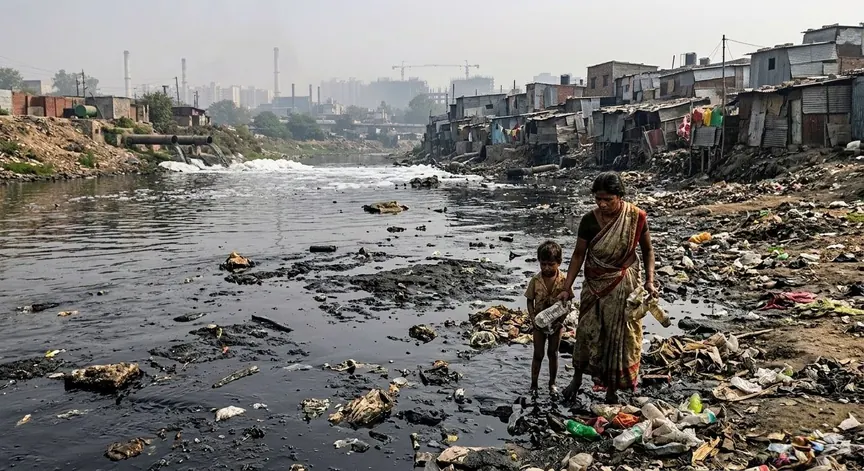
For millions, this river degradation is not an abstract environmental concern; it is a direct assault on their somatic life. Farmers dependent on this water face declining yields; fisherfolk find their livelihoods eroded; households are forced into a dangerous reliance on unsafe water sources. Environmental justice remains profoundly uneven, with the most vulnerable bearing the heaviest costs of this ecological decline. This is why communities are increasingly stepping into the vacuum left by the state. Protests, petitions, and local movements reflect both desperation and a resolve to secure what should be guaranteed.
To frame this crisis solely as pollution would be to dangerously understate its scale. India’s rivers are structurally weakened, a victim of The Extractivist Paradigm. This is a dominant mindset that reduces a complex, living ecosystem to a simple set of commodities: it drains water for agriculture, extracts sand for construction, and fractures natural flows with dams, always prioritizing immediate output over the river's deep, native vitality. This unyielding appetite for acceleration is trading sustained biological integrity for superficial expansion. India’s rivers are now ecologically fractured, rendered less capable of recovery even if pollution were curtailed.
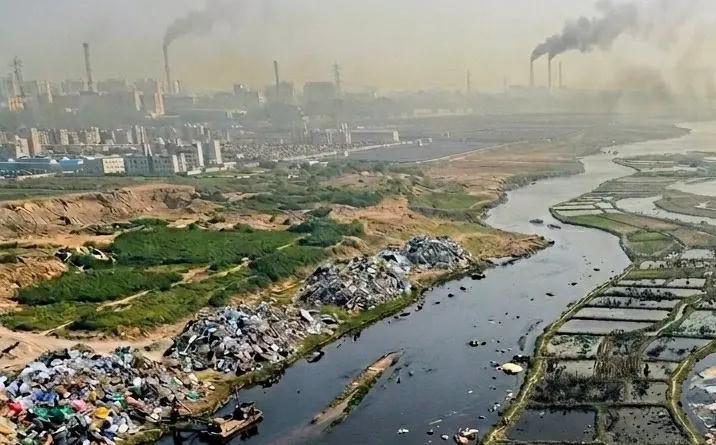
This pattern reveals a set of deeply embedded hidden causes. The very infrastructure often touted as progress—mammoth treatment plants or massive dams—frequently serves as an alibi for continued pollution or a mechanism for further disrupting natural hydrological cycles. These massive, symbolic projects create a facade of action while masking a fundamental failure to address the systemic Polycrisis. Furthermore, our current economic model operates on an infinite throughput mentality, viewing finite natural systems as an endless sink for waste. This frictional economy, dependent on rapid resource conversion and accumulation, inherently conflicts with the slow, cyclical rhythm of ecological metabolism.
The way forward requires a definitive pivot toward a strategy of intentional balance: Proportional Resilience. This is not a position of weak compromise; it is a demanding, forensic standard of judgment that rejects the destructive extreme of unchecked velocity. Proportional Resilience demands that human action—whether in infrastructure development, industrial output, or urban expansion—be calibrated to the actual carrying capacity and regenerative capability of the ecological commons. It is an optimized approach focused on long-term stability rather than rapid maximization.
Opting for this architecture of balance means, first, enforcing environmental laws without exception, closing the loop of neglect. Second, it requires prioritizing the invisible architecture of local ecosystems—wetland restoration, native riparian buffers, and watershed management—over grandiose engineering projects that create new friction points. Third, it mandates shifting the concept of utility itself, valuing the river’s contribution to systemic health and somatic vital signs over quantifiable extraction metrics. Finally, true restoration can only be achieved by centering community participation and sovereignty. Communities possess the diagnostic capacity to identify failures and the direct stake needed to manage ecological metabolism. This distributed model of governance acts as a necessary check against the Dominant Utilitarian Model's tendency toward central oversight and simplified fixes.
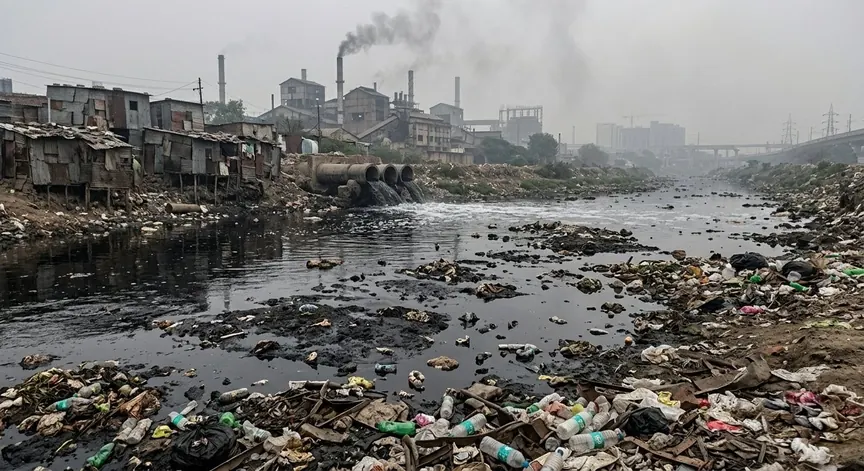
Reversing this crisis will require choices of a magnitude equal to the collapse itself. It demands recognizing rivers not as waste channels, but as vital ecological commons essential for sustained stability. This involves an immediate cessation of activities that structurally weaken the river’s anatomy, such as illegal sand mining and unregulated flow diversion. Without such a conceptual and operational shift, government programs, however well-funded, will remain symbolic gestures, managing symptoms while the systemic failure intensifies.
India’s rivers do not collapse in a single moment; they fade, slowly, often unnoticed beyond the communities that directly depend on them. This gradual erosion of ecological health is precisely what makes the crisis so dangerous—it lacks the immediate drama that compels urgent action. But the signs of this silent emergency are unmistakable. Rivers that once flowed with life now struggle to breathe. The question is whether India will continue to look away, trapped in a compulsion for velocity and accumulation, or finally confront the forensic reality that its rivers—and the millions whose lives are woven into them—can no longer wait for a diagnostic renaissance. The path of proportional resilience is the only way forward; all other paths lead to a parched and unstable future.




Keep on educate the society.