


Public meeting held in Kolkata to demand protection of Great Nicobar’s ecosystem and indigenous rights
Kolkata, 21 June 2026
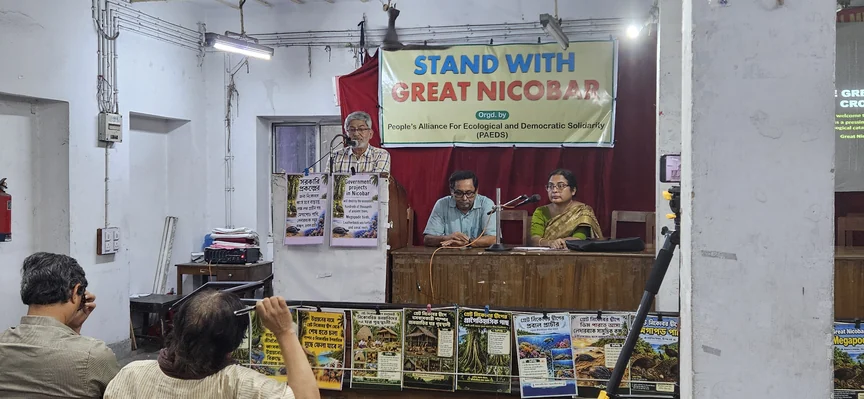
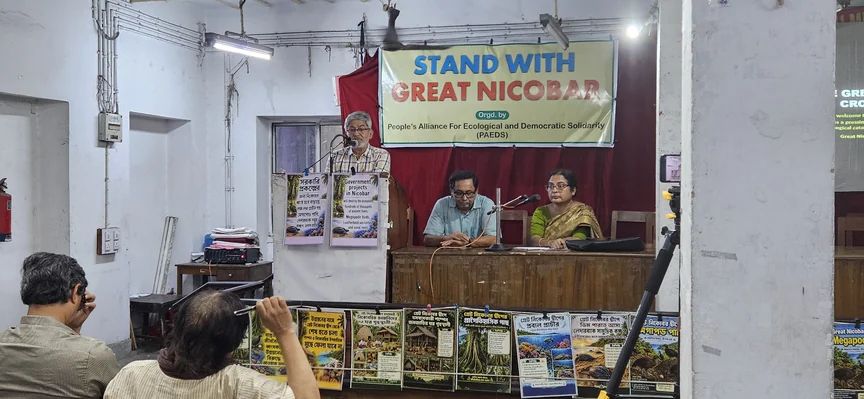
A public meeting was held in Kolkata to demand the protection of the ecosystem, biodiversity, and indigenous communities of Great Nicobar Island. The meeting was organised by the People’s Alliance for Ecological and Democratic Solidarity. Speakers present at the meeting expressed serious concern over the environmental and social impact of the proposed large-scale infrastructure project being promoted in the name of development.
Speaking on behalf of the organisers, participants said that the large infrastructure project being pushed forward in Great Nicobar would not affect only one region. Its impact, they said, would be felt across the wider ecosystem, biodiversity, and future generations. Great Nicobar, they emphasised, is not merely a piece of land. It is a unique coastal ecosystem and one of the world’s important biodiversity-rich regions. The island is home to ancient prehistoric forests, coral reefs, leatherback sea turtles, and other marine life, the Nicobar megapode, the long-tailed macaque, and many other rare species. It is also the homeland of indigenous communities such as the Shompen and the Nicobarese, whose lives and cultures have been connected with the island for generations.
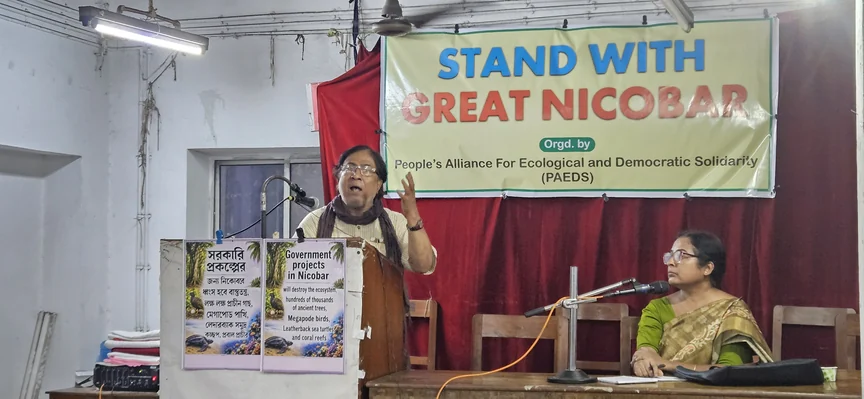
Social and environmental activist Gautam Bandopadhyay, scientist Tapan Saha, Professor Arunabha Mishra, Tapas Biswas, Dr Saleha Begum, Pulak Goswami, Kallol Roy, Pinaki Acharya, Arjan Basu, Abhishek Bhowmik, Bijan Pal, and others took part in the discussion. The speakers said that the relationship between the people and the natural environment of Great Nicobar has existed for generations. They stressed that the lives, cultures, and existence of the Shompen and Nicobarese indigenous communities are deeply linked with the island’s natural surroundings. Therefore, any development plan must give due importance to their rights, opinions, and way of life.
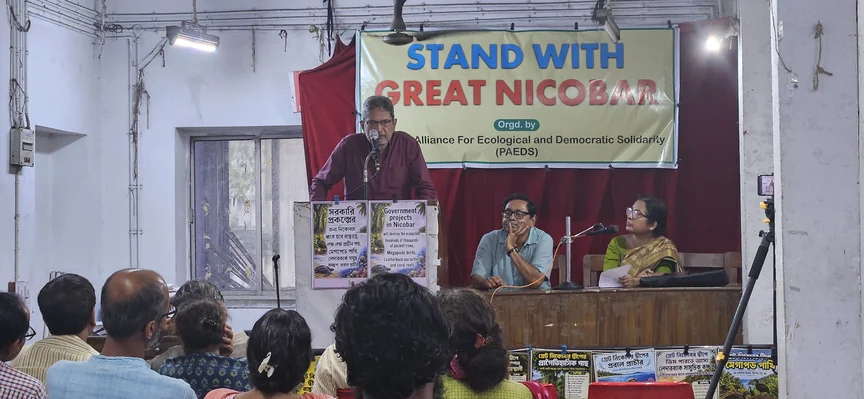
The speakers alleged that large-scale development projects are being justified in the name of national interest and national security. They warned that such projects could lead to the destruction of forests, loss of biodiversity, serious damage to the marine and coastal environment, and the shrinking of indigenous rights. According to them, the impact would not remain limited to Nicobar alone, but could also affect the wider environment and future generations.
The meeting stated that human needs and the existence of nature should not be seen as being opposed to each other. Speakers called for a future based on environmental justice, people’s rights over common natural resources, and the protection of ecological balance.
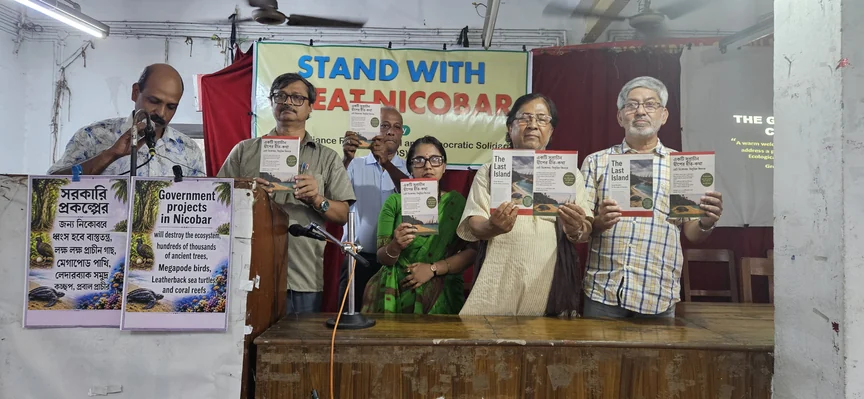
At the meeting, a book titled “The Last Island - Great Nicobar: At the Edge of Erasure”, written by Suman Maity, was released by Ecological Solidarity Movement and The Degrowth (Mass Media of Resistance), two constituent organisations of the alliance. The book “EKTI SUPRACHIN DWIPER ITIKOTHA” has been translated into Bengali by Arpita Bhattacharya.
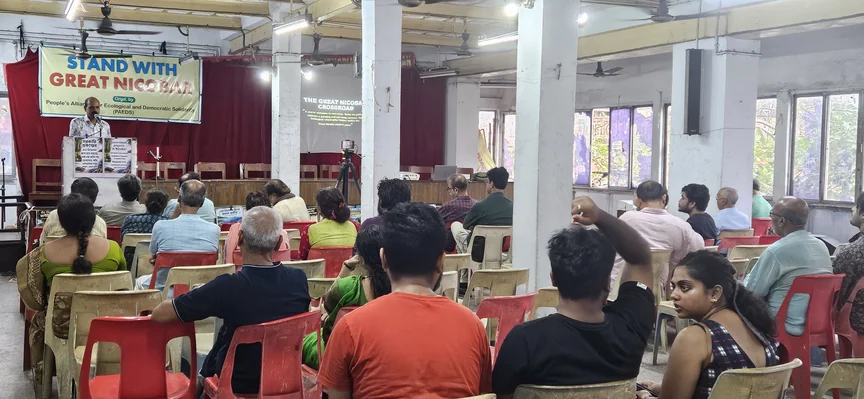
The organisers said that they would continue to hold awareness programmes in the coming days to build public opinion in support of Great Nicobar’s ecosystem and the rights of its people. The meeting was jointly conducted by Gokulananda Goswami, Susmita Mondal and Sanjay Das.


Discussion 1 comment