





Abstract: The recognition of natural entities as holders of legal rights has emerged as a significant development in contemporary environmental jurisprudence. Granting legal personhood to natural entities such as rivers allows them to claim protection for their ecological integrity, natural flow, and identity. Rivers have historically functioned as lifelines for ecosystems as well as human civilizations, making their protection essential for environmental sustainability and long-term human survival.

In the context of accelerating climate change and the growing scientific concern regarding a possible sixth mass extinction of species; scholars, activists, and governments across the world are advocating a transition from an anthropocentric legal order to ward an ecocentric framework. Such a framework recognizes that nature should not merely be viewed as a resource for human exploitation but rather as a community of interdependent living systems in which humans are participants rather than masters.
Development and Nature:
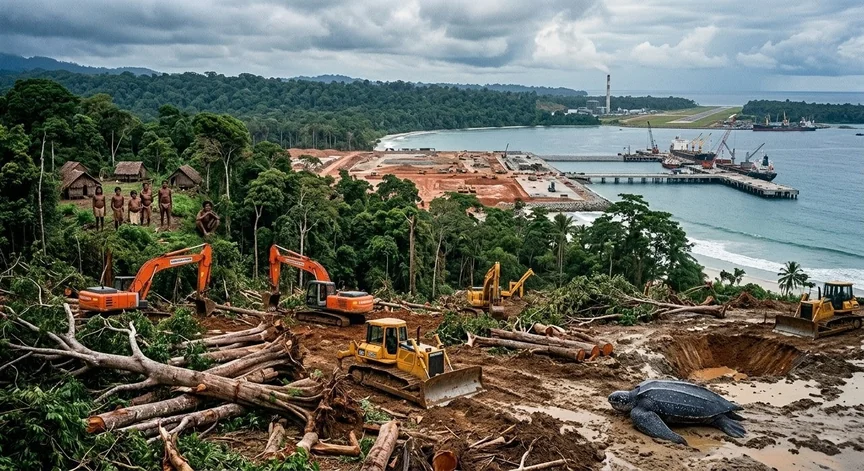
Recent environmental clearances granted by the National Green Tribunal (NGT) for large-scale development projects in Great Nicobar Island have generated important constitutional and ecological concerns. While development projects can be redesigned or modified over time, the destruction of fragile ecosystems and the displacement of indigenous communities may cause irreversible damage.
The Great Nicobar Island is home to the Shompen tribe, recognized as a Particularly Vulnerable Tribal Group (PVTG). The survival of this community has historically been closely linked with the forests and coastal ecosystems of the region. Indigenous communities across the world have traditionally maintained a harmonious relationship with nature, often preserving biodiversity through sustainable practices and traditional ecological knowledge.
The concept of sustainable development attempts to balance economic growth, environmental protection, and social well-being. It emphasizes responsible resource utilization while allowing ecological systems sufficient time to regenerate. Rather than focusing solely on short-term economic expansion, sustainable development promotes long-term environmental stability and equitable distribution of resources.
However, the prevailing model of economic growth is often characterized by extractive practices and unsustainable exploitation of natural resources. Modern economies largely operate within a linear economic framework based on continuous extraction, production, consumption, and disposal. This system assumes the availability of limitless natural resources and has resulted in widespread environmental degradation, including biodiversity loss, habitat destruction, pollution, and greenhouse gas emissions.
The expansion of global market economies has therefore intensified the conflict between economic development and environmental protection. In many instances, development projects are prioritized despite their ecological consequences. Such practices threaten not only environmental stability but also the long-term survival of human societies.
Several environmental scholars have warned that current biodiversity loss may represent the beginning of a sixth mass extinction event driven largely by human activity. In response, many policymakers and scholars advocate a transition toward a circular ec nomic model that prioritizes sustainability, recycling, and ecological regeneration. Within this context, recognizing natural entities as legal persons may serve as an important legal mechanism for strengthening environmental protection.
Public Participation and Environmental Governance:
Public participation is a fundamental component of environmental governance in democratic societies. Civil society movements and public activism often play a crucial role in bringing environmental issues to the attention of courts and policymakers.
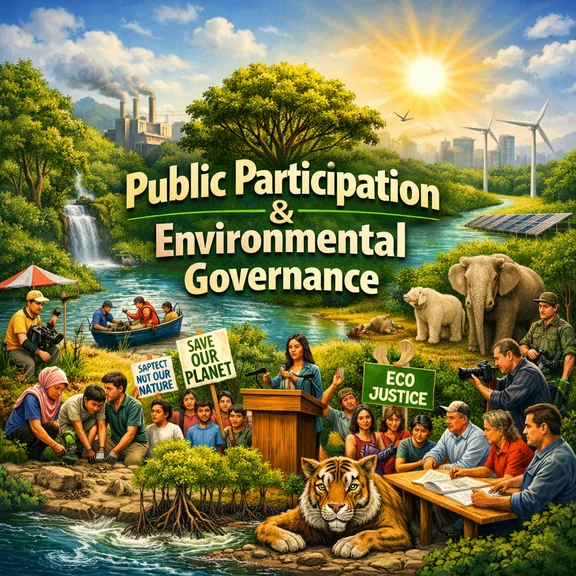
A recent example can be observed in the case concerning the Aravalli hills, where widespread public protests led the Supreme Court of India to take suo motu cognizance and temporarily suspend its earlier order relating to the region. The Court also appointed an Amicus Curiae to assist in examining the environmental concerns involved.
In contrast, the development projects proposed in the Nicobar Islands have not yet generated comparable levels of public mobilization, despite the ecological sensitivity of the region. Although legal challenges have been filed against environmental clearan ces granted by government authorities, broader public awareness and engagement remain limited.
Active public participation strengthens environmental governance by ensuring transparency and accountability in decision-making processes. It also enables citizens to exercise their constitutional duty to protect the environment, as recognized under Articl e 51A(g) of the Constitution of India.
The Supreme Court has previously emphasized in constitutional jurisprudence that “everything cannot be done in the name of national security,” particularly in matters involving civil liberties. A similar principle could apply in environmental governance if natural entities such as rivers, forests, and mountains were recognized as legal persons capable of asserting their rights within the legal system.
Cultural and Indigenous Perspectives on Nature:
Modern legal systems are primarily designed to regulate relationships among human beings. Consequently, most legal frameworks remain fundamentally anthropocentric. However, many indigenous cultures and traditional societies have historically viewed nature as a living and interconnected system in which humans are only one component.

For example, the Lepcha community of Sikkim regards the Rongyung River in Dzongu as sacred. According to traditional beliefs, the souls of deceased individuals travel through the river on their journey toward the sacred landscape associated with Mount Kanchenjunga. Such beliefs illustrate a worldview in which rivers are not merely natural resources but living entities with spiritual and cultural significance.
Similarly, many Adivasi communities across India worship natural elements such as forests, mountains, and rivers rather than constructing physical idols. This practice reflects a deep understanding of ecological interdependence and acknowledges that human survival is closely linked to the health of natural ecosystems.
These cultural traditions demonstrate that the idea of recognizing nature as a living entity is not entirely new. Instead, it reflects long-standing philosophical and cultural perspectives that emphasize harmony between humans and the natural world.
Recognition of Nature by Courts:
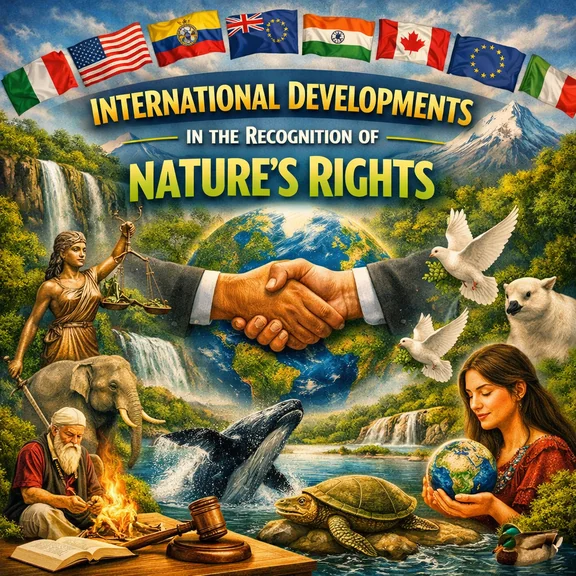
Courts in several jurisdictions have begun to recognize the rights of nature as part of evolving environmental jurisprudence. Granting legal personhood to natural entities enables them to be represented in courts and strengthens legal mechanisms for protecting ecosystems.
This development reflects a gradual transition toward an ecocentric approach in environmental governance. By recognizing nature as a subject of rights rather than merely an object of regulation, legal systems may better respond to the environmental challenges of the twenty-first century.
International Developments in the Recognition of Nature’s Rights:
Ecuador: Constitutional Recognition of Nature
A significant milestone in the recognition of nature’s rights occurred in Ecuador with the adoption of the Constitution of 2008. Ecuador became the first country in the world to constitutionally recognize nature as a subject of legal rights.
The constitution refers to nature as Pachamama, or Mother Earth, and grants it the right to exist, persist, maintain, and regenerate its life cycles. Citizens are empowered to bring legal actions on behalf of ecosystems in order to protect these rights. This constitutional innovation reflects the integration of indigenous ecological philosophy into modern constitutional law.
New Zealand: Legal Personhood of the Whanganui River
Another landmark development occurred in New Zealand with the enactment of the Te Awa Tupua (Whanganui River Claims Settlement) Act 2017, which recognized the Whanganui River as a legal person.
Under this legislation, the river is considered a living entity with legal rights and interests. Two guardians were appointed to represent the river —one nominated by the government and another by the Māori community. This arrangement reflects the Māori belief that the river is an ancestor and a living being rather than a mere natural resource.
Bolivia: Law of the Rights of Mother Earth
Bolivia has also enacted legislation recognizing the rights of nature through the Law of the Rights of Mother Earth. The law acknowledges that Mother Earth possesses inherent rights, including the right to life, biodiversity, water, and ecological balance. It also imposes obligations on both the state and society to ensure the protection and sustainable use of natural resources.
Colombia: Judicial Recognition of Ecosystem Rights
In Colombia, the Constitutional Court has recognized ecosystems as legal subjects. In a landmark judgment, the court declared the Atrato River to be a legal entity possessing rights to protection, conservation, and restoration. The court emphasized that environmental protection requires moving beyond purely human-centered legal frameworks.
These international developments illustrate an emerging transformation in environmental jurisprudence, where ecosystems are increasingly viewed as rights-bearing entities.
Recognition of Nature in Indian Courts:
Indian courts have also contributed to the development of the rights of nature doctrine. In Mohd. Salim v. State of Uttarakhand (2017), the Uttarakhand High Court declared that the Ganga and Yamuna rivers, along with their tributaries, would be treated as legal or juristic persons with rights, duties, and liabilities similar to those of a living person.
The case arose from a Public Interest Litigation concerning environmental degradation and illegal activities along the rivers. The Court observed that severe pollution and exploitation had threatened the very existence of these rivers and therefore required innovative legal protection.
To safeguard the rivers, the Court appointed certain government officials —including the Director of the Namami Gange project, the Chief Secretary of Uttarakhand, and the Advocate General of the state —as legal guardians acting in loco parentis for the rivers.
The judgment relied on constitutional provisions such as Article 48A, which imposes a duty on the State to protect the environment, and Article 51A(g), which establishes a fundamental duty of citizens to safeguard natural resources.
However, the Supreme Court of India later stayed the High Court’s decision in July 2017 due to concerns regarding practical and legal implementation. While the judgment is therefore not currently enforceable, its reasoning continues to influence academic discourse and environmental jurisprudence.
Another significant development occurred in Periyakaruppan v. State of Tamil Nadu (2022), where the Madras High Court observed that “Mother Nature” should be regarded as a living entity with rights, duties, and liabilities similar to those of a legal person. The Court emphasized that recognizing nature’s legal status could strengthen environmental protection by extending legal safeguards to ecosystems such as forests, rivers, mountains, and lakes.

Conclusion:
The growing ecological crises facing the world require a fundamental rethinking of humanity’s relationship with nature. Development policies that prioritize short-term economic gains at the expense of environmental sustainability threaten both ecological stability and human well-being.
Recognising natural entities as legal persons offers an innovative legal framework that can strengthen environmental protection and promote sustainable development. When combined with public participation, indigenous knowledge systems, and responsible economic policies, such legal recognition may help establish a more balanced relationship between human societies and the natural world.
Ultimately, meaningful discussions about environmental protection require conditions of peace and cooperation among nations. Environmental preservation cannot be effectively pursued in times of conflict and war, as geopolitical priorities often overshadow ecological concerns. Therefore, global environmental governance must also be accompanied by efforts to maintain peace and stability.
References:
Stone, C. D. (1972). Should Trees Have Standing? Toward Legal Rights for Natural Objects. Southern California Law Review.
Constitution of Ecuador (2008).
Te Awa Tupua (Whanganui River Claims Settlement) Act, 2017 (New Zealand).
Mohd. Salim v. State of Uttarakhand & Others, Uttarakhand High Court (2017).
Periyakaruppan v. State of Tamil Nadu, Madras High Court (2022).

Be the first to join the discussion.