



Crete's dams have filled again after a wet autumn, but beneath them the island's aquifers, olive groves and villages tell a more troubling story.
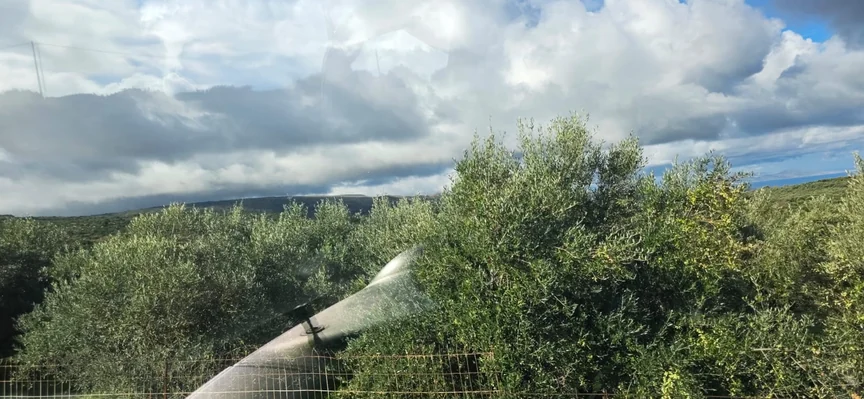
On a hillside not far from the monastery of Arkadi, we came upon a small farm reservoir behind a wire fence. Its black plastic liner had torn away from the bank in long strips that lay crumpled on the bare earth, while green algae clung to a shallow waterline. Reservoirs like this one dot the Cretan countryside. Standing before this reservoir, we felt we were looking at a whole way of managing water, one that hurries to store more and seldom stops to ask whether the need itself might shrink. Once the money has been spent, the work is simply left to weather.
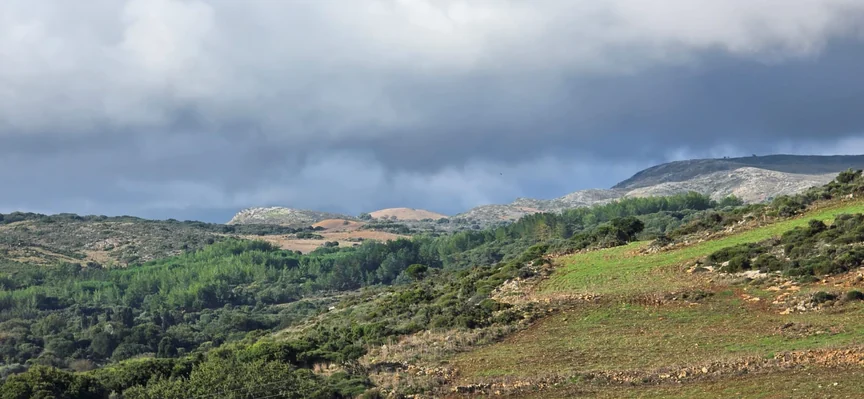
Picture - KInsuk Roy
Full dams, empty ground
In October 2026 the Potamon dam in the Amari valley, which supplies the city of Rethymno, overflowed at 22.5 million cubic metres. Similarly, Aposelemis, the reservoir on which the island's capital, Heraklion, and the northern coast depend, rose past 85% of its capacity.
Yet a full reservoir is a passing state, and the relief runs shallow. In February, Crete's water directorate had warned that the island was entering its fourth consecutive dry year and that its aquifers were steadily falling. Potamon looked full even then only because the authorities had sharply restricted what farmers and towns could draw from it. Beneath the Messara plain, around Moires, the groundwater has sunk more than 25 metres since 2014, while farming takes roughly three-quarters to four-fifths of all the water the island consumes. One wet month can refill a reservoir, but it cannot restore an aquifer that decades of pumping have emptied.
The olive tree feels it first
Olive growers have paid the first bill, and their accounts show how a single dry season passes its loss down the line. In 2025–26, drought, heat and the olive fruit fly cut Crete's olive oil output by around two-fifths, and one cooperative in Krousonas, near Heraklion, watched its production fall from nearly 490 tonnes to 110. Nor did smaller harvests bring better prices. Producers sold at around €4.5–5.4 a kilo, roughly 30% less than a year earlier.
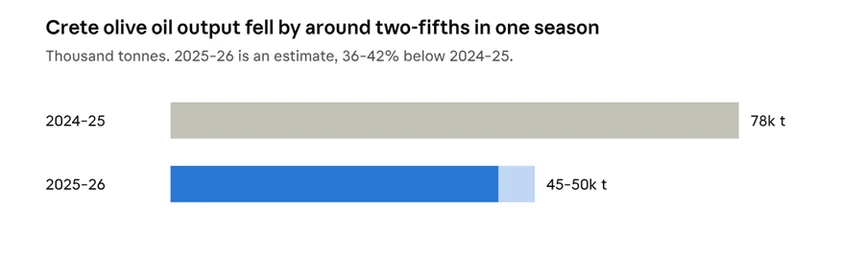
Source: Olive Oil Times, republished by UkrAgroConsult (26 May 2026). Data: Crete olive oil output, harvest seasons 2024–25 and 2025–26; the 2025–26 figure is an estimate.
Let us look below the surface, where the deeper damage gathers. When the rain fails, Cretan farmers start to drill. Greek law gives groundwater to whoever owns the land above it, and about half of the country’s farmland depends on it. Every new borehole therefore answers a shared problem with a private solution. Water drawn from one well lowers the table beneath every other, and the loss spreads quietly from field to field.
Picture - KInsuk Roy
Pools on the coast, taps dry in the hills
Tourism uses far less water than farming, but it demands that water in the driest months and on the most crowded coasts. Researchers studying Crete's hotels estimate that each tourist arrival consumes about 2.71 cubic metres of water directly. In the summer of 2024, residents of Kokkino Chorio, in Chania, went as long as 26 days without running water, while not far away builders went on completing villas, each with its own private pool.
Around the turn of 2026, the water utility of Agios Nikolaos told the developers of a five-star hotel at Plaka that it could not supply the 236 cubic metres a day the project would need at its peak. That refusal struck us because it is so rare, for the usual answer to a shortage is another borehole, another tanker or another desalination plant.
Greece: more pipes, same thirst
Greece repeats the pattern on a larger scale. Greeks now use more than twice as much water each year as they did 25 years ago, about 1.8 billion cubic metres against roughly 800 million in 2000. Athens' reservoirs are 47% fuller than a year ago yet still hold far less than in 2023, and the country's networks leak about 40% of their drinking water and 60% of their irrigation water.
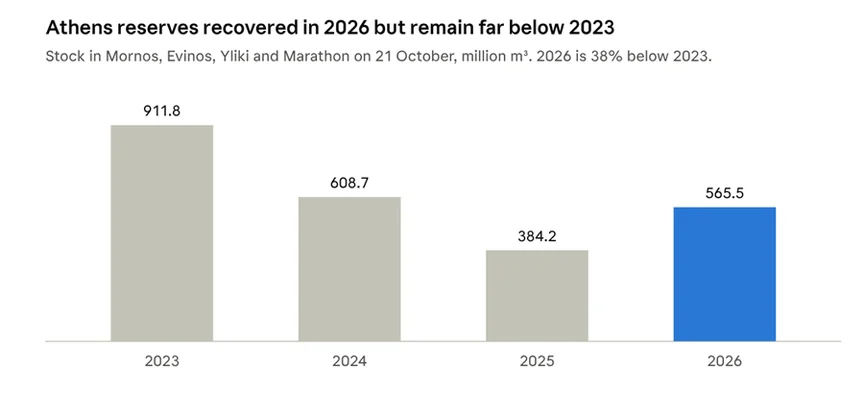
Source: EYDAP (Athens Water Supply and Sewerage Company) data, reported by ProtoThema (24 October 2026). Data: reservoir stocks on 21 October of each year, 2023–2026.
The Greek government has answered with a €2.5 billion national water strategy built almost entirely around supply. New transfers such as the Eurytus project for Attica and desalination plants have been planned. Some of this is clearly needed. In our view, a plan that measures success in additional cubic metres treats demand as a law of nature, when it is in fact a political choice.
The memory of a collapse
Greece has stood at this edge before. Around 1200 BC the Mycenaean palace states collapsed. With them fell much of the Late Bronze Age world of the eastern Mediterranean, and writing vanished from Greece for several centuries. Researchers at the Navarino Environmental Observatory have concluded from pollen and sediment records that a drought around 3,200 years ago helped unsettle the Mycenaean political and economic order. A Stockholm University study published in November 2026 linked a long dry period between roughly 1400 and 900 BC to weakening Atlantic currents.
On Crete, some archaeologists argue that Minoan society faded gradually, and that the eruption of Thera was not the single blow that ended it. In neither case did the climate act alone. The palace economies were centralised, highly specialised and bound to long-distance trade. In a system so tightly woven, a strain in one place soon travelled through the whole. The lesson we draw is that collapse came when rigid systems met a drier world to which they could no longer adapt.
A planet in water bankruptcy
Crete is no exception. In January 2026 the United Nations University's water institute declared that the world had entered an era of "global water bankruptcy", in which societies withdraw and pollute more water than nature renews and cause damage that can no longer be undone. According to its report, about three-quarters of humanity, some 6.1 billion people, now live in countries whose water supply is insecure or critically insecure.
We think the word "bankruptcy" was chosen with care. A crisis eventually passes, whereas bankruptcy means that the savings are gone. Aquifers, glaciers and wetlands have long served as the planet's savings account. Humanity has been drawing them down to pay for present consumption, leaving the debt to those who come after.
Choosing limits
Degrowth begins where the supply plan stops, by asking what the water is for. The Greek ecological economist Giorgos Kallis, who wrote his doctorate on the management of Athens' water, distinguishes two kinds of limit: the scarcity that nature imposes, and self-limitation, a boundary a society chooses so that its members can live well. Drawing on the philosopher Cornelius Castoriadis, Kallis treats that chosen limit not as a sacrifice but as a form of freedom.
Let us be concrete about what such a limit would mean for Crete. The island's authorities would repair the leaking networks before building new dams, and they would hold hotel beds and private pools within what the aquifers can bear. Farming would shift towards dry-farmed olives, vines and pulses and away from thirsty export crops. The authorities would also register and meter every borehole, manage groundwater as a commons rather than as private property, and put villages before resorts whenever supply runs short.
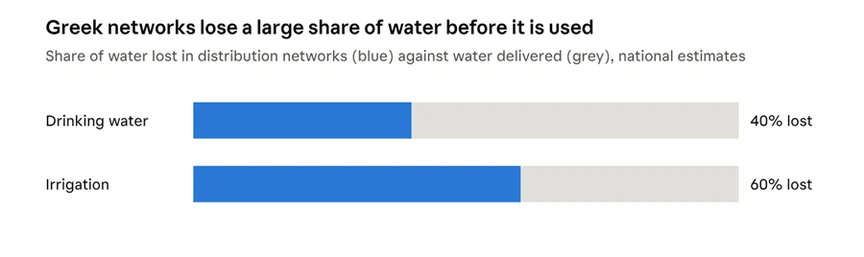
Source: To Vima (25 July 2025), reporting on the National Water Management Plan. Data: national estimates of network losses, 2025; approximate.
One reading of the Bronze Age is that the palaces fell because they could not shrink in an orderly way, and a society that can decide to use less is likely to prove more resilient than one that can only keep chasing more. The torn liner near Arkadi leaves us with a simple question: how much water does Crete need for a good life, and who gets to decide?
#Degrowth #Crete #Greece #WaterCrisis #Drought #WaterBankruptcy #ClimateCrisis #Overtourism #OliveOil #Groundwater #Sufficiency #PoliticalEcology #TheDeGrowth
Sources
• To Vima, 5 November 2026: Crete reservoirs rebound after heavy rains
• Greek City Times, 6 November 2026: Crete reservoirs refill
• Argophilia, 5 February 2026: Crete faces fourth consecutive dry year
• To Vima: Greece faces deepening water crisis
• To Vima, 25 July 2025: Water scarcity, the solution lies in the field
• UkrAgroConsult (from Olive Oil Times), 26 May 2026: Low prices and weak harvest in Greece's olive oil sector
• Argophilia, 21 February 2026: Crete's olive oil push in a difficult year
• The Water-energy-tourism Nexus in the Island of Crete (research paper)
• For The Love of Crete: Kokkino Chorio outages
• Argophilia: Plaka hotel refused water
• ProtoThema, 24 October 2026: Athens enters winter with reserves up 47%
• Smart Water Magazine: Greece commits €2.5 billion
• Neos Kosmos: What ended the Mycenaean era
• Greek Reporter, 14 November 2026: drought and Mycenaean collapse
• Hakai Magazine: Did climate change bring down Late Bronze Age civilisations?
• UNU-INWEH, 20 January 2026: World enters era of global water bankruptcy
• Bloomberg Law: Water bankruptcy era has begun
• Wikipedia: Giorgos Kallis
Be the first to join the discussion.