



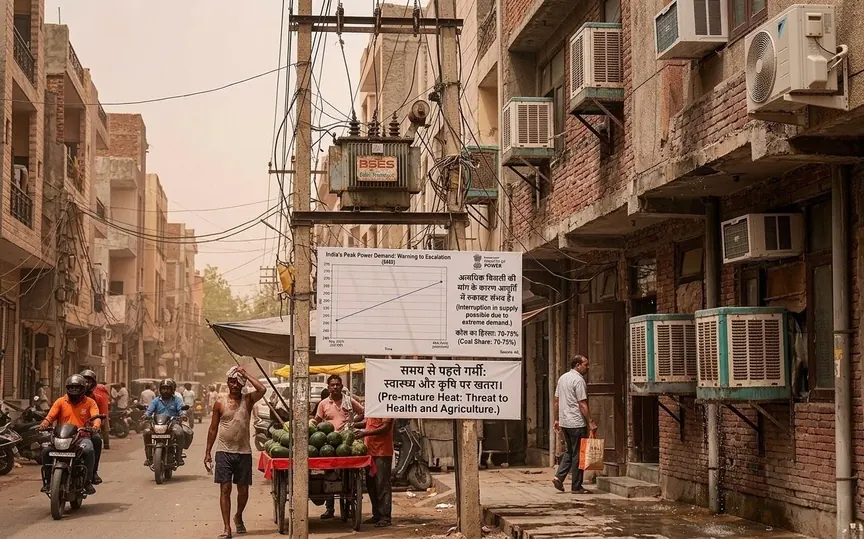

India’s early summer is intensifying a cycle of rising heat, higher power demand, and growing risks to livelihoods.
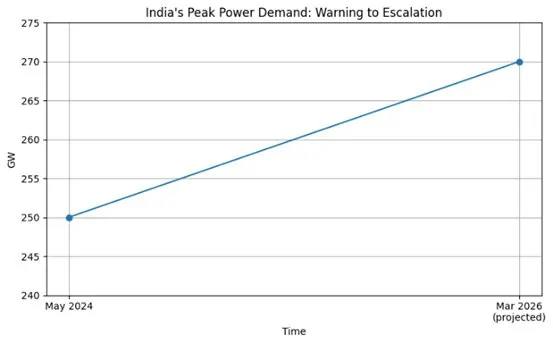
Peak electricity demand is rising sharply as early summer heat intensifies across India.
The rapid disappearance of India’s short spring season is creating a serious crisis where climate change and energy insecurity are now closely linked. As temperatures rise unusually early in the year, the country is facing a dangerous cycle: extreme heat increases the need for electricity for cooling, and this higher demand is still largely being met by coal-fired power. This, in turn, adds to emissions and worsens the warming trend.
According to the India Meteorological Department (IMD), in its March seasonal outlook, several parts of north and west India are likely to see above-normal temperatures and more heatwave days through April and May. Recent IMD updates have also warned that the transition period between winter and summer is becoming shorter in many regions. This is especially visible in cities such as Delhi, where unusually high March temperatures have already placed pressure on households, workers, and public infrastructure.
This change is not only a weather event but also the result of long-term development choices. Its roots lie in decades of rapid industrialisation, coal-led growth, expanding urban concrete cover, shrinking wetlands and green spaces, and a development model that often treated ecological stability as secondary to economic expansion. Over time, rising emissions, deforestation, groundwater stress, and the loss of natural heat buffers have intensified regional warming. What now appears as an early summer is in fact the outcome of a long historical process in which climate change, urban planning failures, and ecological degradation have gradually evolved into a systemic crisis that now threatens agriculture, biodiversity, and the wider environmental balance. For decades, rapid industrial growth, urban expansion, and heavy dependence on fossil fuels have increased greenhouse gas emissions both in India and globally. Climate scientists have repeatedly noted that rising average temperatures are making heatwaves more frequent, longer, and more intense. The effects are being felt across agriculture as well. March traditionally acts as an important buffer month for winter crops such as wheat, mustard, and pulses. Agricultural experts have often pointed out that these crops require relatively mild temperatures during grain formation. When heat arrives early, yields can fall, increasing pressure on food prices and household budgets.
Government agencies now face a difficult balancing act. The Ministry of Power, state electricity boards, and grid operators must ensure uninterrupted supply during peak summer demand. Official projections have indicated that India’s peak electricity demand may reach record levels this summer. At the same time, urban planners and state administrations are under growing criticism for insufficient green cover, unchecked concrete expansion, and the worsening urban heat island effect.
However, it is also important to present the other side fairly. The government has, in recent years, significantly expanded solar and wind capacity and has publicly committed itself to accelerating the renewable energy transition. Several large-scale solar parks, rooftop solar schemes, and transmission upgrades are already underway. Officials argue that coal plants are still necessary in the short term to ensure grid stability and prevent power shortages during extreme heat.
This makes the issue more complex than a simple policy failure. India is trying to meet the immediate survival needs of millions of people who require cooling, while also managing the long-term transition away from fossil fuels.
The social impact of this shift is deeply unequal. In Delhi and other large cities, many delivery workers and construction labourers are already reporting longer hours under direct sun and fewer safe breaks during the day. For middle-class households, early summer may mean higher electricity bills and increased use of air conditioners. But for construction workers, delivery workers, street vendors, farmers, and other outdoor labourers, extreme heat directly threatens both health and livelihood. Public health experts have repeatedly warned that prolonged exposure to high temperatures increases the risk of dehydration, heat stress, and loss of income.
The central contradiction remains clear: the hotter the climate becomes, the more electricity the country needs for survival. Since coal still contributes a major share of India’s electricity generation, higher cooling demand can lead to higher emissions. This creates a feedback loop where heat drives more coal use, and more coal use contributes to further warming.
At the same time, renewable energy growth offers an important counterpoint. Solar generation, especially during daytime peak heat hours, can reduce some pressure on the grid. The coming months will therefore be an important test of how effectively India can balance immediate public need with long-term climate responsibility.
This crisis extends far beyond rising temperatures. The way forward lies in accelerating renewable energy, strengthening urban ecology, and reducing dependence on coal—before this cycle hardens further.
At the heart of this crisis lies a larger truth: excess has become its own poison, while ecological balance demands the discipline of less.
The story is not only about rising temperatures. It is about how climate, development, energy policy, labour, food security, and urban planning now intersect. How the country responds this summer may shape both ecological stability and economic resilience in the years ahead.
What is at stake is not only seasonal comfort, but the ecological rhythm on which both human life and non-human life depend.
According to recent projections by the Ministry of Power, as of March 25, 2026, India’s peak electricity demand is expected to touch nearly 270 GW this summer, while coal still supplies roughly 70–75% of India’s electricity, underlining how immediate survival needs are now colliding with long-term climate responsibility. The warning signs had already become visible in May 2024, when peak demand crossed around 250 GW, pointing to the escalation now unfolding.
Yet even renewable expansion brings its own pressures—from land use and mineral extraction to new ecological strains—reminding us that one crisis can often give rise to another.
Every additional unit of coal burnt to survive today’s heat risks deepening tomorrow’s climate emergency.





Informative.
Informative.
The real estate grow there business on diminishing the height with no ventilator on upper wall.