


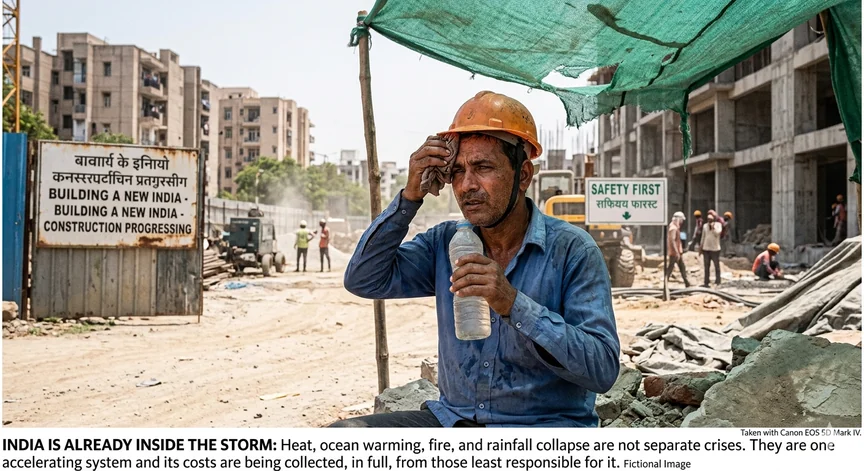
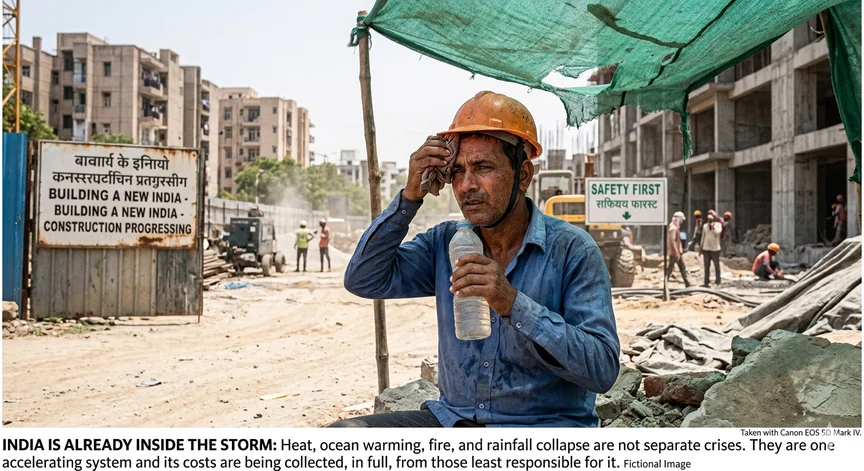
Heat, ocean warming, fire, and rainfall collapse are not separate crises. They are one accelerating system and its costs are being collected, in full, from those least responsible for it.
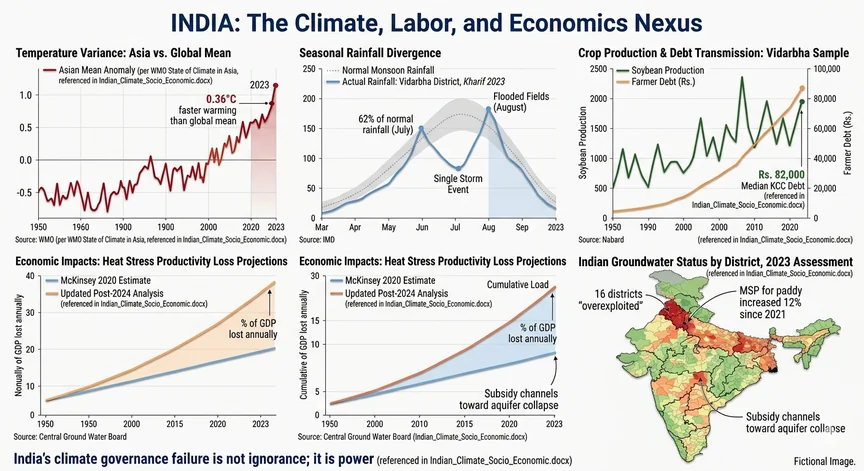
Begin with 0.36°C. That is how much faster Asia is warming than the global mean, per the World Meteorological Organization's 2023 State of the Climate in Asia report. It sounds modest. It is not. On a system calibrated to narrow thermal ranges, fractions of a degree compress everything — monsoon timing, soil moisture, fire ignition thresholds, the biological window for outdoor labour. India is not approaching this reckoning. It is already inside it.
And it is being felt, without abstraction, by the 450 million people the Economic Survey 2023-24 identifies as employed in climate-exposed sectors — agriculture, construction, fishing, outdoor vending — with no formal protections, no employer-provided cooling, and no paid sick leave. The Periodic Labour Force Survey documents that over 90 percent of India's workforce operates without written employment contracts. There is no mechanism to transfer climate risk from worker to employer. It cannot be transferred because the relationship is not formally constituted. The worker absorbs it entirely, in the body.
The IMD recorded simultaneous heatwave conditions across 16 states in April and May 2024, with wet-bulb temperatures in Odisha and Telangana approaching 35°C — the threshold beyond which human thermoregulation fails regardless of hydration. Night-time temperatures in Delhi ran 4–6°C above seasonal average through May. Sleep becomes physiologically insufficient. Recovery from daytime exposure is incomplete. The cumulative load does not add. It compounds. Meanwhile the Indian Ocean is warming at 1°C above its pre-industrial baseline — faster than any other major basin on Earth — narrowing the thermal differential that drives monsoon onset. In Vidarbha, the 2023 kharif season delivered 62 percent of normal rainfall through July, then flooded fields replanted for drought in August. The swing is the signal.
"I no longer plan a season. I plan a week, sometimes three days. After that I don't know what the sky will do."
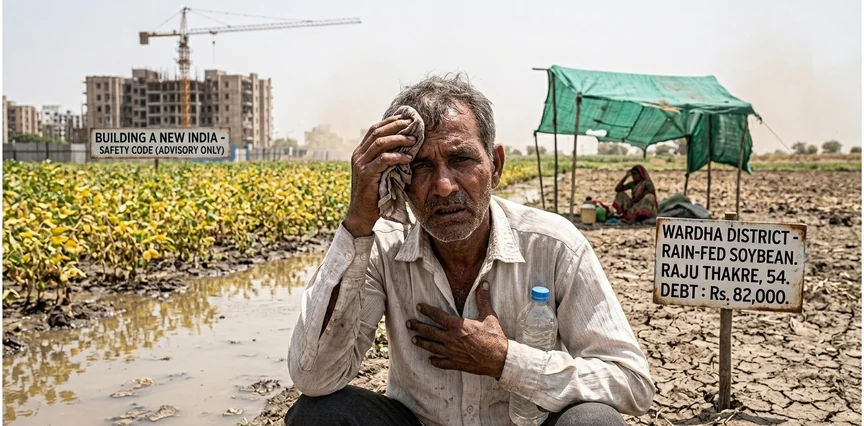
Raju Thakre, 54, farms 3.2 acres of rain-fed soybean in Wardha district. He has switched crop varieties twice and taken two loans in three years. In 2023 he watched a field replanted after a dry July go under water within 48 hours of a single August storm. His Kisan Credit Card debt stood at Rs. 82,000 as of March 2024. He has not discussed it with his wife. This is not an exceptional case in Vidarbha. It is the median one.
The socio-economic transmission is direct and unsparing. McKinsey's 2020 analysis projected heat stress productivity losses of 2.5–4.5 percent of GDP annually by 2030 — a figure now likely conservative. NABARD survey data documents the chain: crop failure triggers informal borrowing, informal borrowing triggers asset liquidation, asset liquidation removes the buffer for the next shock. A Lancet Countdown study found adults over 65 and children under five — both concentrated in lower-income households — face disproportionate mortality risk in sustained heat. In India's informal settlements, where 65 million people live under corrugated metal roofing, internal temperatures during heatwaves exceed outdoor levels by 5–8 degrees. Research in Nature Climate Change documents elevated preterm birth and low birth weight risk during heatwave periods in these communities. The intergenerational transmission of climate harm is already measurable. No ministry with the authority to act is measuring it. Because to measure it honestly would be to confront what the chain of evidence makes undeniable: that the promise of prosperity delivered through ecological sacrifice — the foundational bargain of every development framework India has operated under — has not been kept for the people who paid the ecological price. It was never designed to be. The crisis is not growth itself, but a model of growth that privatises profit while socialising ecological collapse. This Growth is a lie. Not a failed experiment. Not a mismanaged policy. A lie told to the 450 million, sustained across decades, in which the costs were always theirs and the gains were always elsewhere.
Recent forest fires across parts of the Himalayan belt, central India, and the Northeast have further exposed the ecological cost of rising heat and prolonged dry conditions. Thousands of fire incidents recorded through satellite monitoring in 2024–25 damaged wildlife habitats, degraded soil fertility, and disrupted the lives of forest-dependent communities. In several regions, delayed response systems, weak forest protection capacity, and expanding commercial pressure on ecologically sensitive zones have intensified both the scale of destruction and the long-term biodiversity loss.
Meena Menon, general secretary of the Construction Workers' Federation of India, has spent two decades tracking what this means on a construction site. "What used to be a few unbearable days in May is now six weeks where our members face an impossible choice — work in dangerous heat or lose the contract," she said. "The contractor doesn't lose. The worker's body does." Her federation's representations to the Ministry of Labour have produced no binding regulation. The 2023 occupational safety code was revised before passage to retain only advisory language — at the request of industry groups citing project timelines. The 50 million workers whose bodies bear those timelines were not consulted. They never are.
This is where the system's architecture becomes visible. Coal India Limited — a state enterprise whose board carries Ministry of Coal nominees — produces over 700 million tonnes annually and is pledged to increase that volume through 2030. The Adani Group simultaneously holds India's largest private coal distribution network and major solar and port contracts, with regulatory clearances from ministries whose senior appointments overlap with its interests. When a single conglomerate profits from both the crisis and the partial remedy, the incentive to resolve the contradiction disappears. In agriculture, the MSP regime — defended as farmer welfare — functions simultaneously as guaranteed revenue for input corporations including Chambal Fertilisers and Coromandel International, whose margins depend on water-intensive cultivation continuing in aquifer-depleted zones. The Central Ground Water Authority has statutory power to restrict over-extraction. Its enforcement record is near-zero.
The EIA notification of 2020, which weakened public consultation requirements for infrastructure projects in sensitive zones, was drafted while major lobbying groups had made undisclosed representations to the ministry. The notification passed. The representations were never published. Each of these — the shortened consultation window, the advisory-only safety code, the unenforced groundwater statute — was justified, publicly, in the language of development. Roads need to be built. Energy needs to be secured. Investment cannot be delayed. The word "development" is not incidental to this architecture. It is load-bearing. It is the reason the general person accepts the sacrifice, waits for the promised return, and finds, when the aquifer is gone and the forest is ash and the monsoon no longer comes on schedule, that nothing was coming for them at all. Development is an illusion. Constructed precisely, maintained deliberately, and funded by the ecological capital of those who were told they were its beneficiaries.
India's climate governance gap is not explained by ignorance or institutional incapacity. It is explained by the fact that the entities with the most to lose from meaningful climate regulation are also the entities with the most consistent access to those who design it. The populations absorbing the costs — rain-fed farmers, construction workers, informal settlement residents, coastal fishing communities — are not in those rooms. They are outside, in the heat, planning three days at a time, waiting for rain that no longer arrives on schedule and does not leave when it does.
"India's climate governance gap is not explained by ignorance. It is explained by power."
The Architecture of Inaction: Following the Money
The overlap between regulatory authority and commercial interest in India's climate governance is not circumstantial — it is structural, and it is documentable. Consider the sequence: the Ministry of Coal nominates board members to Coal India Limited while simultaneously approving expansion targets through 2030; those targets are underwritten by state-backed financing from institutions whose risk frameworks do not price stranded-asset scenarios. The Ministry of Environment, Forest and Climate Change — the body nominally charged with limiting ecological damage — approved 105 coal mining projects between 2014 and 2023, per data tabled in the Lok Sabha.
The EIA notification of 2020 did not emerge from a policy vacuum. Submissions to the ministry under the Right to Information Act, compiled by the Centre for Policy Research, show that industry bodies including the Federation of Indian Chambers of Commerce and Industry (FICCI) and the Confederation of Indian Industry (CII) made detailed representations on draft language during a comment window that simultaneously excluded Gram Sabhas in affected zones from participation — a window shortened from 60 days to 20.
The Adani Group's simultaneous presence across coal, solar, port infrastructure, and airport privatisation is not merely a conflict of interest in the conventional sense. It is a hedge: the group profits if fossil expansion continues, and profits again if green transition accelerates through port and logistics infrastructure that its assets control. Regulatory clearances for Adani's operations, cross-referenced against the timeline of Indian port contract awards, reveal a pattern of reciprocal public asset access that no independent competition body has reviewed. In India, the Competition Commission has not opened any investigation into conglomerate climate-related asset bundling. No parliamentary committee has subpoenaed lobbying disclosure records from the Ministry of Power. These are not oversights. They are outcomes.
The MSP system's role in this architecture deserves equal scrutiny. Price supports for wheat and rice — concentrated in Punjab and Haryana, where groundwater depletion is most severe — channel public subsidy toward crops whose cultivation is accelerating aquifer collapse. The Central Ground Water Board's 2023 assessment classifies 16 districts in these two states as "overexploited." The MSP for paddy has increased 12 percent since 2021. The two policy lines have never been formally reconciled in any budget document. The entities that benefit — large procurement agencies, fertiliser manufacturers with government supply contracts — have consistent representation on planning bodies. The farmers in Vidarbha who bear the downstream consequence of a destabilised water table do not.
WHAT REFORM WOULD ACTUALLY REQUIRE
The gaps documented here are not, in the main, gaps of legislation. India has environmental law. It has occupational safety codes. It has a statutory groundwater authority. The deficit is enforcement architecture and conflict-of-interest insulation — and both are addressable without constitutional amendment or new fiscal commitments.
Mandatory climate disclosure for publicly listed Firms and PSUs: The Securities and Exchange Board of India introduced business responsibility and sustainability reporting requirements in 2023, but exempted state-owned enterprises in sectors classified as "strategic." Coal India, NTPC, and ONGC — the three largest public-sector emitters — report no standardised Scope 3 emissions data. Bringing them under the same framework applied to private-sector firms would not require new legislation; it requires an SEBI circular. The circular has been drafted. It has not been issued.
Binding heat action protocols with employer liability: The National Disaster Management Authority's 2023 heat action plan guidelines remain advisory. Seventeen states have adopted localised plans, but enforcement authority rests with district administrations that lack the capacity and legal mandate to penalise construction contractors or brick kiln operators. Converting advisory language to Schedule provisions under the Occupational Safety, Health and Working Conditions Code is a drafting exercise that the Ministry of Labour's own legal cell has the technical capacity to execute. The 2023 revision chose not to. That choice should be reversed.
Firewall between regulatory appointments and industry: The EIA process is compromised at its foundation when the same ministry that issues clearances also manages the tenures of the officials who conduct assessments. An independent Environment Clearance Review Authority — modelled on the structure of the Competition Commission — would not require new expenditure; it would require a gazette notification and a Lok Sabha resolution. Parliamentary standing committees have recommended this structure twice, in 2016 and in 2021. Both recommendations were acknowledged and shelved.
MSP-groundwater linkage: No fiscal instrument requires the government to support crops that are destroying the aquifers on which food security depends. A time-bound transition premium — paying farmers in overexploited districts more, per quintal, to shift to less water-intensive crops — would cost a fraction of the procurement subsidy currently sustaining paddy cultivation in Punjab. NABARD has modelled this. The model exists. The political will to act against the interests of large procurement intermediaries does not, yet.
Statutory lobbying disclosure: The undisclosed representations that shaped the 2020 EIA notification should not have been undisclosed. A statutory lobbying register — requiring any entity that makes representations to a ministry on draft regulation to file the substance of those representations in a public database within 30 days — would not prevent industry from participating in policy. It would make that participation visible. Visibility is the precondition for accountability. India has the administrative infrastructure to implement this; it was recommended by the Second Administrative Reforms Commission in 2008 and has not been enacted.
None of these are radical propositions. They do not require India to abandon its development trajectory or its energy sovereignty. They require only that the people most exposed to climate harm have as much access to the rooms where decisions are made as the people most insulated from it. That gap — not the 0.36°C of additional warming, not the failing monsoon, not the rising Indian Ocean — is the central governance failure of this moment. It is also the one most directly within reach of correction.
The populations absorbing the costs — rain-fed farmers, construction workers, informal settlement residents, coastal fishing communities — are not in those rooms. They are outside, in the heat, planning three days at a time, waiting for rain that no longer arrives on schedule and does not leave when it does. The question is not whether India can afford to act. It is whether the people who benefit from inaction will continue to be the people who decide.
Sources:
WMO State of the Climate in Asia 2023
IMD Heatwave Bulletins 2024
Geophysical Research Letters — Indian Ocean SST Data
Central Ground Water Board 2023
NABARD All India Rural Financial Inclusion Survey
McKinsey Global Institute — Climate Risk and Response in Asia 2020
Lancet Countdown South Asia
Nature Climate Change — Heat and Reproductive Health
India Economic Survey 2023-24
NASA FIRMS Active Fire Data
Centre for Policy Research — EIA Analysis
Lok Sabha Starred/Unstarred Questions — Coal Clearances 2014–2023
SEBI Business Responsibility and Sustainability Reporting Framework 2023
Second Administrative Reforms Commission Report 2008
National Disaster Management Authority Heat Action Plan Guidelines 2023
Glossary:
WMO → World Meteorological Organization (already written out in original)
IMD → India Meteorological Department
GDP → Gross Domestic Product
NABARD → National Bank for Agriculture and Rural Development
MSP → Minimum Support Price
EIA → Environmental Impact Assessment
FICCI → already expanded in text
CII → already expanded in text
NTPC → National Thermal Power Corporation
ONGC → Oil and Natural Gas Corporation
SEBI → Securities and Exchange Board of India
PSUs → Public Sector Undertakings
NDMA → National Disaster Management Authority (already written out)
RTI → Right to Information



The piece does address the renewable-fossil politics directly. The Adani Group holds both coal and solar assets simultaneously — so for them, transition is not a solution, it is just another profit stream. And Coal India is committed to expanding production through 2030, meaning the state itself is standing against transition. Simply switching fuels will not reduce the heat unless the same concentrated interests stop controlling both fossil and renewable policy. That structural capture is exactly what needs to change. So yes — System Change is the demand. And Climate Justice is impossible without it.