



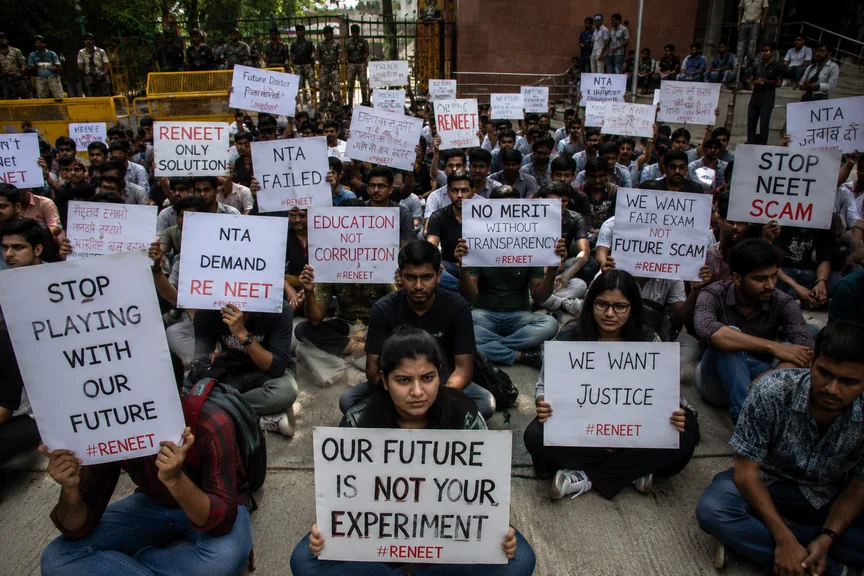
After years of recurring examination scandals, the NEET cancellation has pushed India into a deeper crisis of institutional credibility. A system built to standardise fairness now risks standardising distrust instead.
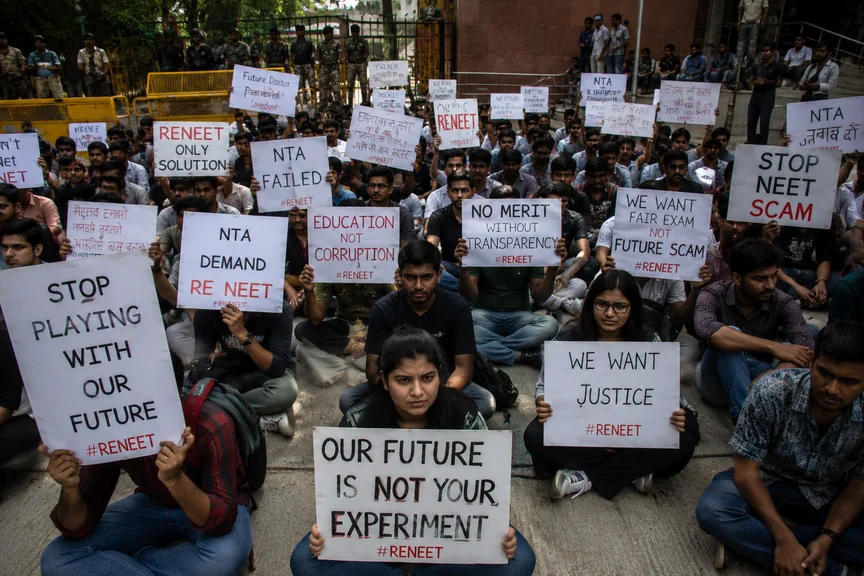
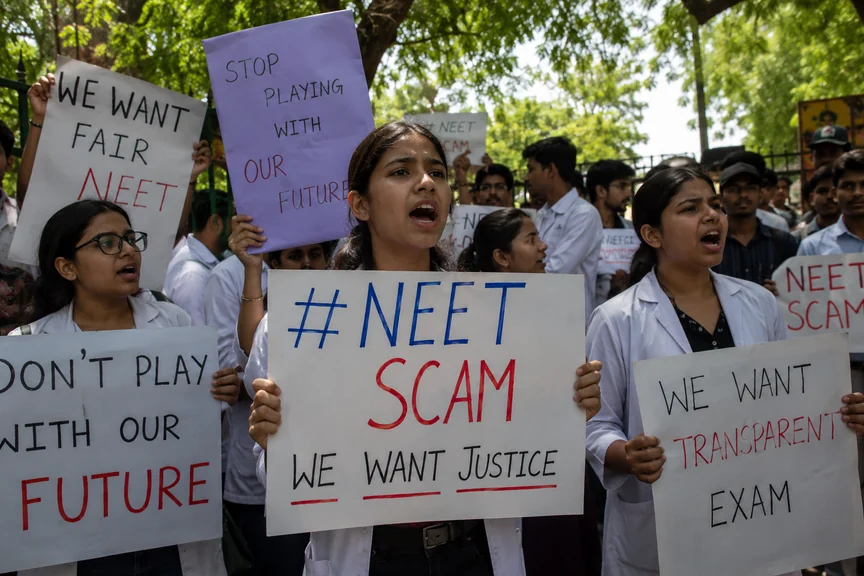
In May 2026, India cancelled NEET after another paper leak scandal ripped through the country’s largest medical entrance examination. Within days, investigative agencies and state police forces began arresting alleged intermediaries, solver-network operators and examination-linked suspects across multiple states, exposing the scale of the network operating beneath the country’s meritocratic façade.
Another leak. Another investigation. Another wave of arrests, raids and official assurances that the system remained secure. More than two million students were left stranded between uncertainty and exhaustion while authorities attempted to contain the political damage.
The shock no longer lies in the scandal itself. The shock lies in its familiarity.
Each year repeats the same sequence: exposure, outrage, arrests, assurances, committees — and eventual institutional amnesia.
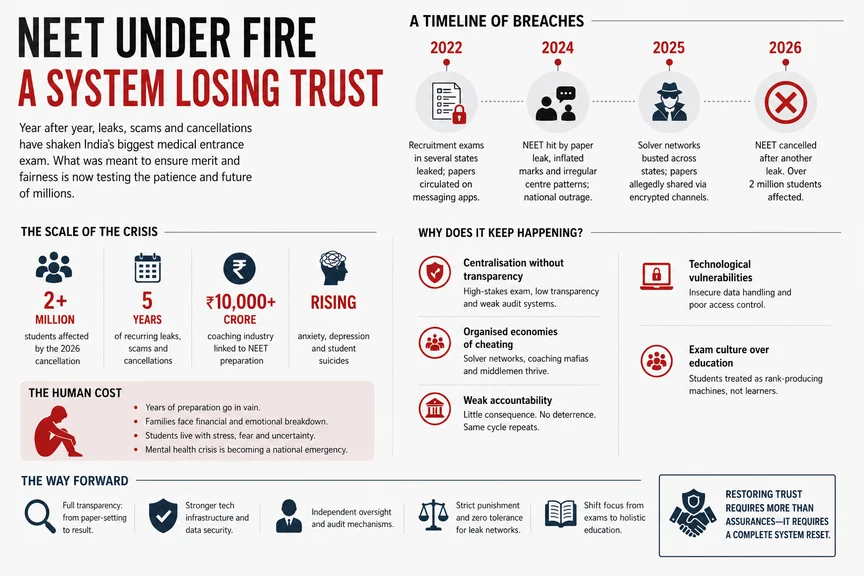
Over the last five years, India’s examination system has repeatedly collapsed under the weight of leaks, proxy-candidate rackets and organised cheating networks. In 2022, recruitment examinations in several states were cancelled after question papers allegedly circulated through messaging groups before candidates entered halls. By 2024, NEET triggered national uproar over leaked papers, inflated marks and irregular examination-centre patterns.
The controversy forced the Supreme Court, investigative agencies and the Union government into defensive coordination. Officials defended the system even as students produced evidence suggesting organised compromise. In 2025, investigators probing recruitment fraud uncovered solver networks operating across states through coaching intermediaries and digital payment chains. In one instance, question papers allegedly circulated through encrypted messaging groups hours before candidates entered examination centres. By 2026, repetition had become outcome: cancellation after collapse.
This is no longer an education controversy. It is a credibility crisis inside the Indian state.
For years, NEET was defended as the great equaliser — a centralised mechanism meant to replace opaque admissions, capitation economies and discretionary corruption with measurable merit. The logic was compelling. A country of India’s scale requires uniform standards. Medicine demands rigorous selection. Public trust requires visible fairness.
But centralisation without transparency produces the opposite outcome: opacity, capture and institutional fragility.
That is precisely what NEET has become.
One examination now carries disproportionate weight over mobility, legitimacy and survival. Families reorganise entire years around it. Students sacrifice adolescence to it. Coaching industries scale into billion-rupee economies around it. Political narratives of merit attach themselves to it. In such an ecosystem, corruption does not appear as external contamination.
The structure itself generates incentives for manipulation.
The official defence remains familiar. NTA Director General Vinay Kumar publicly insisted there was “no possibility of early access to the question paper” and urged students not to believe circulating rumours. Within days, investigative agencies arrested suspects across multiple states and the examination was cancelled. The explanation remains consistent: scale creates unavoidable leakage risk; enforcement must be strengthened.
This argument collapses under repetition.
A single leak signals breach. Repeated leaks signal design failure. A system cannot invoke scale as justification while demanding absolute public trust. Scale explains pressure. It does not explain recurrence.
India no longer conducts examinations. It conducts recurring audits of public trust.
The problem does not end with security. It begins with design.
India increasingly treats individuals not as citizens to be cultivated, but as competitive units to be filtered.
Education has shifted from public good to sorting mechanism. Students pass through algorithmic preparation systems designed for rank extraction rather than intellectual growth. Aspiration is converted into measurable output, then sold back as merit.
The system survives not by guaranteeing success, but by ensuring that enough people keep chasing it. Success remains visible, but structurally scarce. That imbalance sustains compliance. In this environment, aspiration becomes an economic instrument.
The psychological consequences are now systemic. Students are socialised into continuous competition as normal life condition. Childhood compresses into preparation. Curiosity yields to ranking. Entire cohorts grow up equating worth with performance metrics.
The consequences now extend beyond examination halls. A generation raised inside continuous elimination systems increasingly experiences anxiety, exhaustion and psychological instability not as exceptional conditions, but as ordinary features of educational life.
When self-worth becomes inseparable from rank and validation, distress stops being an individual pathology and becomes a social condition. A society organised around permanent comparison eventually normalises fear as motivation and exhaustion as discipline.
The crisis therefore exceeds administrative failure. It reflects a society organised around perpetual performance anxiety.
The same logic appears elsewhere in governance: forests reduced to land banks, rivers to water assets, mountains to mineral reserves, and citizens to data points within examination grids. Everything becomes an extractive category. Nothing retains intrinsic value.
That logic eventually weakens the institutions enforcing it. Systems built on extraction prioritise throughput over legitimacy. This is now visible in India’s examination architecture: unlimited demand placed on students and families, paired with recurring institutional failure to ensure procedural integrity.
This is why arrests alone cannot resolve the crisis. Leak networks are symptoms. Coaching mafias are symptoms. The deeper problem lies in a governance culture that concentrates authority while resisting equivalent transparency.
The solution is not abolition of national standards, nor authoritarian overcorrection. It requires structural correction: decentralised accountability paired with transparent institutional design.
India must reduce dependence on single-point examinations that compress life outcomes into one day. Medical admissions must evolve toward layered evaluation systems combining standardised testing, academic history and contextual assessment. Concentration creates vulnerability; distributed systems reduce capture.
Second, examination governance must become transparent by default: independent audits, secure distribution systems, real-time monitoring and mandatory post-exam disclosure frameworks.
Third, the state must address the scarcity that fuels the examination-industrial ecosystem. Where stable pathways are limited, corruption becomes structurally incentivised.
Even as arrests proceed, institutional reflex remains unchanged: contain scandal first, reflect later. That reflex has now normalised recurrence.
At a nearly empty examination centre in northern India, chairs remain stacked in silence. Answer sheets were never distributed. Invigilators have left. Students were informed that the examination no longer exists. Outside, families stand briefly, then disperse without protest or explanation. The architecture of selection remains intact, but its authority has momentarily dissolved.
Reports from the ongoing investigation also identify a Rajasthan-based BJP functionary, Dinesh Biwal, among those arrested in connection with the alleged network, underscoring how the racket intersects with local political and coaching-linked intermediaries rather than remaining confined to purely academic actors.
The cancellation of NEET 2026 reveals more than administrative failure. It exposes a state that concentrates authority but fails to secure the systems carrying it.
A republic cannot sustain legitimacy through repetition of reassurance. Trust survives only when power is matched by scrutiny. India’s examination system has reached that threshold.
The question is no longer whether another investigation will follow. It is whether institutional transparency will ever match institutional control.
Without that shift, the cycle remains predictable: another exam season, another breach, another committee, another declaration of normalcy.
And outside another examination centre, students will continue arriving for a future that is repeatedly postponed by the systems meant to certify it.
At that point, the real question will no longer concern merit at all. It will concern how long institutional failure can be normalised before trust itself becomes structurally irreversible.




Discussion 6 comments