



A gavel without a pact
When Murat Kurum brought down the gavel in Antalya on Sunday 22 November, nearly two days after the summit was due to close, there was no agreement left to bless. COP31 ended without a cover decision. The proposed “Antalya Pact” was rejected in the closing plenary, and the presidency declined to table another draft.
By most accounts, it is the first time since Copenhagen in 2009 that a COP has failed to produce an overarching political text. It was also the longest summit in the history of the process. Delegations from almost 200 countries left with a scattering of technical decisions and a growing sense that the machinery itself is under strain.
The question in Antalya was simple to state. With current policies heading for roughly 2.8°C of warming, according to the UN Environment Programme, would governments repeat the pledge made at COP28 in Dubai to transition away from fossil fuels, even in softened form?
They would not. That refusal tells us a great deal about who holds power in climate diplomacy and which solutions the powerful prefer. It also exposes a growth-centred model that keeps promising decarbonisation without naming its cause.
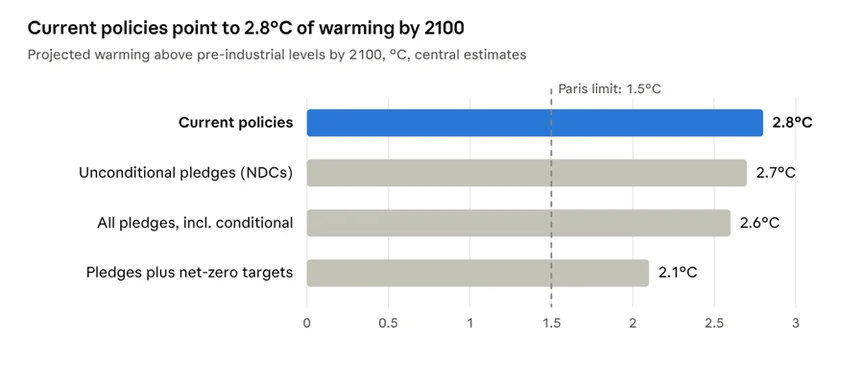
Source: UNEP Emissions Gap Report 2026 (21 October 2026), central estimates with 66% likelihood, via UNEP and Carbon Brief
Even if every pledge were honoured, warming would remain well above the Paris limit.
The vanishing words
The story of Antalya is, above all, the story of a missing phrase. The first draft of the pact, published on 16 November, still offered options for a transition away from fossil fuels, including one for an “immediate transition”. By 19 November, according to Down To Earth, that language had gone. The final text made no reference to coal, oil or gas at all.
The resistance came from familiar quarters. Saudi Arabia and other oil producers reportedly opposed any fossil fuel wording, and Russia objected to references to a transition. Both argued for carbon capture instead. On the other side, the EU, the UK and around 130 countries had backed a letter, convened by Germany, asking for the Dubai commitment to appear in the outcome. When it did not, they refused the text. Ireland’s climate minister, Darragh O’Brien, speaking for the EU, called it “unconscionable”.
The arithmetic matters here. A handful of producers could never have prevailed in a vote. Yet the UNFCCC works by consensus, and consensus hands every delegation a veto. In Antalya, that veto was used not to protect the vulnerable but to protect a product. The majority then used its own veto to refuse a text that would have quietly buried the Dubai pledge. Neither side could win. Both could only prevent.
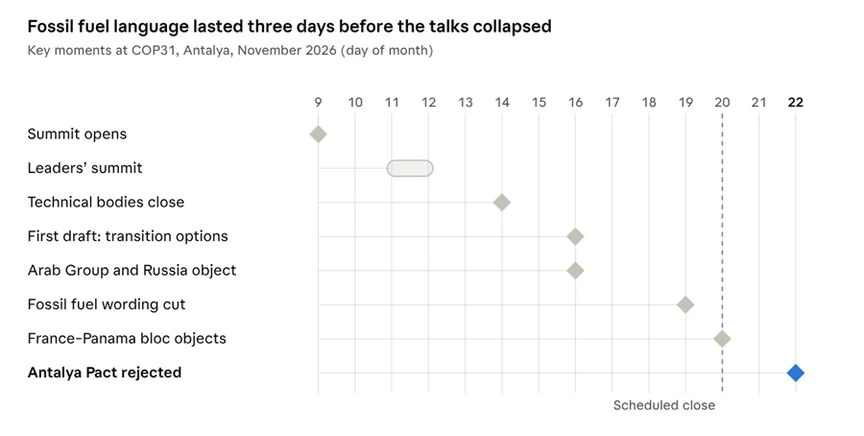
Sources: UNFCCC COP31 schedule; Earth Negotiations Bulletin; Down To Earth; UN News; Reuters. All dates 2026.
The talks ran two days past their scheduled close before the final text was rejected.
Shaping the words, not the outcome
COP31 was an experiment in shared leadership. Turkey held the presidency, while Australia’s climate minister, Chris Bowen, chaired the negotiations. In practice, it produced two hosts whose own records sat uneasily with the ambition they were asked to broker. Turkey still draws about a third of its electricity from coal, has no phase-out date and plans to expand two coal plants. Kurum said earlier this year that cutting emissions should not come at the expense of growth. Australia remains one of the world’s great exporters of coal and gas.
Access deepened the unease. Reuters reported that Saudi, Chinese and Russian officials enjoyed frequent access to the presidencies’ offices, while other groups struggled to secure meetings. “It seems like we are negotiating with the Saudis,” Tuvalu’s Maina Talia told Reuters. The presidency denied giving any country preferential treatment.
One chair stood empty. For the second year running, the United States, the largest historical emitter, sent no delegation after the Trump administration’s withdrawal from the Paris Agreement. Its absence did not decide the outcome, but it removed a heavyweight that might once have pressed the producers to yield.
Machines in place of limits
What the final draft offered instead is revealing. It aspired to scale carbon capture, utilisation and storage to gigatonne levels by 2035, and called for more carbon removal. It also set a target for electricity to reach 35% of final energy consumption by 2035, while dropping the explicit link to tripling renewables.
None of this is inherently wrong. Clean electrification is necessary, and some carbon removal will almost certainly be needed. Yet the shape of the package matters more than its parts. Operating capture capacity is just over 50 million tonnes a year, according to the International Energy Agency, so a gigatonne implies a twentyfold expansion in under a decade. Climate Action Network warned that such a goal could justify continued fossil fuel expansion. A text that can promise machines but cannot name the fuels they are meant to clean up has quietly chosen its side.
Here a degrowth reading becomes useful. The draft treats the crisis as an engineering gap rather than a problem of scale. It asks how to produce more energy more cleanly, never how much energy and material a just society needs. Consumption and the emissions of the wealthiest stay outside the frame, although Oxfam calculated in October that the richest 0.1% of humanity emit more than the poorest 3.5 billion.
Capture lets extraction continue; electrification lets growth continue. Neither asks whether a finite planet can sustain endless expansion, however clean its wiring. The pact did not fail for lack of technology. It failed because it would not name the limits that technology is being asked to dissolve.
The unpaid bill
If fossil fuels were the loudest dispute, money was the deepest. According to the UNFCCC’s own assessment of their costed climate plans, developing countries need between $455 billion and $584 billion a year in climate finance through 2030. The UN Environment Programme puts adaptation needs alone at around $305 billion a year. Antalya offered little that was new.
The draft repeated the pledge to at least triple adaptation finance by 2035, but set no baseline from which to triple. A target of at least $120 billion a year, present in the draft of 16 November, was removed. No fresh pledges were made for loss and damage, and the Adaptation Fund raised only about $50 million against a $300 million annual target, according to Anadolu. For countries already counting the cost of floods and droughts, a promise without a number is hardly a promise.
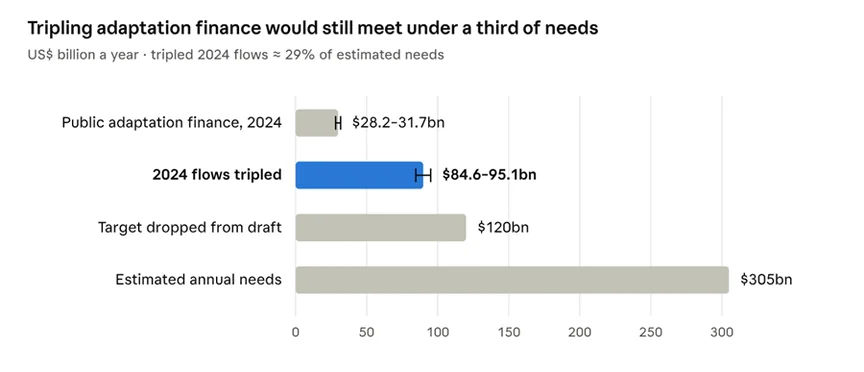
Sources: UNEP Adaptation Gap Report 2026 (needs of about $305bn a year to 2035; 2024 international public flows of $28.2–31.7bn); Antalya draft of 16 November 2026 via Down To Earth and Reuters. Tripled flows are three times the 2024 range, our calculation.
Even the figure removed from the draft would have covered well under half of estimated needs.
India’s position captured the tension. Environment Minister Bhupender Yadav said India regretted the failure, having worked with the BASIC and Like-Minded Developing Countries groups for an outcome built on equity and finance from the rich world. That argument carries real moral weight, given where historical emissions lie. Yet it sits beside India’s own coal expansion; the campaign group Urgewald counts India among the leading developers of new coal power. Indian civil society was sharper still. “No deal is better than a deal that locks in failure,” said Harjeet Singh of the Fill the Fund campaign.
Refusal and residue
The collapse was also a story of refusal, and refusal can be a form of action. On the final Friday, according to CBS News, a coalition led by France and Panama declared the draft too weak. Panama’s environment minister, Juan Carlos Navarro, said his country could no longer be held hostage by petroleum producers. For Pacific nations facing the slow erosion of home, the disappointment was raw. “We have been let down on all sides,” the Marshall Islands delegation said. Bowen conceded he could not overcome “unbridgeable red lines”, and in Canberra the opposition is demanding his resignation.
Something did survive. Decisions were adopted on the Just Transition Work Programme, with the new mechanism’s structure deferred to COP32, and on carbon markets and transparency. The Adaptation Fund will now receive a mandatory 5% share of proceeds from the UN carbon market. Yet the work programme on mitigation ambition lapsed after objections from Russia and Saudi Arabia, according to Eco-Business. This is the residue of a negotiation, not its resolution.
After Antalya
The breakdown revives an old question: can a process that requires the consent of almost 200 parties ever confront the industries that sustain some of them? UN climate chief Simon Stiell admitted that the process “fell short”. Others are already looking beyond it. In April, 57 countries met in Santa Marta, Colombia, for the first conference on transitioning away from fossil fuels, working outside the consensus rule. A second, led by Tuvalu and Ireland, is planned for 2027. These coalitions of the willing may now carry more weight than the plenary halls.
The next COP, in Addis Ababa in November 2027, will inherit an unfinished agenda and damaged trust. It will also inherit a warming world that does not pause for procedure.
Perhaps the deepest lesson lies here. Every word struck from a draft and every dollar withheld from adaptation travels outward, from conference rooms to fields, coastlines and cities. The consequences are shared even when responsibility is not. A politics that cannot name the problem will not solve it, and a growth model that cannot imagine enough will keep mistaking motion for progress. Until those two silences are broken, we should expect more summits that end with a gavel and nothing beneath it.
Sources
• UN News, COP31 closes without agreement
• Reuters via KFGO, Saudi Arabia’s influence loomed large over failed COP31 deal
• CBS News, COP31 ends with no agreement
• IBTimes UK, COP31 ends without agreement on fossil fuels and finance
• RTÉ, Pacific nations express dismay as no COP31 deal reached
• France 24, Pacific island nations express despair over COP31 failure
• Down To Earth, COP31 ends with no major deal
• Down To Earth, Cover decision draft drops fossil fuel phase-out language
• UNFCCC, Final draft cover decision, FCCC/PA/CMA/2026/L.25
• Earth Negotiations Bulletin, COP31 daily report, 16 November 2026
• Eco-Business, COP31 falls short, and not just on fossil fuels
• The Tribune, India regrets failure to reach consensus on COP31 cover decision
• Hürriyet Daily News, COP31’s Adaptation Fund receives lacklustre support
• Adaptation Fund, COP31 completes the Fund’s transition to the Paris Agreement
• Al-Monitor, Turkey’s COP31 message: electrify, recycle, don’t mention coal
• Climate Home News, COP31 chief rejects priority focus on fossil fuels
• Eco-Business, COP31 hosts pursue coal expansion, says Urgewald
• UNEP, Emissions Gap Report 2026 press release
• Carbon Brief, UNEP: opportunity lost to meet 1.5°C without overshoot
• UNEP, Adaptation Gap Report 2026 press release
• UNFCCC, Second Needs Determination Report, executive summary
• Down To Earth, Richest emit more carbon than the poorest, says Oxfam
• Carbon Brief, Santa Marta: key outcomes from first summit on transitioning away from fossil fuels

Be the first to join the discussion.