


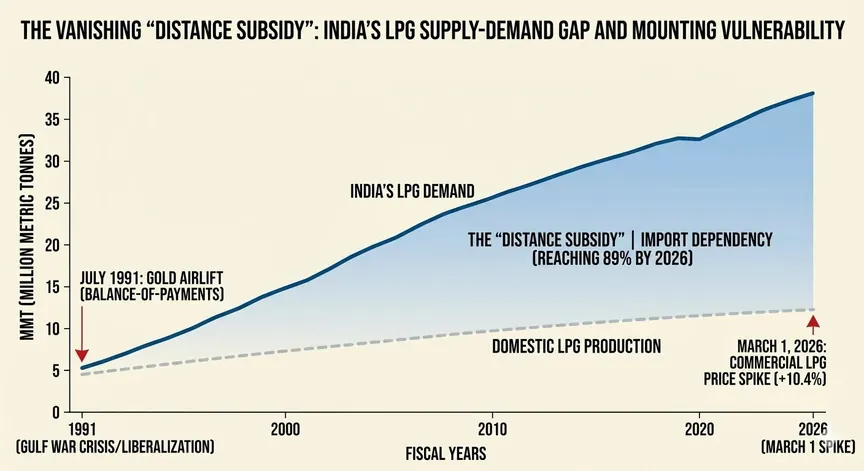
As the "Distance Subsidy" that funded modern life evaporates, a conflict thousands of miles away is dictating the price of a meal in Indian homes. With commercial LPG spiking by 10.4% on March 1, 2026, the nation is facing more than a price hike; we are waking up to how fragile our energy supplies really are. For the common person, the challenge is no longer just about paying a bill—it is about surviving a global web where every fix seems to create a new problem.
The ripple effects of the West Asia crisis have reached every doorstep. This vulnerability is not new; it is a legacy of the 1990s. As national energy use exploded during liberalization, domestic production stalled, leaving a massive gap filled by volatile imports. History reminds us of the stakes: in July 1991, a similar Gulf-triggered crisis forced the government to airlift 47 tonnes of national gold to London just to stay afloat. Today’s hikes are simply the latest chapter in this long-standing exposure.
The immediate cause is the "War Premium" on oil passing through the Strait of Hormuz. But untangling this reveals a trap: solving one shortage often triggers another. Shifting to electric vehicles to break an 89% oil reliance merely trades a fuel crisis for a new dependency on rare minerals like lithium.
"Green" technology carries its own debt. Solar panels and batteries require intensive mining that scars distant lands and leaves a massive waste problem for our children. Simply swapping an oil dependency for a mineral dependency moves the environmental problem rather than lifting it. This is the friction of the era: every technological escape hatch comes with a hidden cost.
Real security lies in a return to the discipline of the home. It is often assumed that survival requires more—more subsidies, more technology, or more spending. Yet the most resilient shield is the elegance of "enough." By reducing unnecessary energy use and streamlining how life is lived, the household gains room to breathe. When reliance on the disposable is minimized, the most secure resource is the one that never had to be bought. True wealth is now measured by how little a home is beholden to a distant well.
This reality is visible in the neighbourhood "pice hotel." Consider Sanjit, whose small eatery serves daily wage earners. For him, a commercial cylinder crossing ₹2,100 is not an abstract statistic; it is a mechanical failure of his livelihood.
The fallout is evident in the hollowed-out doorways of closed shops and the anxious queues at LPG offices—scenes carrying the ghost-like echoes of the desperate COVID-19 lockdowns. As shutters come down, a silent exodus has begun: thousands of daily workers are returning to their villages, their income extinguished by a conflict they had no part in. "Last year, I could plan," Sanjit says. "Now, a headline in a country I’ve never seen decides if I can pay my staff. Being 'connected' to the world is not the same as being 'secure' in the street."
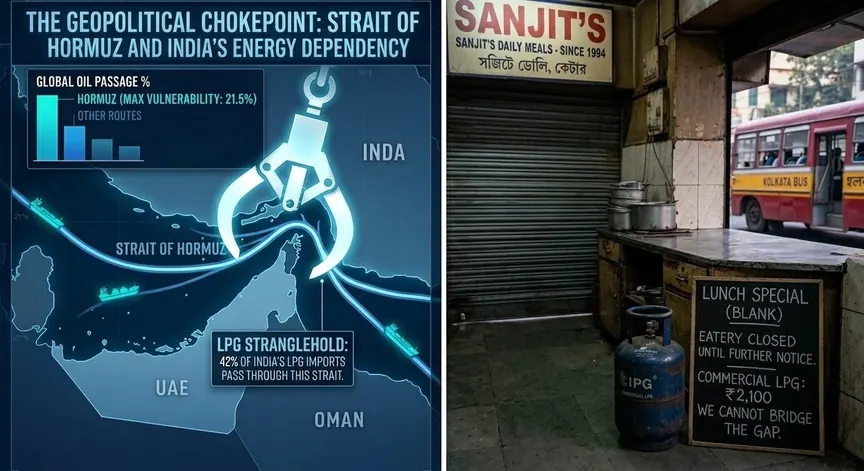
Switching to induction cooking is no simple rescue. Local grids in older neighbourhoods cannot handle the massive electrical load. Furthermore, shifting to the grid merely swaps a gas dependency for a power-plant dependency. It trades a fuel crisis for a grid crisis. When the "Distance Subsidy" vanishes, Sanjit is forced to reduce portions or cut overhead, directly threatening the nutritional security of the workers he serves.
The most viable path forward is a strategy of principled balance. Total isolation is impossible, but passive reliance on a volatile global market is unsustainable. This path is about ensuring the common kitchen is no longer held hostage by a single global chokepoint.
The structural limits of "business as usual" have been reached. In 2026, the buffers that protected global logistics have worn thin. What follows is a transition from "just-in-time" convenience to "just-in-case" preparedness. Local self-reliance must move from a fringe idea to a core survival strategy.
However, this cannot be an individual burden. The true "Distance Subsidy" that must be replaced is the isolation of one citizen from another. When costs threaten a neighbourhood institution, the solution is found in social infrastructure—the informal cooperatives and shared purchases that keep a street functioning when markets fail. This is the birth of a new urban intelligence, protected by the shared resolve of the neighbourhood.
The success of a community will no longer be measured by GDP, but by collective stamina. By choosing a balanced path, a society reclaims the right to a stable, sovereign home. Security must be determined by local innovation and deliberate choice, not by the shifting sands of a distant battlefield.





Discussion 10 comments