



As the India Meteorological Department forecasts another season of gruelling heat across the subcontinent, the climate warning has moved from scientific projection to lived emergency. From shrinking wetlands to overwhelmed hospitals, India's sweltering landscape demands a decisive shift — away from unchecked expansion toward a new architecture of equilibrium.
India is bracing for an intense summer, and this time the climate crisis has crossed a threshold. The India Meteorological Department has forecast above-normal heatwave days across eastern, central, and northwestern India. States including West Bengal, Bihar, Jharkhand, Odisha, Rajasthan, and large parts of central India face prolonged heat and rising humidity. This is no routine seasonal alert. It is a serious public health and governance emergency - a moment when extreme temperatures have become one of the most immediate ways in which climate change is felt in everyday life.
What was once considered rare has now become alarmingly recurrent. India cannot afford to keep rediscovering this truth with each passing summer.
For many households, this crisis is no longer visible only in temperature charts. It is the exhaustion of a construction worker in Kolkata finishing his shift under the afternoon sun. It is the crowded corridors of district hospitals. It is the rising cost of food, electricity, and water. The timing of the IMD warning which was issued at the very start of the summer cycle suggests the country may be entering yet another season of prolonged climatic stress.
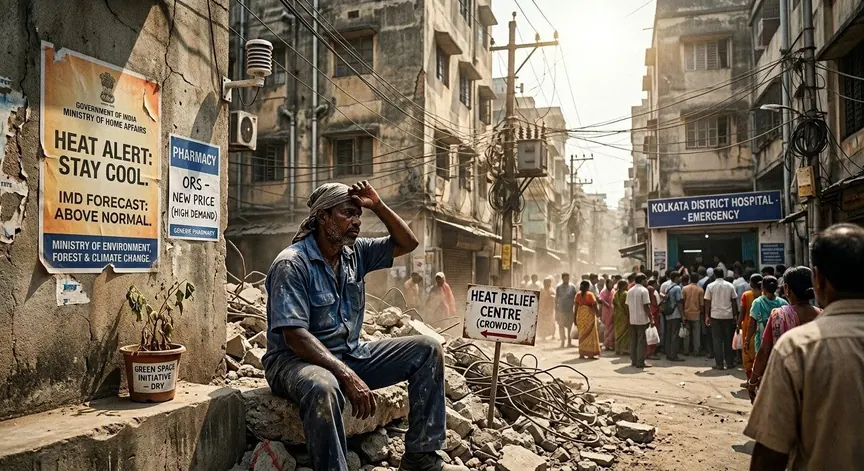
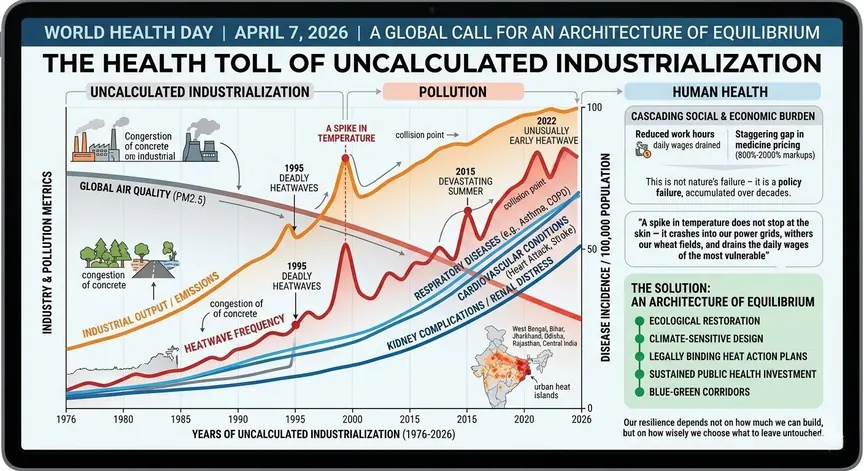
India has seen this pattern before. The deadly heatwaves of 1995, the devastating 2015 summer that claimed over 2,500 lives, and the unusually early 2022 heatwave. What was once considered rare has now become alarmingly recurrent. India cannot afford to keep rediscovering this truth with each passing summer.
The geography of this crisis tells an equally important story. The IMD's warning covers regions where both population density and livelihood vulnerability are high. In cities, the effects of heat are compounded by large-scale concretisation, shrinking green cover, and the gradual loss of wetlands. Around Kolkata, the steady encroachment on wetlands has intensified the urban heat island effect, making recovery between heatwaves more difficult. In rural areas, rising temperatures translate quickly into crop stress, livestock decline, and acute water scarcity — challenges that have no seasonal off-switch.
The present climate instability is not merely an isolated fluctuation in weather. It is closely linked to decades of unchecked urban expansion, the loss of tree cover, and the weakening of natural drainage systems. At the heart of this sweltering reality lies a difficult truth: we have mistaken accumulation for advancement and scale for success. By paving over green corridors and filling in wetlands, we have dismantled the very systems that once buffered us against extremes. We have suffocated the natural buffers that once breathed for us. By choosing a congestion of concrete over a harmony of space, the very abundance we sought has become the toxin that endangers us. The loss of these natural cooling mechanisms is not background noise; it is a direct and measurable contributor to the intensity of every heatwave that follows. This is not nature's failure - it is a policy failure, accumulated over decades.
This policy failure is further aggravated by the predatory nature of the healthcare market. While families struggle with heat-induced illnesses, they face a staggering gap between the manufacturing cost and the retail price of essential medicines. In a market where prices of medicines are frequently marked up by 800, 1,000, or even 2,000 times the original cost, the right to health becomes a luxury few can afford.
A spike in temperature does not stop at the skin - it crashes into our power grids, withers our wheat fields, and drains the daily wages of the most vulnerable.
What we are witnessing is a collision of crisis. A surge in temperature does not stop at the skin - it crashes into our power grids, withers wheat fields, and drains the daily wages of the most vulnerable. These are no longer separate problems to be solved in isolation. When extreme heat shuts down a transformer, it simultaneously threatens a hospital's ability to save lives and a family's access to water. The heat emergency is an economic emergency, an energy emergency, and an urban planning emergency - all at once.
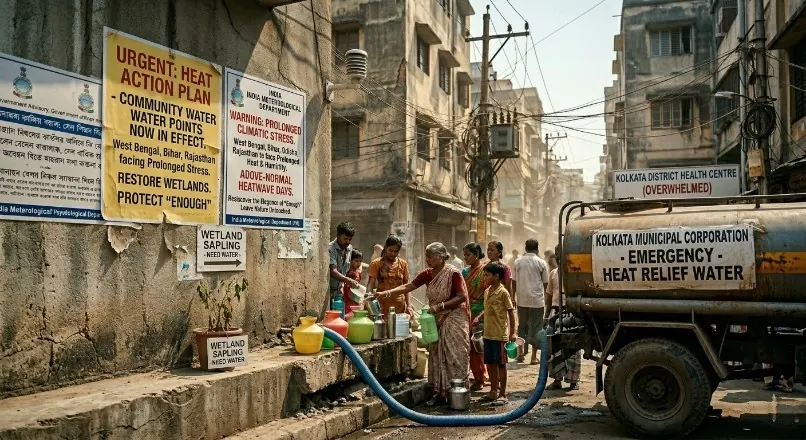
The physical toll is equally stark. Extreme heat increases the risk of dehydration, heat exhaustion, respiratory distress, kidney complications, and cardiovascular stress. The danger is disproportionate for outdoor workers, children, the elderly, and those with pre-existing conditions. Warmer, more humid conditions also expand the habitat for disease vectors, raising the incidence of dengue and malaria. Reduced work hours mean lower wages for daily earners; crop stress translates into higher food prices. What begins as a weather event rapidly becomes a cascading social and economic burden.
The way forward demands a deliberate shift - away from the reckless expansion that has brought us here, and toward what might be called an architecture of equilibrium. This is not a call for stagnation; it is a call for smarter, more resilient growth. City planners must be required to integrate blue-green corridors – networks of trees, water bodies, and permeable surfaces – into urban design, so that growth no longer comes at the cost of our natural cooling systems. State governments must enforce and expand heat action plans with legally binding timelines, not merely advisory circulars. The Centre must strengthen ecological restoration programmes and set clear targets for wetland recovery around major cities. And public health systems need sustained investment so they can absorb the burden that climate stress will continue to place on them.
Technology has a role, but a supporting one: to protect the most vulnerable, not to substitute for the ecological systems we have dismantled. Heat-resilient architecture, early-warning systems, and community cooling centres are not luxuries – they are the minimum infrastructure a warming India requires.
What may happen next depends on whether Institutions move beyond seasonal advisories and address the structural causes of this crisis. Without stronger heat action plans, climate-sensitive urban design, ecological restoration, and sustained public health investment, the warnings issued each summer will become recurring signals of a deeper, normalised emergency. India has faced extraordinary challenges before and found the capacity to act. The question is whether this moment – when the science, the forecasts, and the human cost all align – will finally be the moment that drives structural change. The greater danger is not only the rising temperature this season, but the steady normalisation of a crisis shaped as much by human choices as by climate itself.
Our resilience depends not on how much we can build, but on how wisely we choose what to leave untouched.





আলোচনা 8 মন্তব্য