


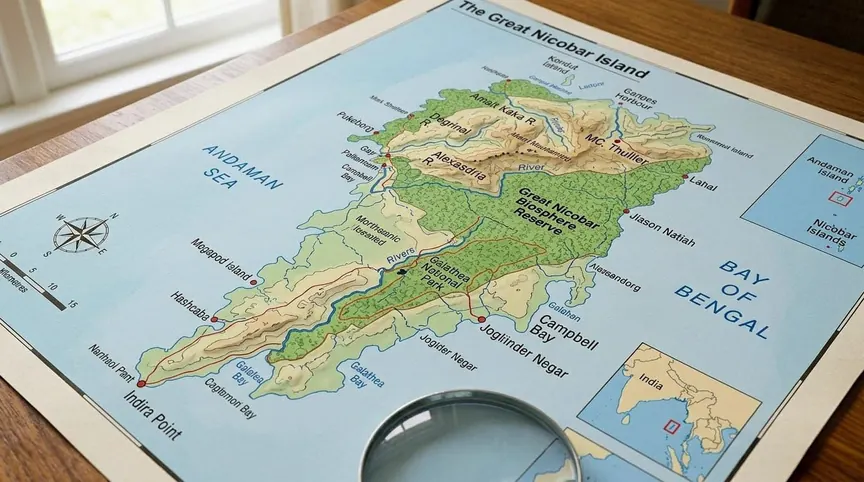
The global developmental machine, fueled by a relentless appetite for strategic dominance and economic throughput, has set its predatory sights on the last bastion of evolutionary purity: Great Nicobar Island. Under the euphemistic banner of “Holistic Development,” a ₹81,000-crore mega-project is being carved into a landscape that has, until now, operated on a timeline of millennia rather than fiscal quarters. This substance of the current crisis—the physical reality of a transshipment hub, a greenfield international airport, and a captive power plant—is not progress in any civilized sense; it is a calculated Ecocide. It represents the deliberate and systematic destruction of an entire ecosystem until it can no longer support its native life forms. As the NITI Aayog pushes for a logistics node to rival Singapore, the world is witnessing the cold transformation of a biological treasure into a mere commodity. At the heart of this project lies the International Container Transshipment Terminal at Galathea Bay, an ambitious attempt to capture the maritime churn of the Malacca Strait. But the price of this ambition is the Deep Exhaustion of a biosphere reserve that serves as the primary atmospheric and thermal stabilizer for the Bay of Bengal. To facilitate a concrete grid designed for a settler population of 650,000, nearly a million ancient trees are slated for execution.
The state attempts to justify this carnage through the bureaucratic fiction of “Compensatory Afforestation” in the arid, scrub-land plains of Haryana, thousands of kilometers away. This is a profound display of Ecological Illiteracy, a systemic failure to understand the specific, irreplaceable context of this tropical rainforest. A forest is not a mere collection of timber that can be “offset” elsewhere; it is a complex, subterranean intelligence that belongs uniquely to its soil. According to reports from the Anthropological Survey of India, Galathea Bay is the primary nesting site for the Giant Leatherback Turtle, a prehistoric wanderer that has returned to these shores for millions of years. To pave over these nesting grounds is to sever a link in the chain of global biodiversity that can never be mended. The current trajectory trades the Inherited Stillness of a million-year-old evolutionary cradle for the Insatiable Extraction of a twenty-year infrastructure cycle—a consumption-driven craving that recognizes no limits and respects no boundaries. This geographical reality—the precise, fragile “where” of the island—cannot be replicated or moved; once the Galathea is paved, the leatherback’s lineage is extinguished.
The human cost of this disruption is equally staggering, as the Shompen and Nicobarese tribes—the original custodians of this land—face what can only be described as a civilizational death sentence. By “de-notifying” tribal reserves to make way for the project, the administration is effectively erasing a 10,000-year-old cultural lineage that has lived in Sacred Poise. This is that profound, existential state of balance where human activity is so perfectly aligned with nature’s rhythms that the community flourishes without depleting its source of life. To these indigenous groups, the forest is not a “resource” to be exploited for GDP; it is a living relative and a historical record of their own being. To disrupt this sanctuary for a shipping lane is a profane act of Anthropocentric Hubris, the dangerous, ego-driven overconfidence that human interests are the absolute center of the universe and that engineering is superior to the primal forces of the Earth. The attempt to impose a "Smart City" logic onto a “Sacred Forest” logic results in the loss of the very wisdom required to survive a warming planet.
This hubris becomes even more alarming when one considers the Permanent Tectonic Strain of the region. Great Nicobar does not sit on stable ground; it rests atop one of the world's most volatile subduction zones, where the Indo-Australian plate relentlessly dives beneath the Burma microplate. This creates a condition of Permanent Tectonic Strain—where the Earth's crust is under a constant, unrelenting physical pressure, like a coiled spring pushed far beyond its breaking point, storing massive amounts of invisible energy that can only be released through catastrophic seismic upheaval.
This is a zone where the very foundation of the island is in a state of perpetual geological tension, making it a ticking clock for earthquakes and tsunamis. Historical records from the 2004 Indian Ocean Tsunami prove the fragility of this geography; during that event, the island's southern tip subsided—or sank—by nearly fifteen feet, permanently altering the coastline. Research published in journals like Current Science warns that building a massive, heavy-infrastructure urban hub on a shifting, seismically hyper-active plate is a structural hallucination. A monument to growth is being built on a foundation of shifting rock, ignoring the geological reality that nature can reclaim in minutes what spends decades under construction.
The urgency of this moment—the critical “when” in shared history—cannot be overstated. As the world navigates the volatile climate of 2026, where seasonal cycles are already unravelling across the mainland, the environmental clearance process for this project has been criticized by the Constitutional Conduct Group for being hurried and opaque. The “Holistic Development” plan bypasses several layers of protective legislation, signaling that the state values the friction of trade over the stillness of life. This is the ultimate manifestation of a Woven Collapse, where political, economic, and environmental errors entwine to create a disaster that is greater than the sum of its parts. Ecological security is being sacrificed for a perceived “strategic” gain that will likely be rendered obsolete by the very climate volatility this project accelerates.
The only way out—the strategic “how” for survival—is a Turning Point of Grace, a collective moment of pause where it is recognized that true national “security” comes from preserving the ecological systems that sustain the very breath of the inhabitants. Movement must begin toward a Self-Sustaining Harmony by immediately granting “Environmental Personhood” to Great Nicobar, recognizing its legal right to exist and evolve without human interference. This Self-Sustaining Harmony is not a regression to the past, but a sophisticated advancement into a future where human presence acts as a restorative force rather than an extractive one. This refusal to compromise with destruction is not an act of extremity; rather, it is the only way to return to the center. When a civilization has leaned so far into the abyss of consumption that it risks immediate collapse, the most balanced and reasonable action is to pull back toward the stable ground of reality. Tribal sovereignty must be respected as the final authority over these lands, embracing a logic where the stillness required for a future to exist is valued over the Insatiable Extraction of expansion. This method of protection is the only path that honors the role of planetary stewards rather than planetary consumers.
The call to action must be absolute and uncompromising. This is not a project that requires “mitigation” or “green-washing” tweaks; it requires total abandonment. The judiciary, the scientific community, and the global citizenry must rise in defense of the Great Nicobar Island. A moratorium on all construction and a restoration of the tribal and ecological protections that were so casually stripped away is required immediately. To sacrifice this island at the altar of “growth” is to admit that civilization has lost its balance and its moral compass. The path of Quiet Endurance must be chosen, protecting the wild and respecting the ancient, before the friction of excess burns away the last frontier of sanity. The Great Nicobar is not a plot of land for sale; it is the final test of humanity. Failure in this test proves a species knows the price of everything and the value of nothing. The time for “balance” is over; the time for protection is now. Let the silence of the Shompen forest be the voice that finally stops the roar of the machines. The Great Nicobar Project must be stopped, because it represents a fatal Systemic Convergence of our own making. We must stop it not because it is difficult, but because it is right.


It is very rightly said in the concluding para that we must stop it not because it is difficult but, it is right
This Editorial is one of the classic example.So development and technology should be applied in true sense in an environment friendly way.
This Editorial is one of the classic example.So development and technology should be applied in true sense in an environment friendly way.
should be prioritized. People should be more concerned about the true definition of development. It is not just constructing some thing - it should be also preserving ecological balance.
Nicely written 👌