


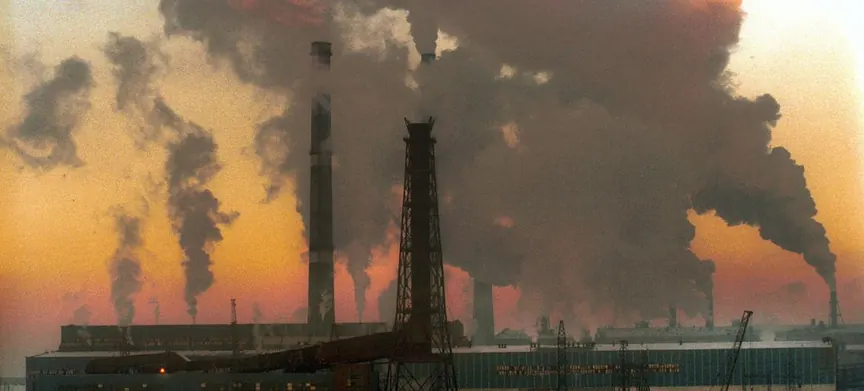
The atmosphere is being treated as an invisible ledger for a debt that can never be repaid. New satellite analyses revealing dozens of massive methane leaks across the globe are not merely technical findings—they are a verdict on the way modern economies function. What we are witnessing is not a series of isolated failures, but a coalescent ruin: a moment in which industrial negligence, weak governance, and ecological disregard converge into a single, accelerating crisis.
Methane, a gas far more potent than carbon dioxide over the short term, has become the clearest signal of this failure. Each major leak carries a warming impact comparable to that of a coal-fired power station. Yet these emissions often go unnoticed in policy debates dominated by long-term carbon accounting. The result is a dangerous contradiction: governments speak of climate targets while allowing vast quantities of the most aggressive greenhouse gas to escape, unchecked, into the air.
The geography of these leaks exposes a shared global pattern. Turkmenistan has emerged as one of the largest sources, where persistent emissions from fossil infrastructure reflect both opacity and deep economic dependence on gas revenues. But the problem is not confined to authoritarian systems. In the United States, significant leaks have been detected in Texas’s Permian Basin—one of the most technologically advanced energy regions in the world. Here, the issue is not absence of capacity, but absence of enforcement. Venting and flaring failures, often treated as routine operational practices, release methane directly into the atmosphere.
This is the central illusion of modern energy systems: that expansion can coexist with control. In reality, the scale of extraction has outpaced the systems designed to regulate it.
The crisis extends beyond oil and gas fields. In rapidly urbanising regions, landfills have become major methane emitters, transforming consumption into atmospheric damage. Satellite observations show that emissions from waste sites are frequently far higher than official estimates. In Delhi, for instance, methane releases from landfill sites have reached levels comparable to tens of millions of vehicles. These are not marginal discrepancies; they are systemic undercounts that obscure the true scale of the problem.
For those living near such sites, this is not an abstract climate issue. It is immediate and physical—a daily exposure to toxic air, a reminder that the costs of economic growth are unevenly distributed. Waste, like emissions, does not disappear; it accumulates, transforms, and returns.
Scientists have warned that the surge in methane since the late 2000s represents one of the most immediate threats to climate stability. Unlike carbon dioxide, methane does not linger for centuries. It acts quickly, intensifying warming over a matter of decades. This makes it both more dangerous in the short term—and more actionable. Cutting methane emissions is one of the fastest ways to slow global warming.
The tragedy is that many of these emissions are preventable. Leaks can be detected. Infrastructure can be repaired. Waste can be managed differently. The tools already exist. What is missing is not technology, but urgency—and, more fundamentally, a willingness to confront the limits of the current model of growth.
That model rests on a quiet assumption: that the natural world can absorb the consequences of endless expansion. Methane leaks expose the falsity of that belief. They reveal a system that depends not only on extraction, but on invisibility—on emissions that are unseen, uncounted, or ignored.
Addressing this crisis requires more than incremental reform. It demands a shift in priorities. First, there must be an immediate, enforceable global effort to detect and repair methane leaks using satellite monitoring and mandatory reporting. Transparency can no longer be optional. Second, routine venting and flaring must be phased out, not merely reduced, with strict penalties for non-compliance. Third, urban waste systems must be overhauled to eliminate unmanaged landfills, replacing them with composting, methane capture, and circular waste strategies.
But beyond these measures lies a deeper question. Energy security has long been framed in terms of supply—how much can be extracted, transported, and consumed. Yet true security depends on stability: a climate system that remains within the bounds that make human life possible. The pursuit of growth without regard for those bounds has created a fragile equilibrium—one in which the atmosphere itself becomes a site of accumulation and risk. Methane leaks are not an anomaly within this system; they are its logical outcome.
To confront them is to confront the broader trajectory of industrial civilisation. It is to recognise that progress, defined solely as expansion, carries within it the seeds of its own undoing. The solutions are within reach. What remains uncertain is whether there is the political will to act before the damage becomes irreversible. The leaks can be stopped. The question is whether the system that produces them is willing to change.

Discussion 4 comments