



Call to Save Wetlands and Fisherfolk:
From Kolkata, “People’s Convention” Emerges, Demand for a Broader Movement Special Correspondent, Kolkata | February 18, 2026
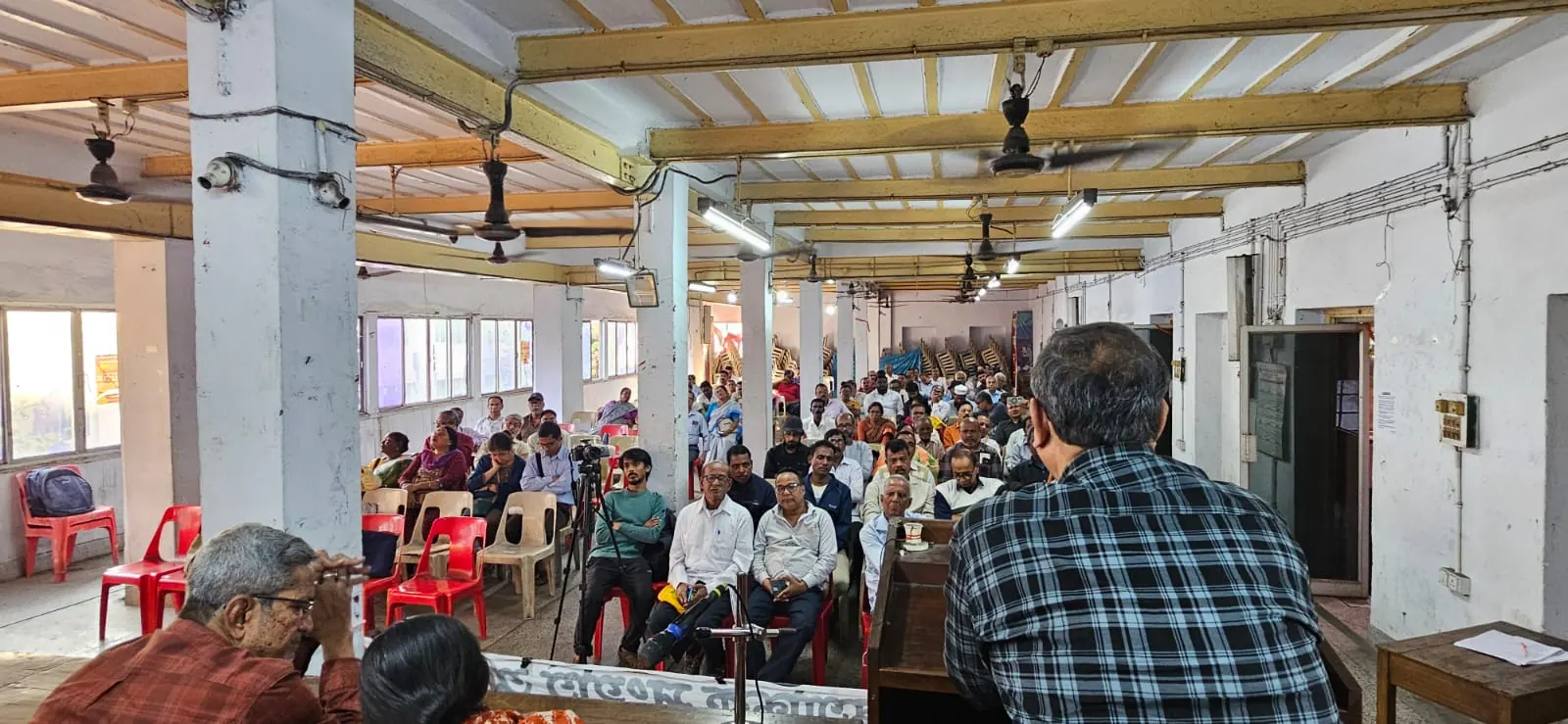
A People’s Convention was held yesterday, Wednesday, February 18, at the auditorium of the Krishnapada Ghosh Memorial Trust on Surya Sen Street, Kolkata. The convention was organized at the call of Bastutantrik Sanghati Andolan and Paribesh Bandhob Mancha Barrackpore, to demand the protection of wetlands and fishermen’s cooperatives across East Kolkata and the entire state, as well as the cancellation of recent unethical government directives. The convention saw participation from men and women members of fishermen’s cooperatives, farmers, agricultural labor organizations, along with leaders from environmental, river, scientific, and social movements across Kolkata, North and South 24 Parganas, Nadia, Howrah, Malda, and Murshidabad districts. During the meeting, representatives strongly demanded the withdrawal of the recent state government gazette notification (No. 3412, dated 12/07/2025) and expressed deep anger against the illegal encroachment of wetlands.
Endangered Wetlands and the Crisis of Fisherfolk:
Until recently, fishermen’s cooperatives across the state could lease wetlands or bheris directly from the concerned government departments. Private entrepreneurs had no role in acquiring such leases. However, the current state government has introduced a directive that opens the door for private ownership, allowing individuals and corporate interests to bid for these wetlands—a move widely seen as a conspiratorial attempt to transfer community resources into private hands. As a result, one after another, wetlands in the districts of North and South Bengal are being handed over to promoters and corporate powers. In East Kolkata Wetlands, as well as in North Bengal’s Chapramari Lake, Shobhabaari Dighi, Jor Dighi, Gazaldoba, and water bodies adjoining the Mahananda Canal, records are being altered to facilitate their destruction. In reality, this marks the beginning of an effort to eliminate these wetlands altogether. If these wetlands disappear, the consequences will be dire—not only for nature and the environment but also for the livelihoods of fishermen, farmers, and agricultural workers. The entire ecological balance will face a grave threat.
Key Speeches and Demands:
At the beginning of the People’s Convention, Kallol Ray, on behalf of Bastutantrik Sanghati Andolan and Paribesh Bandhob Mancha Barrackpore, welcomed everyone with love and solidarity. In his opening remarks, he highlighted how ponds, canals, lakes, rivers, and wetlands across the state—including the East Kolkata Wetlands—are being sold off to promoters in the name of “development.” He criticized the government and administration for their indifference and failure to take effective action, which has led to widespread encroachment. The meeting began with a song by Swati Chatterjee.
Sanjay Das, representing Bastutantrik Sanghati Andolan, explained the necessity and purpose of the convention. He said society is facing multiple crises: filling wetlands for profit-driven high-rise construction cannot be called development. Instead, protecting ecosystems and the livelihoods of fishermen, farmers, and marginalized communities is the most urgent priority. He reminded everyone that without preserving natural resources in their natural state, neither the present nor future generations can live healthily. He called upon all democratic organizations to build a united movement based on collective discussion and consensus.
Srinath Mondal, from North 24 Parganas CFCS, described the hardships of fishermen who wake up at dawn in every season to catch and supply fish to markets, despite receiving no government subsidies unlike farmers. He lamented that lease money for water bodies—created by fishermen since the 1960s—has skyrocketed, pushing nearly 350 cooperative societies to the brink of collapse. He emphasized that fishermen cultivate fish while protecting nature, leaving fish for birds, stopping bird-killing practices, and raising awareness. Yet, the government is stripping them of fundamental rights and imposing unnecessary policies. He urged fellow fishermen and allied organizations to unite and fight together.
Sourav Chakraborty, General Secretary of Paschim Banga Bigyan Mancha, said just as forest dwellers protect forests, fishermen protect wetlands and water bodies. But with water resources being sold off, a severe water crisis has emerged, threatening fishermen’s livelihoods. Referring to the Aravalli Hills case, he noted that even the judiciary often sides with corporate interests. He warned that at this rate, Purulia and Bankura may lose their hills and wetlands altogether. He called for joint protests and demonstrations across Kolkata and the state.
Dhruva Dasgupta, an environmental activist working tirelessly for East Kolkata Wetlands and fishermen’s rights, demanded proper implementation of the Land Reform Act (1991) and the Fishermen’s Cooperative Rules (2006). He stressed that fish production was never meant to be privatized, but the government now prioritizes revenue over livelihoods. He pointed out that fishermen traditionally respected breeding seasons and never overfished. He opposed the internal fisheries notification, explaining that wetlands regulate temperature, and filling them in the name of development is worsening heat. He urged collective responsibility to protect all wetlands and criticized the recent gazette notification as anti-people.
Bimal Sarkar, from Nadia CFCS, alleged that records of over 200 wetlands in Nadia have already been altered. He said the recent gazette notification (No. 3412, dated 12/07/2025) violates fishermen’s fundamental rights. He remarked bitterly that the slogan “Jal jar, jal tar” (Water belongs to those who fish) has been replaced by “Taka jar, jola tar” (Water belongs to those with money). He noted that large buildings have been constructed along the Churni River in Ranaghat. He said letters have been sent to the Chief Minister demanding protection of wetlands, and if necessary, the matter will be taken to the Supreme Court.
Gafur Haldar, from South 24 Parganas CFCS, spoke of fishermen’s daily struggles—from catching fish at dawn to selling them in markets. He noted that their hard work has reduced fish imports from Andhra Pradesh. He explained how they naturally purify dirty water before cultivating fish, stopped bird-killing, and maintained harmony with nature. He warned that profit-driven laws will destroy fishermen and called for an urgent united struggle.
Asit Ray, also from South 24 Parganas CFCS, said laws alone are not enough; fishermen must build collective resistance inspired by the lessons of the convention.
Tushar Ghosh, from the Agricultural Labourers’ Association, highlighted the hardships of fishermen and farm workers. He strongly criticized the administration’s negligence in protecting the East Kolkata Wetlands, saying laws have been ignored entirely.
Legal Struggle and Movement Outline:
On behalf of the People’s Alliance for Ecological and Democratic Solidarity (PAEDS), Pinaki Acharya opened a new perspective by saying that this movement must spread like the Chipko Movement. He emphasized that there are nearly 3.2 million fishermen in the state, and uniting them is essential to protect both livelihoods and biodiversity. He added that even those who are not directly fishermen must join this struggle to defend the ecosystem and the environment.
Rabindranath Haldar, State Secretary of the Fishermen’s Cooperative Society, clearly stated that Bengal’s fishermen are losing their work and being forced to become migrant laborers. He declared: “We are preparing to take the fight for wetlands and fishermen’s livelihoods to the High Court and Supreme Court. If necessary, we will seek legal advice and submit deputations to the Governor, Chief Minister, and Fisheries Minister.”
The convention was conducted by Tapas Biswas and Swati Chatterjee. All representatives present took a collective oath that they would not hesitate to take to the streets to defend the existence of wetlands and fishermen.
Upcoming Programs:
From the People’s Convention, it was resolved that in the coming days, a strong movement will be built to protect the commons—the natural resources that are inseparably linked with the survival of all beings: animals, birds, fish, aquatic life, insects, bees, rivers, canals, lakes, ponds, wetlands, forests, trees, hills, and mountains. The goal is to preserve these resources in their natural state, safeguard human survival, and demand the cancellation of the recent state government gazette notification (No. 3412, dated 12/07/2025). The convention also decided to intensify resistance against the illegal encroachment of wetlands.
At the conclusion of the meeting, Sanjay Das, on behalf of Bastutantrik Sanghati Andolan, called for deputations to be submitted to all district and state-level administrative offices by March 10. In addition, a proposal was adopted to create a broader platform involving environmental, scientific, social, and cultural organizations to strengthen the collective struggle.


The Public Trust Doctrine of the key principles of the Env Law clearly says that Natural Resources like Air, Water and forest are held in trust by government for public use and cannot be privatised for profit.
So e-tendering of the pisi culture to the private regulators with the sole interest of profit cannot sustain the waterbodies and wetlands. Therefore, goes against the priciple law of environment, which is prevent environmetal degradation and sustainability